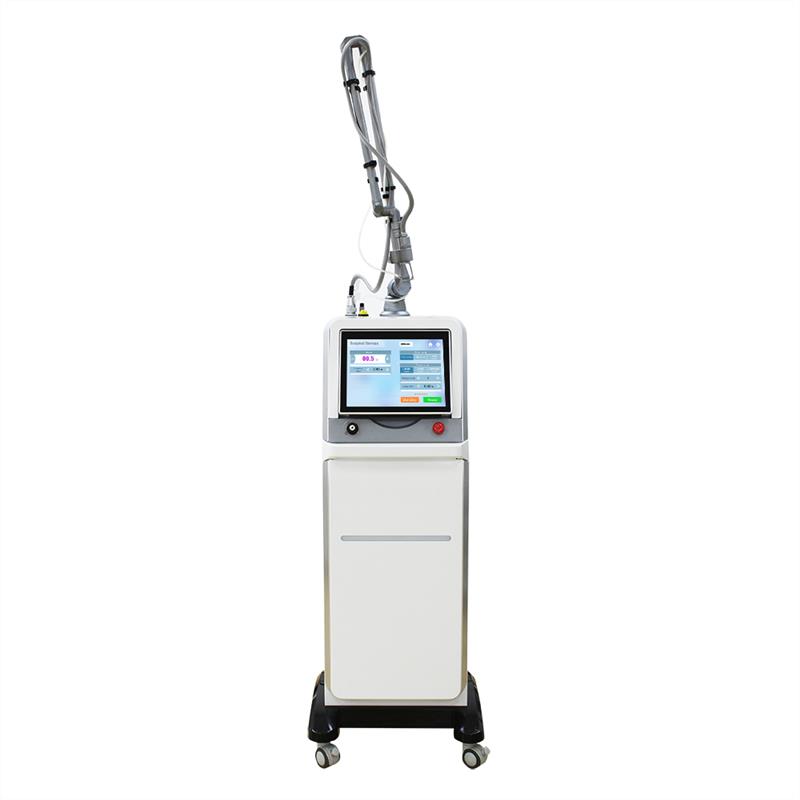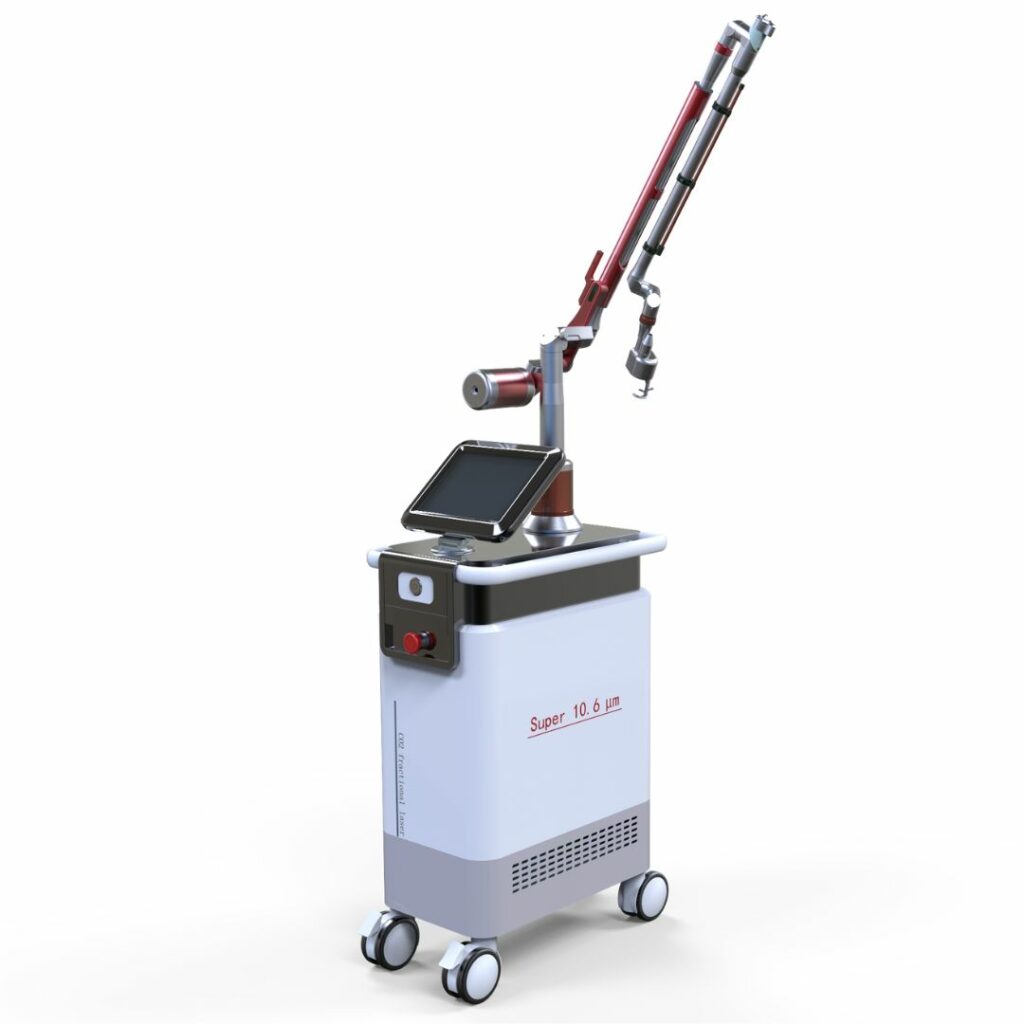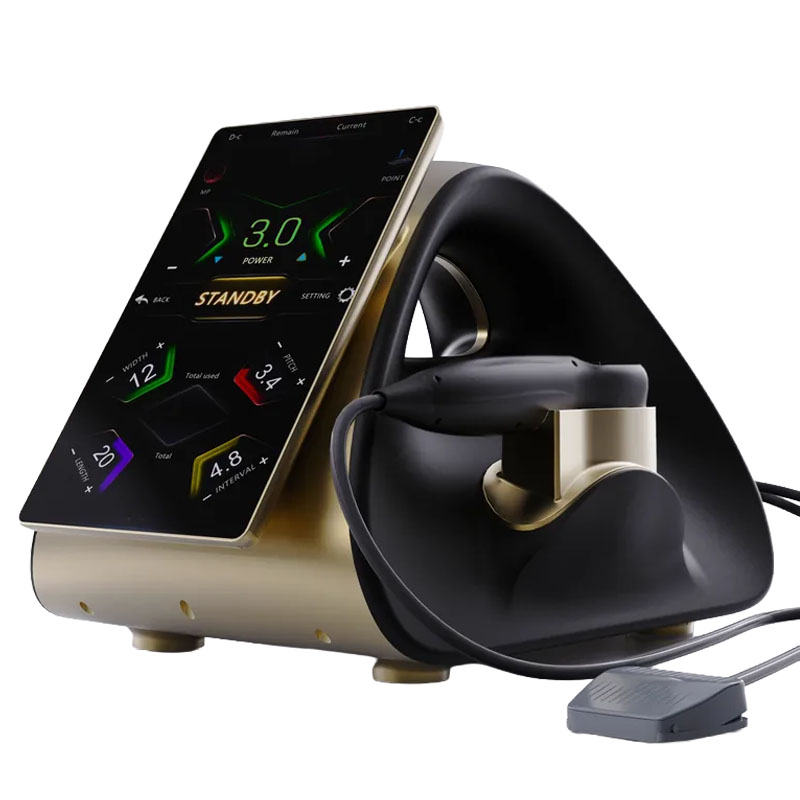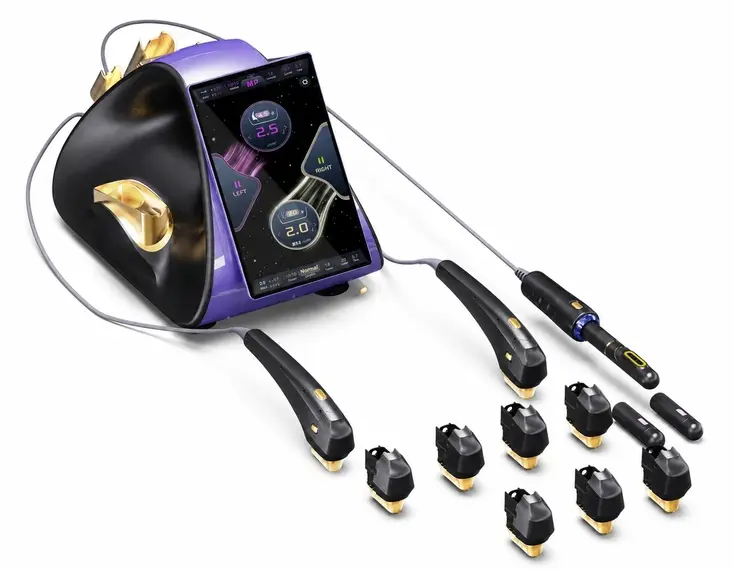
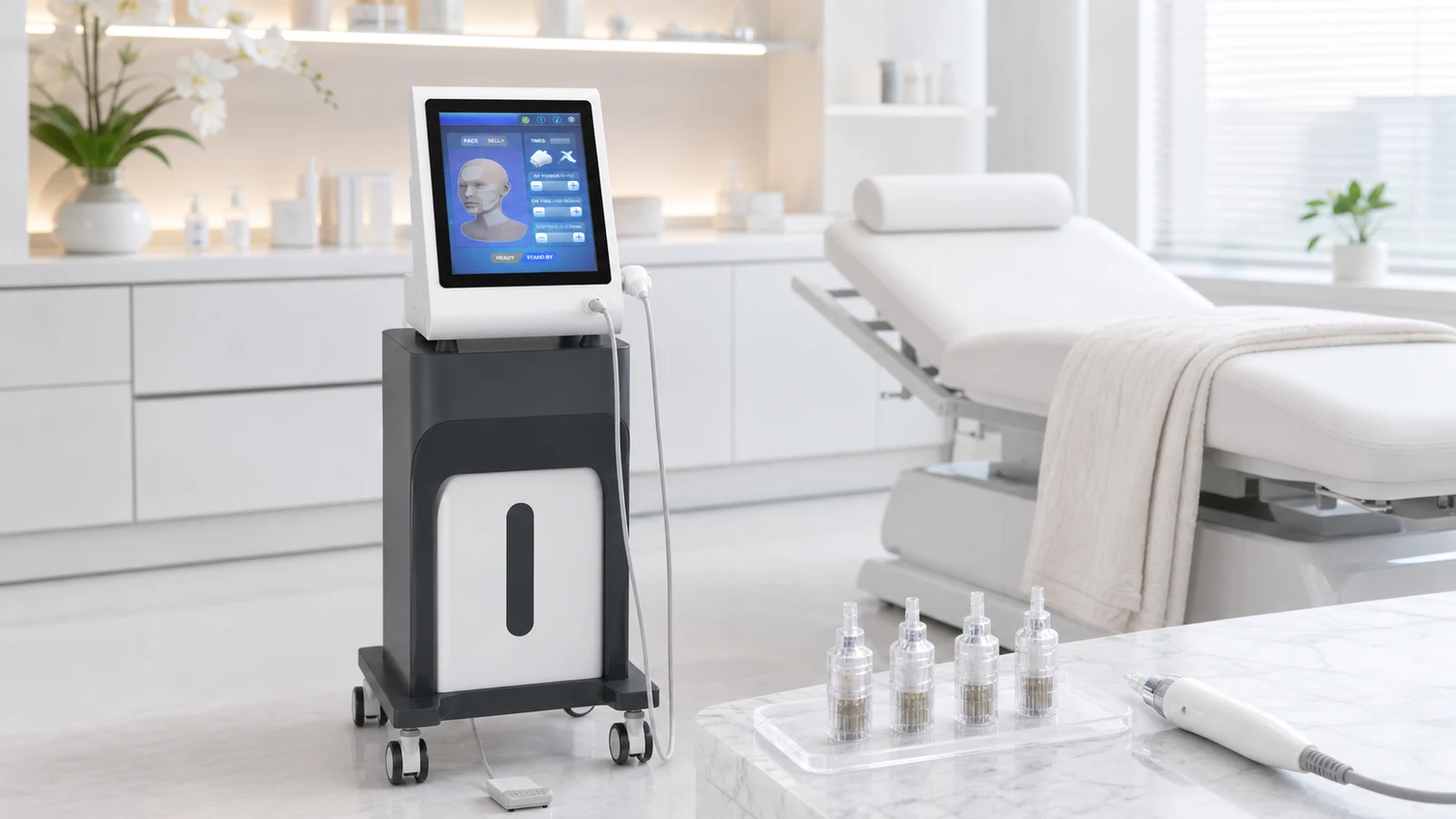
This guide is written for beauty salons, aesthetic clinics, med spas, and equipment distributors that are evaluating a fractional RF microneedle machine for professional skin rejuvenation services. It explains what the machine does, how the technology works, which treatments it can support, and what buyers should check before choosing a supplier.
A fractional RF microneedle machine combines fine microneedles with radiofrequency energy. The needles create controlled microchannels in the skin while RF energy is delivered into selected layers. For businesses, the real question is not only whether the technology is popular. The more important question is whether the machine has stable energy output, suitable treatment tips, clear safety documents, practical training, reliable after-sales support, and consumable costs that make sense for your service menu.
Key Takeaways
- A fractional RF microneedle machine is different from a regular microneedling pen because it delivers RF energy through or around the needles.
- It is commonly used by professionals for skin tightening, acne scar appearance, fine lines, enlarged pores, texture concerns, and body skin rejuvenation.
- Buyers should compare needle depth, RF stability, tip options, handpieces, comfort design, safety documents, training, warranty, and replacement tip costs.
- Beauty salons, clinics, med spas, and distributors should choose different configurations based on their service model and client expectations.
- The safest choice is to treat this as a long-term equipment investment, not a one-time machine purchase.
What Is a Fractional RF Microneedle Machine?
A fractional RF microneedle machine is a professional aesthetic device that uses microneedles and radiofrequency energy together. The microneedles enter the skin at a controlled depth, and RF energy is delivered in a fractional pattern rather than across the whole skin surface. This targeted delivery is one reason the technology is widely used in professional skin rejuvenation menus.
The term “fractional” means the treatment affects selected zones while leaving surrounding tissue untreated. The device is not the same as a home microneedling roller, a basic microneedling pen, or a simple radiofrequency skin tightening machine. A fractional RF microneedle machine combines controlled needle penetration with RF energy delivery, which gives professional users more flexibility when building advanced treatment menus.
The United States Food and Drug Administration explains that microneedling devices can vary in design, claims, and regulatory status. Clinics and buyers should review local regulations before using or advertising treatment claims. This is especially important when a supplier uses terms such as “FDA approved,” “FDA cleared,” or “medical grade,” because these phrases do not always mean the same thing in every market.
How Does a Fractional RF Microneedle Machine Work?
A fractional RF microneedle machine works in 4 basic steps: needle penetration, RF energy delivery, controlled thermal effect, and collagen remodeling response. The operator selects the needle depth and energy setting based on the treatment area, skin condition, and professional protocol. The machine then delivers energy through the treatment tip in a controlled pattern.
First, the microneedles create small channels in the skin. Second, RF energy is delivered into the tissue instead of relying only on surface contact. Third, the RF energy creates controlled heating in the treated zones. Fourth, the skin responds over time, which is why clients are often told that visible improvement may develop gradually.
The exact experience depends on the machine, the tip, the energy setting, the operator’s training, and the client’s skin condition. A responsible supplier should not present one setting or one treatment plan as suitable for every person. For a B2B buyer, this means training and protocols matter almost as much as the hardware.
What Treatments Can It Support?
Professional fractional RF microneedling machines are commonly used in service menus that focus on skin rejuvenation, texture improvement, and tightening-related concerns. The language on your website, brochures, and consultation forms should stay conservative. It is safer to say the treatment “may help improve the appearance of” a concern rather than promise a guaranteed result.
Common treatment areas include the face, neck, jawline, abdomen, arms, thighs, and other selected body zones. Common service goals include:
- Skin tightening and firming support
- Fine lines and wrinkle appearance
- Acne scar appearance
- Enlarged pores
- Uneven skin texture
- Stretch mark appearance
- General face and body rejuvenation
Acne scar treatment is one of the most common topics associated with RF microneedling in professional and clinical discussions. Published studies and reviews on radiofrequency microneedling and acne scars can vary by device type, treatment protocol, scar type, and study design. For a clinic or salon, the practical takeaway is simple: avoid promising a fixed percentage of improvement unless you have your own documented clinical basis and your local regulations allow that claim.
If your business is still comparing different professional devices, FotroMed’s guide to professional RF microneedling machines for estheticians can help you understand how clinics and salons evaluate different machine types.
Fractional RF Microneedle Machine vs Traditional Microneedling
Traditional microneedling and fractional RF microneedling are related, but they are not the same service. Both involve fine needles, but the energy source and business value are different.
| Factor | Traditional Microneedling | Fractional RF Microneedle Machine |
|---|---|---|
| Main action | Mechanical microchannels | Microchannels plus RF energy |
| Energy source | No RF energy | Radiofrequency energy |
| Typical positioning | Entry-level skin texture service | Advanced rejuvenation and tightening service |
| Treatment depth | Depends on pen and cartridge | Adjustable depth with RF delivery |
| Consumables | Needle cartridges | RF microneedle tips or cartridges |
| Business value | Lower to mid ticket | Often positioned as a higher-ticket service |
| Buyer fit | Entry salons, facial rooms | Clinics, med spas, advanced salons, distributors |
Traditional microneedling can still be useful for salons and clinics because it is simpler and usually requires a lower equipment budget. Fractional RF microneedling can support a more advanced service menu, but it also requires stronger operator training and more careful client communication. The real question is not “Which one is always better?” It is “Which treatment fits your clients, your team, your budget, and your local rules?”
Key Features to Check Before Buying
When comparing machines, do not judge only by product photos. Many fractional RF microneedle machines look similar online, but the details can be very different. A serious buyer should compare technical design, treatment flexibility, safety documentation, consumables, and supplier support before asking for the final price.
Adjustable Needle Depth
Needle depth is one of the most important features to check. Different treatment areas may require different depths, and the operator needs control. Ask the supplier for the available needle depth range, the adjustment method, and whether the depth is stable during use.
For example, delicate facial areas, thicker body skin, and scar-focused services should not be handled with the same setting by default. If a supplier cannot clearly explain needle depth control, the machine may be difficult to use safely and consistently in a professional environment.
Stable RF Energy Output
Stable RF energy output affects treatment consistency. If energy delivery is unstable, clients may experience uneven comfort, and operators may find it harder to build trust in the protocol. Ask whether the supplier can explain how the machine adjusts power, how the operator controls intensity, and how users are trained to select settings responsibly.
You do not need to become an engineer before buying a machine. But you should understand the basic control logic. A professional supplier should be able to explain settings in practical treatment language, not only in technical terms.
Needle Tip Options
Needle tip options can affect how flexible the machine is. Some systems support insulated tips, non-insulated tips, or different pin counts. Different tip designs may suit different treatment areas and service goals.
For business planning, also ask whether replacement tips are easy to buy, whether they are individually packaged, how many shots or treatments they support, and how much they cost. A machine with a low purchase price but expensive or hard-to-source tips can become a poor long-term investment.
Vacuum or Negative Pressure Function
Some fractional RF microneedling machines include vacuum or negative pressure. This feature may help the treatment tip stay in closer contact with the skin and can support more stable operation in selected areas.
In my view, vacuum should be treated as a helpful design feature, not as the only reason to choose a machine. If a supplier promotes vacuum heavily, ask how it works, which handpieces include it, and whether it changes treatment technique or client comfort.
Cooling and Comfort Design
Comfort matters because RF microneedling is not a basic spa facial. Clients may feel heat, pressure, and needle sensation during treatment. If cooling handpieces or cold hammer features are included, ask whether they are built into the system or sold separately.
Comfort also depends on skin preparation, treatment speed, operator technique, and aftercare guidance. A machine with comfort features is useful, but it does not replace proper training.
Handpieces and Consumables
The number and type of handpieces can affect how many services you can offer. A 1-handle system may be enough for a focused salon menu, while a multi-handle system may be better for a clinic or distributor that wants face, body, and specialized treatment options.
Consumables are part of the real cost of ownership. Before buying, ask about treatment tips, cartridges, packaging, shelf life, minimum order quantity, and shipping time. FotroMed’s fractional RF microneedling machine with 4 handles is one example of a professional multi-handle configuration.
Safety Documents and Training
Safety documents and training are not optional details. Ask suppliers for operation manuals, contraindication guidance, treatment protocols, certification documents, and warranty terms. ISO 13485 relates to quality management systems for medical devices, while FDA device databases can help buyers understand whether a device or company has relevant public regulatory records. These resources do not replace legal advice, but they help buyers ask more precise questions.
Training should cover more than how to turn the machine on. It should explain treatment areas, settings, client screening, skin preparation, aftercare, contraindications, and maintenance. A machine without training can create business risk even if the hardware itself looks attractive.
How Much Does a Fractional RF Microneedle Machine Cost?
The cost of a fractional RF microneedle machine depends on configuration, supplier, certification documents, handpieces, consumables, warranty, and order quantity. It is better to compare total cost of ownership than machine price alone.
Several factors can affect the final quotation:
- Number of handpieces
- RF energy design and output range
- Needle depth range and tip options
- Vacuum or cooling functions
- Included accessories
- Training and operation support
- Warranty period and parts availability
- Certification documents
- Shipping, tax, and import requirements
- OEM, ODM, or distributor order quantity
For a small beauty salon, a compact system with clear training and affordable consumables may be more realistic than the most complex machine. For a clinic or med spa, a more flexible system may make sense if the business can build several treatment packages around it. For a distributor, margin, reorder speed, packaging, documentation, and after-sales handling can matter more than the lowest unit price.
If you want to compare this topic with wider RF microneedling pricing and purchase logic, FotroMed’s article on how to choose a professional RF microneedling machine can help you evaluate the buying process in more detail.
How to Choose the Right Rf Microneedling Machine for Your Business
Different businesses need different machines. A beauty salon, an aesthetic clinic, and a distributor may all search for the same keyword, but they are not buying for the same reason.
For Beauty Salons
Beauty salons usually need a machine that is practical, trainable, and easy to explain to clients. The team may not have a medical background, so supplier training and safe treatment language are especially important.
Salons should also pay close attention to consumable costs because replacement tips directly affect service pricing and profit. A balanced machine with clear operation steps is often more useful than a complicated system that staff cannot use confidently.
For Aesthetic Clinics and Med Spas
Aesthetic clinics and med spas often need stronger treatment flexibility. They may serve clients who compare RF microneedling with HIFU, laser, IPL, or other rejuvenation services.
Clinics should focus on energy stability, treatment documentation, operator training, and consultation scripts that explain realistic expectations. A client who understands gradual improvement and aftercare is less likely to expect an instant transformation.
For Distributors
Distributors need to think beyond one machine. They need a product that can be explained, demonstrated, shipped, supported, and reordered. Documentation, private label options, spare parts, and training materials may be more important than visual design alone.
Ask whether the supplier supports OEM or ODM orders, what packaging options are available, how long production usually takes, and whether marketing materials can be adapted for your market. A wiser choice is to test the supplier’s support process before placing a large order.
Buying Mistakes to Avoid
This section is important because many buyers compare machines too quickly. A fractional RF microneedle machine can support strong service value, but a poor buying decision can create problems with training, consumables, client satisfaction, and long-term profit.
Choosing Only by the Lowest Price
The lowest machine price is not always the lowest business cost. A very cheap machine may have limited energy control, fewer treatment tips, weak training, unclear documents, or poor spare part support. These issues may not be visible in product photos.
Before choosing by price, ask what is included. Does the quotation include handpieces, starter tips, operation training, shipping support, warranty, and after-sales guidance? If two machines look similar but one supplier offers stronger support, the higher price may be easier to justify.
Ignoring Consumable Costs
RF microneedling tips are recurring costs. If replacement tips are expensive, difficult to order, or available only in large minimum quantities, your treatment profit can shrink. This is why consumable cost should be calculated before buying the machine.
Ask how many tips are included with the machine, how much replacement tips cost, and how fast they can be shipped. Also ask whether different tip types are needed for face and body treatments. A clear consumable plan helps salons and clinics set service prices more accurately.
Overlooking Training and Treatment Protocols
A machine is only useful if your team can operate it confidently. Training should cover machine setup, skin assessment, client screening, treatment areas, setting selection, aftercare, contraindications, and maintenance. A short video may help, but it should not be the only support for a professional device.
Without protocols, each operator may use the machine differently. This can lead to inconsistent client experience and weaker service positioning. Training also helps your team explain the treatment in a more professional and responsible way.
Making Unsupported Treatment Claims
Marketing claims can create risk. Avoid statements such as “permanently removes scars,” “guarantees lifting,” or “safe for everyone.” These claims are too strong and may not be allowed in your market.
Use more careful wording, such as “commonly used to improve the appearance of acne scars” or “may support firmer-looking skin as part of a professional treatment plan.” The FDA’s public microneedling device information is a useful reminder that device claims, intended use, and regulatory status matter.
Buying Without After-Sales Support
After-sales support affects daily business. If a handpiece has a problem, if tips are out of stock, or if your staff need help with settings, you need a supplier who responds quickly. A machine is not a one-time purchase; it is part of your treatment operation.
Before ordering, ask who handles warranty, how replacement parts are shipped, what remote support is available, and how long the supplier usually takes to respond. If you are a distributor, ask whether the supplier can support your customers indirectly with manuals, videos, and technical answers.
Questions to Ask Your Supplier Before Ordering
Use these questions before you request the final invoice. They help separate serious suppliers from sellers who only provide photos and a low price.
| Question | Why It Matters |
|---|---|
| What needle depths are available? | Shows whether the machine can support different treatment areas. |
| Are insulated and non-insulated tips available? | Helps you understand treatment flexibility and consumable options. |
| What handpieces are included? | Affects face, body, and specialized service planning. |
| What certificates or safety documents can you provide? | Helps with compliance review and distributor due diligence. |
| Is operation training included? | Reduces staff uncertainty and improves service consistency. |
| What is the warranty period? | Clarifies long-term risk after purchase. |
| How much do replacement tips cost? | Affects treatment pricing and profit. |
| Do you support OEM, ODM, or distributor orders? | Important for wholesalers and private label buyers. |
You can also ask for videos, manuals, packaging photos, sample treatment menus, and aftercare guidance. The goal is not to collect documents for decoration. The goal is to understand whether the supplier can support your business after the machine arrives.
For readers comparing professional and home-use positioning, FotroMed’s article on professional RF microneedling vs home use RF microneedling explains why professional systems should not be evaluated the same way as consumer devices.
Why Consider FotroMed Fractional RF Microneedle Machine?
FotroMed supplies professional beauty equipment for salons, aesthetic clinics, med spas, and distributors. For buyers researching a fractional RF microneedle machine, the main value is not only the device itself. It is the combination of machine options, B2B communication, training support, consumable supply, and after-sales service.
FotroMed RF microneedling and MNRF machine options can support professional skin rejuvenation menus, including tightening-focused, texture-focused, and scar-appearance-focused services. Depending on the buyer’s market and business type, FotroMed can also discuss OEM, ODM, distributor cooperation, packaging, and long-term supply planning.
For salons, clinics, and distributors, a practical supplier relationship matters. You need clear machine information before purchase, accessible consumables after purchase, and support that helps your team build a stable treatment menu over time.
FAQ
What is a fractional RF microneedle machine?
A fractional RF microneedle machine is a professional aesthetic device that combines microneedles with radiofrequency energy. The needles create controlled microchannels while RF energy is delivered into selected skin layers. It is commonly used in professional services for skin rejuvenation, texture improvement, tightening support, and acne scar appearance.
Is fractional RF microneedling better than regular microneedling?
It depends on the treatment goal. Regular microneedling may fit entry-level texture services, while fractional RF microneedling adds RF energy for more advanced rejuvenation and tightening-focused menus. Clinics and salons should choose based on client needs, operator training, budget, and local regulations.
What treatments can a fractional RF microneedle machine support?
Professional users commonly use fractional RF microneedling for skin tightening support, fine lines, acne scar appearance, enlarged pores, uneven texture, stretch mark appearance, and face or body rejuvenation. Claims should remain conservative because results depend on skin condition, device settings, protocol, and operator training.
How much does a fractional RF microneedle machine cost?
The price depends on handpieces, needle tip options, RF output design, vacuum or cooling features, certification documents, training, warranty, shipping, and order quantity. Buyers should compare total cost of ownership, including replacement tips and after-sales support, not only the machine price.
What should I check before buying one?
Check needle depth range, RF energy stability, available tips, handpieces, consumable cost, safety documents, training, warranty, spare parts, and supplier response speed. If you are a distributor, also ask about OEM or ODM support, packaging, production lead time, and documentation for your market.
Conclusion
A fractional RF microneedle machine can be a strong investment for salons, aesthetic clinics, med spas, and distributors that want to build professional skin rejuvenation services. It can support treatment menus focused on tightening, texture, acne scar appearance, enlarged pores, and face or body rejuvenation when used with proper training and responsible client communication.
The best buying decision is not based on product photos or the lowest price. It should be based on needle depth control, RF energy stability, tip options, consumable costs, safety documents, training, warranty, and supplier support. If those basics are clear, the machine is easier to turn into a real business service rather than just another device in the treatment room.
If your business is comparing fractional RF microneedling equipment for salon, clinic, or distributor use, contact FotroMed to discuss machine options, training support, consumables, and B2B cooperation.