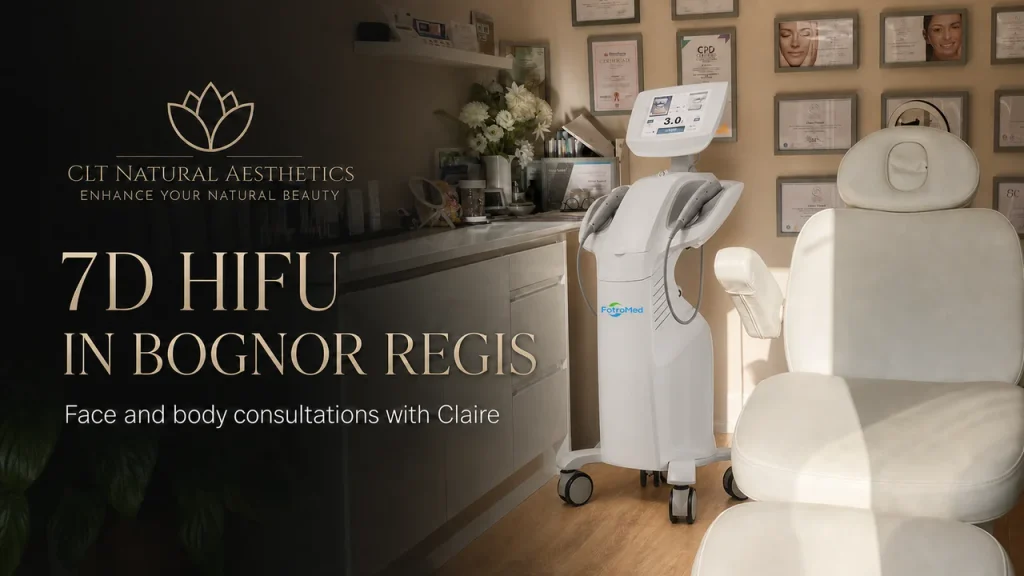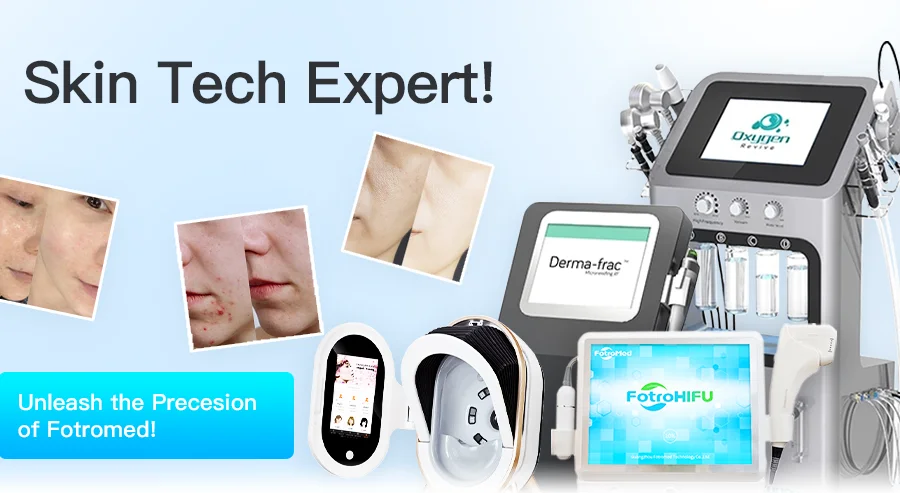
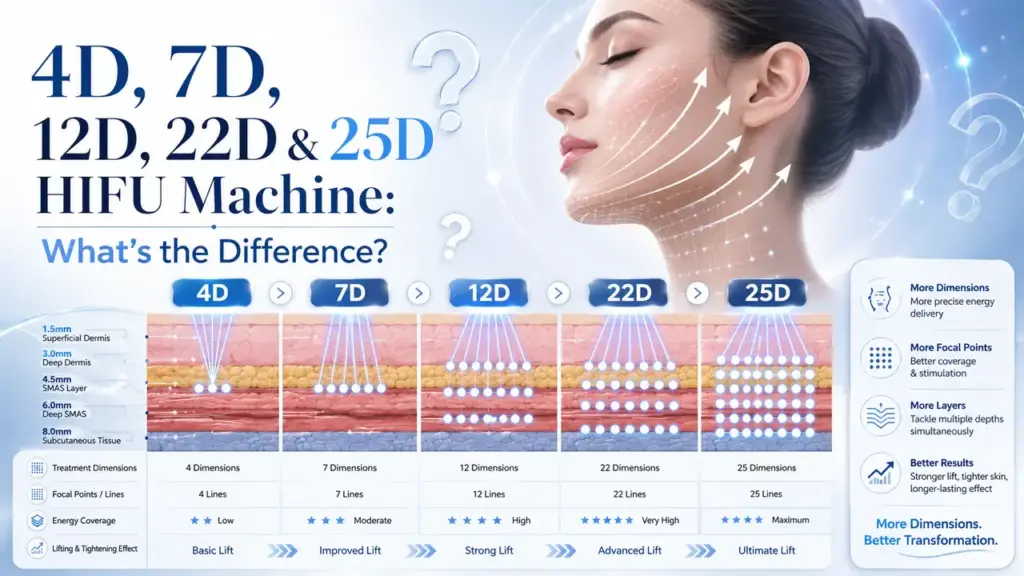
In HIFU machine names such as 4D, 7D, 12D, 22D, and 25D, the “D” usually comes from “dimension.” However, it is not a unified industry standard. In many cases, these D numbers are product naming terms used by Chinese HIFU machine suppliers for marketing and product differentiation. Different suppliers may define their own machine names in different ways. Some use D numbers to describe treatment modes, cartridge depth options, line output, or handle design, while others use them mainly to separate newer product series from older ones.
This article is written for clinic owners, beauty salon buyers, distributors, and aesthetic equipment purchasers who are comparing HIFU machines before buying. It explains what these D labels usually mean, where the real differences are, and how to judge a machine by treatment depth, energy stability, cartridge options, certifications, training, and after-sales support instead of choosing only by the biggest number.
Understanding “D” in HIFU Machine
When you see numbers like 4D, 7D, or 25D on a hifu machine, it shows the level of technology and treatment choices. The “D” means “dimension” or “depth.” A bigger number means the hifu machine can treat more layers or use more lines in one shot. This gives you faster and more accurate results. You get more options for your clients and can fix more skin problems.
Hifu technology gets better with each new model. Newer machines have more features and feel more comfortable. Clinics often pick machines with higher “D” numbers to give the best care. You can trust that every hifu machine from FotroMed has strict certifications for safety and effectiveness. These certifications help you feel sure about the results and the technology you use.
Comparing 4D, 7D, 12D, 22D & 25D HIFU

What Does “D” Mean in a HIFU Machine?
The “D” in 4D, 7D, 12D, 22D and 25D HIFU is a supplier-defined model name. It is often described as “dimension,” but it is not a medical or engineering standard. It does not always show the number of treatment depths, cartridges, lines or handpieces. Two suppliers may sell very different HIFU machines under the same D name.
A higher D number is not always better. It does not guarantee deeper SMAS treatment, stronger energy, faster treatment, less pain or better results. Performance depends on the focal depth, transducer frequency, energy stability, firing pattern, cartridge condition and treatment protocol.
When comparing professional HIFU machines, check the handpieces, cartridge depths, lines or points per shot, energy range, shot life, treatment speed, warranty and training. The table below compares the exact configurations tested by Fotromed.
Quick Comparison Table
| Parameter | 4D HIFU | SD HIFU | 7D HIFU | 12D HIFU | 22D HIFU | 25D HIFU |
|---|---|---|---|---|---|---|
| Core Technology | Multi-line MFU | HIFU + RF | MMFU (Micro & Macro Focused Ultrasound) | Superpulse with MP mode | Multi-line HIFU + RF Lipo/Spiral | 360° delivery |
| HIFU Firing Pattern | Up to 12 lines/shot | 1 line/shot, 12 points/line | 1 line/shot, 12 points/line | MP mode: up to 417 points/shot | HIFU handle: 13 lines; RF Lipo handle: 22 lines | 360° delivery, Normal/MP modes |
| Treatment Depth | 1.5–16mm | 1.5–16mm | 1.5–13mm | 1.5–16mm | 1.5–18mm | 1.5–18mm |
| Treatment Speed | Standard | Fast | Fast (~20–25 min full face) | Medium | Medium | Medium |
| Treatment Areas | Face, neck, eye/mouth, body, intimate area | Face, body | Face, neck, eye/mouth, body | Face, neck, mouth, body | Face, neck, mouth, body | Face, neck, mouth, body |
| Result Duration | 12–18 months | 12–18 months | 12–18 months | 12–18 months | 12–18 months | 12–18 months |
| Main Features | Entry-level, multi-platform | Low pain, high comfort | 2.0mm eye cartridg | 417-point MP mode | Body contouring | 360° system |
How We Compared These HIFU Machines: The comparison above pairs each machine’s factory-recorded specifications with hands-on testing carried out on our production floor. Our product and training teams ran every machine on the same volunteer panel under one evaluation protocol, so results are comparable across models.
What Is 4D HIFU Machine?
4D HIFU Machine is not one fixed machine configuration. At Fotromed, our 4D HIFU is designed as a customizable, multi-function platform. Clinics can start with one handpiece or add more functions based on their treatment menu, client needs and budget.
Available options include a traditional 4D HIFU handpiece for multi-line face and body treatments, a V‑Max handpiece for detailed contouring, RF microneedling for skin texture and collagen remodeling, a Lipo handpiece for body contouring, and a vaginal HIFU handpiece for intimate treatments.
This modular design allows clinics, salons and distributors to build one professional HIFU machine around the services they want to offer. The exact handpieces, cartridges and treatment modes depend on the selected configuration.
What Is 7D HIFU Machine?
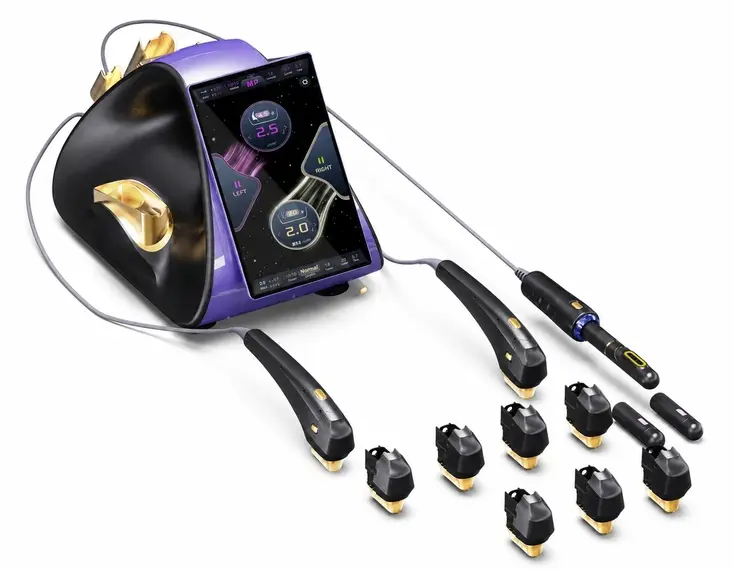
The 7D HIFU machine gives you advanced MMFU technology. You get seven cartridges, including a special 2.0mm one for small areas like around the eyes and mouth. This device uses dual-frequency energy, so you can treat the face and body with great accuracy. The treatment is fast, and you can finish a full-face session in about 20 to 25 minutes. For a deeper look at its treatment functions, you can read our full guide to 7D HIFU machine functions.
The 7D HIFU machine sends energy to certain skin layers. This helps lift and tighten skin without surgery. You can use it for:
- Lifting the face
- Tightening the eye area
- Shaping the body
- Reducing fat
The difference between 4D and 7D HIFU becomes clearer when you compare their cartridge depths, firing pattern, and treatment comfort. 7D HIFU usually offers more depth options, including smaller depths for delicate areas such as the eyes and mouth. Because it delivers one line per shot with 12 points in each line, the treatment can feel more controlled and is usually less painful than 4D HIFU. Clients may still feel warmth or mild tingling, but the overall comfort level is often better.
12D HIFU Machine
The 12D HIFU machine gives you even more options. You get seven multi-frequency probes that reach every skin layer, from the top to the deep SMAS fascia. This device has two HIFU handpieces and an advanced MP Mode to send energy to many points at once. You can treat the face, body, and even intimate areas with special probes.
Main features of the 12D HIFU machine:
- Superpulse technology for even energy
- MP Mode for quicker treatments
- Airbag detection system for safe vaginal care
- Probes for 1.5mm to 16mm depths
You can use this HIFU machine for lifting the face, slimming the body, and tightening the vagina. The technology helps your body make more collagen, so results last longer. Clinics like this model because it treats many areas and has good safety features.
22D HIFU Machine
The 22D HIFU machine mixes Multi-Line HIFU and RF Lipo technology. You get a device that works 2.5 times faster than older ones. This means you can help more clients in less time. The machine is great for tightening the face and neck, but you can also use it for shaping the body.
Main features include:
- Lifting skin without surgery
- Multi-dimensional anti-aging
- Better body treatment with surface or circle energy patterns
- Long-term collagen growth
You will see natural lifting with no downtime. The body handpiece lets you treat big areas quickly. This HIFU machine is a good pick if you want to give fast, strong treatments for both face and body.
25D HIFU Machine
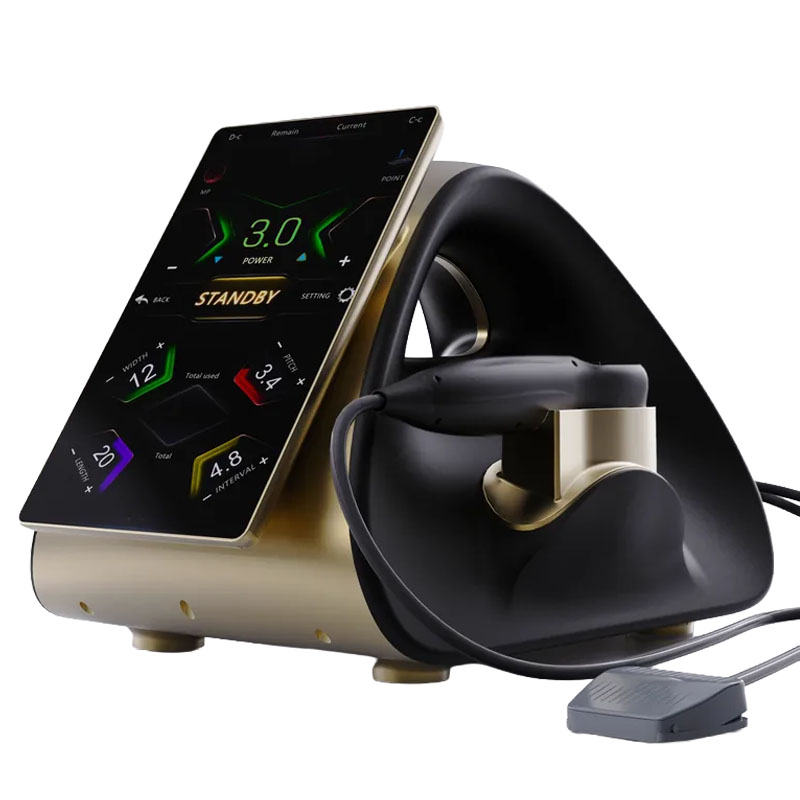
The 25D HIFU machine is the most advanced. You get a platform that uses HIFU, RF, and EMS together. The 360° rotating handles make sure you do not miss any spots. You can treat skin depths from 1.5mm to 18mm, so you can work on the face and body with great accuracy.
Main features of the 25D HIFU machine:
- HIFU, RF, and EMS work together for better results
- 360° rotating handpieces for no missed spots
- Settings you can change for energy, length, and point size
- Normal and MP modes for custom treatments
Tip: Always tell your clients what to expect after a HIFU treatment. Mild redness, swelling, or sensitivity can happen, but these usually go away fast.
If you want to pick the best HIFU machine for your business, look at the technology, treatment depths, and features that fit your clinic’s needs. Each model from FotroMed gives you safe, strong, and advanced solutions for your clients.
VMAX HIFU vs 7D HIFU
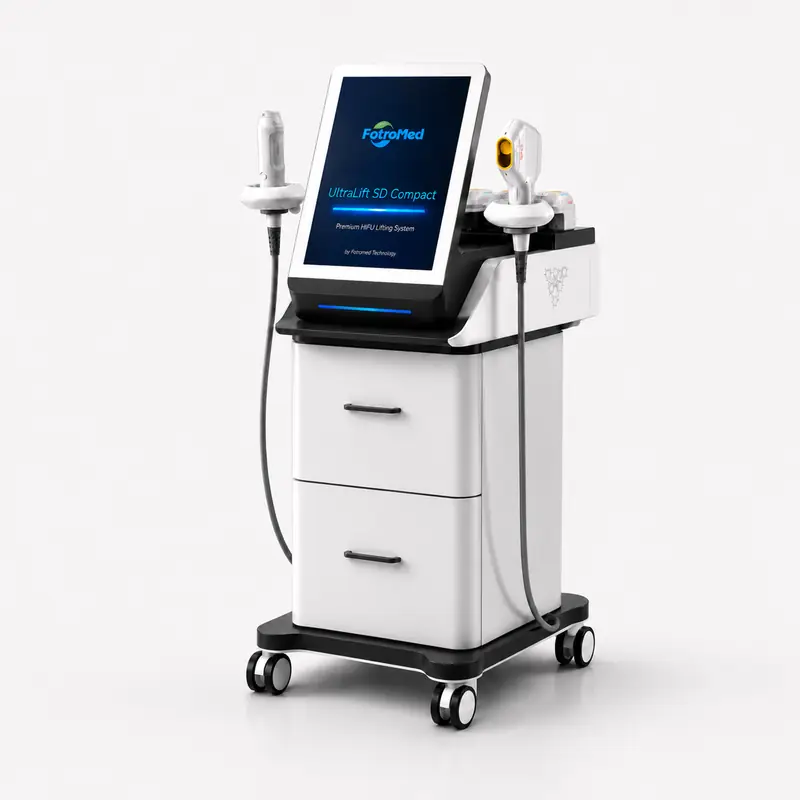
VMAX HIFU usually refers to a compact HIFU system with a pen-style or rubbing handpiece. It is designed for flexible treatment around the face, jawline and other detailed areas. Fotromed SD Compact HIFU Machine follows a similar treatment concept. However, our V‑Max handpiece also adds radiofrequency energy. Clinics can switch between focused ultrasound and RF based on the treatment area and skin concern.
A 7D HIFU machine uses a different treatment structure. It delivers a defined line of focused ultrasound points through replaceable cartridges at multiple depths. This makes it suitable for structured face lifting and body contouring protocols.
Neither system is always better. Fotromed SD Compact HIFU is suitable for clinics that want flexible facial treatments, and its V‑Max handpiece integrates RF (radiofrequency) energy, which significantly improves client comfort during treatment compared with traditional HIFU systems.
How to Choose the Right HIFU Machine
Picking the right professional hifu machine is important. It can help your clinic or spa do well. You want to give safe treatments that work and make clients happy. This guide shows you what to check for and how to find the best hifu machine for your salon or clinic.
Key Factors for Selection
You need to look at some main things when picking a professional hifu machine. These points help you get good value and keep every treatment safe.
- Energy Stability
The hifu machine should give steady energy. If energy stays the same, results are reliable. You will not get uneven treatments. - Cartridge Variety
Find a professional hifu machine with many cartridges. Different cartridges let you treat the face and body. You can reach different skin depths. - Shot Speed
A faster shot speed lets you treat more clients quickly. Your clinic works better and you help more people. - Engineered Safety
Safety matters most. Pick a hifu machine with safety features like contact sensors and temperature checks. These features keep clients safe and help you feel calm. - Build Quality & Certifications
Good build quality and certifications mean the professional hifu machine meets strict rules. This makes sure every non-invasive treatment is safe and reliable.
Think about how well each hifu machine works and how deep it can treat. Machines with more depth choices can fix more skin problems and give better results.
Here is a simple table to help you compare:
| HIFU Machine | Best For | Suitable Store Type | Price Range |
|---|---|---|---|
| 4D HIFU (Multi-Function Platform) | Basic face and body HIFU treatments | New beauty salons, small clinics, first-time HIFU buyers | Best ROI per machine |
| 7D HIFU | Face lifting, eye area, and comfortable HIFU treatments | Beauty salons, aesthetic clinics, clinics with regular facial treatment demand | Quote Suggestion |
| 12D HIFU | Faster face and body treatments | Busy salons, chain stores, clinics with higher daily treatment volume | Quote Suggestion |
| 22D HIFU | Body contouring and larger treatment areas | Body-shaping studios, larger beauty clinics, multi-service aesthetic centers | Quote Suggestion |
| 25D HIFU | Premium face and body treatments with more technology options | Busy salons, premium beauty centers, distributors looking for flagship models | Quote Suggestion |
Tips: Each clinic has different client volume, and budget plans, the final HIFU machine price should be confirmed based on the exact configuration you need. You can send us your interested machine and business type, and our team will recommend a suitable HIFU machine package.
FAQ
What does “D” mean in a HIFU machine?
In HIFU machine names, “D” usually comes from “dimension,” but it is not a fixed industry standard. Different suppliers may use 4D, 7D, 12D, 22D, or 25D to describe different handpieces, firing modes, treatment depths, or product generations.
Is a higher “D” HIFU machine always better?
No. A higher “D” number does not always mean better results. It usually means the machine has a different design, firing pattern, treatment speed, or handle configuration. Buyers should compare the real specifications, treatment comfort, warranty, training, and after-sales support before choosing.
What is the main difference between 4D and 7D HIFU?
4D HIFU usually works as an entry-level multi-function platform with wider multi-line output. 7D HIFU uses MMFU technology and fires one line with 12 points per shot, which usually gives better control and a more comfortable treatment experience for facial areas.
Which HIFU machine is better for a new beauty salon?
For a new salon with a limited budget, 4D HIFU can be a practical starter option because it is often sold as a multi-function machine. If the salon focuses more on facial lifting, eye area treatments, and client comfort, 7D HIFU may be a better choice.
How should I choose between 12D, 22D, and 25D HIFU?
Choose based on your treatment menu and budget plans. 12D HIFU is suitable for faster treatments. 22D HIFU is often better for body contouring. 25D HIFU is more suitable for premium clinics that want 360° output with HIFU, RF, and EMS.