 para una clínica, cadena estetica, o distribuidor, a hair removal device is often a capital investment worth tens of thousands of dollars. It is also a service line that usually depends on repeat treatments to recover the investment. If the device is not chosen well, the cost is very specific: a system that only suits light skin limits darker-skin clients; a short consumable life quietly reduces margin; and claims such as «permanent hair removal» o «painless treatment» can create complaint and compliance risks.
IPL is affordable and multi-purpose, but its hair removal suitability and durability are often overstated. Laser costs more, but the clinical evidence base is stronger. La verdadera pregunta es: for your client base and treatment menu, which option is the right fit?
This guide compares IPL and diode laser hair removal from core parameters such as wavelength, ancho de pulso, and fluence. It also combines peer-reviewed clinical evidence with device-engineering realities, so clinics can evaluate the two technologies by client profile, menú de servicio, and business model.
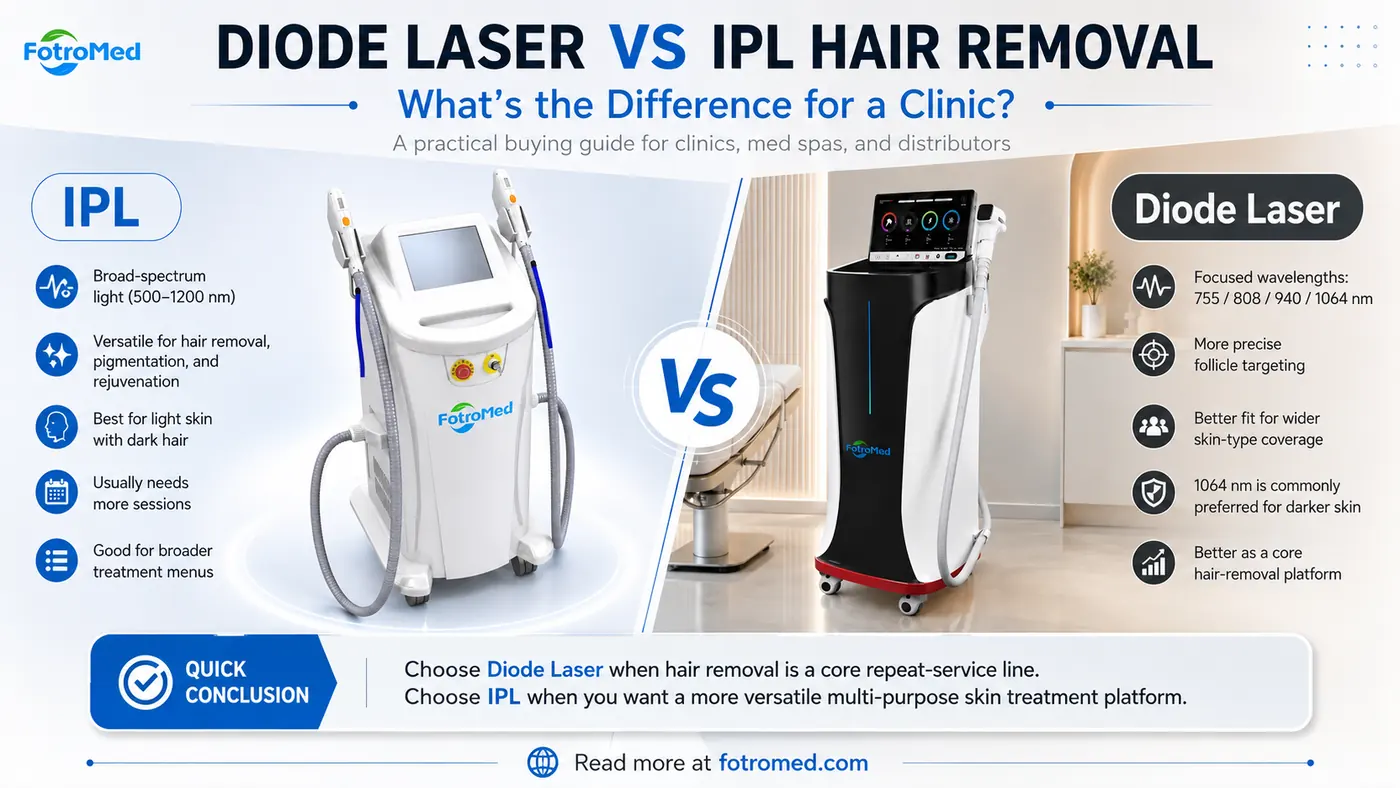
Quick Conclusion
If hair removal is a core repeat-service line, diode laser is usually the more stable core platform. IPL is more suitable for clinics with a limited budget, a multi-purpose skin treatment menu, or entry-level positioning, but its hair removal suitability is narrower and darker skin requires extra caution.
The table below is a quick parameter snapshot for professional laser hair removal. The values are category-level references, not claims for every single machine model. The detailed IPL vs diode laser comparison follows in later sections.
| Artículo | Parámetro clave / Reference |
|---|---|
| Main professional wavelengths | 755 / 808 / 940 / 1064 Nuevo Méjico. Multi-wavelength platforms may cover Fitzpatrick I-VI when output, ajustes, enfriamiento, and training are appropriate. |
| Wavelength commonly preferred for darker skin | 1064 Nuevo Méjico, often used for Fitzpatrick IV-VI |
| Efficacy measurement language | FDA «Reducción de cabello permanente»: stable reduction measured at 6 / 9 / 12 meses |
| Hair reduction in lighter skin | Acerca de 75% in Fitzpatrick I-III |
| Typical treatment course | 2-6 sessions as a baseline / 6-8 sessions in practice, usually spaced 4-6 semanas de diferencia |
| Key adjustable parameters | Fluence (J/cm2), ancho de pulso (EM), tamaño de la mancha, epidermal cooling |
| Regulador / certification language | FDA 510(k) cleared is not the same as CE marking. Each document must be verified separately. |
These clinical conclusions are not only manufacturer claims. Long-term hair reduction beyond six months is supported for alexandrite, diodo, y nd:Láser de yag, mientras long-term evidence for IPL is more limited. El 1064 nm wavelength is widely discussed as a safer option for darker skin because of its longer wavelength and lower epidermal melanin absorption. Wavelength-to-skin-type fit, the role of cooling in epidermal safety, and the relationship between spot size and treatment throughput also matter in real device engineering and installation feedback.
Depilación de IPL: Principio, Key Parameters, and Clinical Fit
Principio de trabajo
IPL, o luz pulsada intensa, is essentially a flashlamp system. It emits a broad spectrum of pulsed light, often around 500-1200 Nuevo Méjico, and relies on cut-off filters to block the shortest wavelengths that are more easily absorbed by the skin. The remaining light is still a multi-wavelength, scattered output.
Like laser hair removal, IPL works through selective photothermolysis: melanin in the hair shaft absorbs light, converts it into heat, and helps damage the hair follicle. The fundamental difference is that IPL is not a single wavelength. That is the source of both its advantages and its limitations.
Key Parameters
| Parámetro | IPL Characteristic | Meaning for a Clinic |
|---|---|---|
| Longitud de onda | Broad spectrum, generalmente 500-1200 Nuevo Méjico, controlled by filters | Harder to optimize precisely for one skin type |
| Fluence | Usually lower than professional laser systems | Single-session effect may be weaker, often relying on more sessions |
| Ancho de pulso | Adjustable range is often limited | Less room to adapt to coarse terminal hair and darker skin |
| Lugar / window size | Usually larger | Faster coverage for large areas |
The engineering cost of broad-spectrum light is that some energy is absorbed by the epidermis rather than the hair follicle. This reduces efficiency and raises the risk margin for burns and pigment changes on darker skin.
Clinical Fit
- Skin and hair contrast: IPL works best on high-contrast cases, such as light skin with dark hair. Grey, rojo, blond, and white hair respond poorly because they contain less melanin.
- Treatment course: IPL usually requires more sessions than laser.
- Long-term effect: Evidence beyond six months is relatively limited.
- Breadth advantage: One device can often support vascular, pigmentación, rejuvenecimiento de la piel, y tratamientos de depilación, which makes IPL suitable for broader skin treatment menus.
The real value of IPL is «versatilidad,» no «specialization.»
Depilación Láser de Diodo: Longitud de onda, Ancho de pulso, and Skin Type Fit
Principio de trabajo
A diode laser emits a single coherent wavelength with directional output. Its energy is concentrated around the hair follicle. Under selective photothermolysis, melanin absorbs a specific wavelength of light and converts it into heat, helping damage the hair-growth structure while limiting unnecessary heating of surrounding tissue.
Wavelength x Penetration x Skin Type
Wavelength determines two things: melanin absorption strength and penetration depth. Shorter wavelengths are absorbed more strongly by melanin; longer wavelengths penetrate more deeply and are less absorbed by epidermal melanin.
| Longitud de onda | Absorción de melanina | Profundidad de penetración | Mejor ajuste |
|---|---|---|---|
| 755 Nuevo Méjico (alexandrite type) | Alto | Poco profundo | Fitzpatrick I-III, fine or lighter hair |
| 808 / 810 Nuevo Méjico (diodo) | Medium-high | Medio | Broad-use main wavelength, light to medium-deep skin |
| 940 Nuevo Méjico (diodo) | Medio | Más adentro | Medium skin tones, often used to support 808 Nuevo Méjico |
| 1064 Nuevo Méjico (Dakota del Norte:YAG type) | Más bajo | Deepest | Fitzpatrick IV-VI, commonly preferred for darker skin |
Clinical literature discusses 1064 nm as a safer option for darker or more pigmented skin because longer wavelengths reduce epidermal melanin absorption. This does not mean one wavelength alone guarantees safety. Enfriamiento, ancho de pulso, fluencia, selección de pacientes, and operator training remain essential.
How Wavelength and Pulse Width Work Together
Pulse width is not an isolated setting. It should match the thermal relaxation time (TRT) of the hair follicle. Coarse terminal hair has a larger volume and a longer TRT, so it is usually treated with a longer pulse width. Fine hair is the opposite.
Longer pulse width, longer wavelength, and strong epidermal cooling can help heat the follicle more gradually on darker skin while reducing surface injury risk. Al mismo tiempo, because longer wavelengths are absorbed less strongly by melanin, they often require higher fluence to compensate. This is why the common darker-skin strategy is longer wavelength + suitable fluence + longer pulse width + fuerte enfriamiento.
A 2025 study indexed in PMC on a sequential multi-wavelength approach applied this logic in practice: darker-skin patients (Fitzpatrick IV-VI) started with 1064 Nuevo Méjico, then moved to 808 nm as hair became finer, and finally used 755 nm for finer or lighter hair. During follow-up, the study reported only transient erythema and edema, without permanent scarring or pigmentary change. This supports the practical value of multi-wavelength protocols in selected patients, but it should not be read as proof that every multi-wavelength machine is automatically superior to every single-wavelength system.
Engineering Note: Longitud de onda, ancho de pulso, and cooling must work together
- Longitud de onda determines penetration and epidermal safety. Longer wavelengths penetrate deeper and are less absorbed by epidermal melanin, which is why 1064 nm is commonly used for darker skin.
- Ancho de pulso (EM) should match the hair follicle’s thermal relaxation time. Coarse terminal hair usually requires longer pulse width; finer hair usually requires shorter pulse width.
- Fluence (J/cm2) may need to increase as wavelength becomes longer, because melanin absorption decreases.
- Enfriamiento lowers epidermal temperature and helps make higher-energy treatment safer for darker skin.
Al evaluar una máquina, look at whether these four factors can be adjusted and coordinated. Do not judge the device only by a single «peak energy» number on the specification sheet.
Clinical Performance
- In lighter skin (Fitzpatrick I-III), laser hair removal has reported about 75% reducción de cabello.
- Diode laser showed significant hair count reduction at around 3 months and 6 meses, with no statistically significant difference between major laser types in a 13-RCT network meta-analysis (n=652).
Diode Laser vs IPL: Dimension-by-Dimension Comparison
This is the core of the guide. The table below combines the parameter and evidence points above and compares IPL and diode laser by the factors clinics actually care about when buying equipment.
| Dimensión de comparación | IPL | Láser de diodo | Conclusión |
|---|---|---|---|
| Targeting precision | Broad-spectrum, scattered output; part of the energy enters the skin | Single wavelength concentrated around the follicle | Laser is more precise |
| Darker skin safety (IV-VI) | Higher risk margin | 1064 nm is commonly preferred for darker skin | Laser has the advantage |
| Long-term evidence (>6 meses) | Limitado | Supported in the same review | Laser has stronger evidence |
| Hair reduction level | Often weaker and more maintenance-dependent | Acerca de 75% in lighter skin | Laser evidence is stronger |
| Number of sessions | Usually more | 2-6 baseline / 6-8 common in practice | Laser is often fewer |
| Application breadth | Vascular, pigmentación, rejuvenecimiento, y depilación | Mainly hair removal | IPL is more versatile |
| Single-session coverage speed | Large window, fast coverage | Depends on spot size | Depends on model |
| Regulatory claim language | Reducción de cabello permanente, depending on device documentation | Reducción de cabello permanente, depending on device documentation | Same claim category, device-specific |
In one sentence: for hair removal precision, darker-skin safety margin, and long-term evidence, diode laser has a clear advantage; IPL’s advantage is the breadth of a multi-purpose skin treatment menu. Por lo tanto, the decision is not «cual es mejor,» pero «are you selling dedicated hair removal or a broader skin treatment menu?»
How to Choose Based on Your Clinic
The starting point is not the device specification sheet. It is your business. Before comparing prices, clarify three things: quienes son tus clientes, where their skin types are concentrated, and whether you are selling dedicated hair removal or a broader skin treatment menu. Once you work through the four dimensions below, the right machine direction becomes much clearer.
Primero, Understand Your Client Base and Skin Type Distribution
Melanin is the shared target for both laser and IPL. But the contrast between color de piel (epidermal melanin) y hair color (hair-shaft melanin) determines the safe treatment window.
So the first question is: what skin types do your hair removal clients mainly have?
If most clients are light skin types (Fitzpatrick I-III), 755/808 nm wavelengths have stronger melanin absorption and higher efficiency, so a single-wavelength machine may be enough. If your market has many darker-skin clients (Fitzpatrick IV-VI, common in Southeast Asian, Middle Eastern, Latin American, and African-descent populations), relying only on shorter wavelengths can increase epidermal heating and raise the risk of burns and pigment changes. Para este grupo, clinics usually need access to 1064 nm and strong epidermal cooling.
If your local market includes a wide skin type range and one single-wavelength device cannot serve all clients comfortably, a multi-wavelength platform is a more stable option. Por ejemplo, Lasesmooth Pro covers 755/808/940/1064 nm and uses handle cooling down to -22 do, helping one platform serve Fitzpatrick I-VI when used with suitable settings and training. These are manufacturer-stated specifications and should be verified against the product documentation and local compliance requirements.
Próximo, Look at Hair Type
Under the same skin type, hair color and thickness determine the number of sessions and the upper limit of results. Oscuro, coarse terminal hair contains more melanin and usually responds best; acerca de 75% hair reduction has been reported in lighter skin. Grey, rojo, blond, and white hair contain less melanin and respond poorly, so this should be explained honestly during consultation.
The engineering reason is straightforward: coarse terminal hair has a larger volume and longer thermal relaxation time, so it needs a longer pulse width to heat effectively without overheating the epidermis. That requires a device with adjustable pulse width, not one fixed setting. The more varied your clients’ hair types are, the more important parameter adjustability becomes.
Are You Selling Dedicated Hair Removal or a Broader Skin Menu?
This step directly determines whether you should buy laser, IPL, o ambos.
- If hair removal is a dedicated service line and repeat visits are the main payback driver: use professional diode laser as the core platform. It has stronger long-term evidence beyond six months and can better serve darker skin when the right wavelength and cooling are available.
- If hair removal is only one part of your skin treatment menu, and you also want vascular, pigmentación, and rejuvenation services: IPL may be more cost-effective as a multi-purpose platform. You can review IPL platforms.
- If you have both client groups: use laser as the core hair removal platform and IPL to supplement skin treatments. If budget is limited, start with a multi-wavelength laser platform to cover the most difficult and higher-ticket hair removal needs, then add IPL when repeat demand supports it.
En breve: laser wins on «specialization + piel más oscura + durability.» IPL wins on «breadth.» Choose according to the center of gravity of your treatment menu.
Calculate Throughput and Payback
A device is an asset. Payback depends on three things: revenue per chair-hour, treatment cost per session, and how many revenue lines one machine can support.
Throughput: If your clinic mainly performs large-area body hair removal and has high client volume, a larger spot size can reduce treatment time. A 16 incógnita 35 mm large spot can directly shorten each patient’s treatment time and improve room productivity. This is a manufacturer-stated specification and should be checked against the exact device model.
Device investment and consumable cost: The table below uses Fotromed product and quotation examples to show the calculation logic.
| Artículo de costo | IPL / DPL Module | Diode Laser Module |
|---|---|---|
| Device purchase price (multi-modality platform) | About USD 6,000-8,000, based on Fotromed quotation range for selected configurations | Included in the same platform context |
| Vida útil de la pieza de mano | 200,000 tiros / pieza de mano | 10,000,000 tiros / pieza de mano |
| Handpiece replacement cost | Dólar estadounidense 650 / pieza de mano | To be confirmed |
| Consumable cost per shot | About USD 0.0033 / disparo | Much lower than IPL in this example because the stated life is about 50x longer |
| Replacement frequency / falta del tiempo | More frequent | Less frequent |
The calculation logic is simple. En 1,000,000 accumulated shots, an IPL/DPL handpiece rated for 200,000 shots would need to be replaced five times: 5 x USD 650 = Dólar estadounidense 3,250 in consumable cost. Under the same shot volume, a diode handpiece rated for 10,000,000 shots would use only about one-tenth of its stated life. En otras palabras, IPL may have a lower entry price, but replacing a USD 650 handpiece every 200,000 shots is a hidden long-term cost. Once the exact diode handpiece replacement price is confirmed, the clinic can calculate a precise cost per shot and payback period.
How many revenue lines can one machine support? For clinics that want both hair removal and skin tightening or rejuvenation services, a multi-modality platform can turn one purchase into several revenue lines. The following is an illustrative monthly revenue model for a four-in-one platform: diode hair removal + DPL + RF + Pico / carbon.
| Servicio | Sesiones Mensuales | Unit Price | Ingresos mensuales |
|---|---|---|---|
| Diode hair removal | 20 | Dólar estadounidense 120 | Dólar estadounidense 2,400 |
| DPL photorejuvenation | 12 | Dólar estadounidense 150 | Dólar estadounidense 1,800 |
| Estiramiento de la piel por radiofrecuencia | 8 | Dólar estadounidense 120 | Dólar estadounidense 960 |
| Pico / carbon treatment | 6 | Dólar estadounidense 180 | Dólar estadounidense 1,080 |
| Total | 46 | – | Dólar estadounidense 6,240 / mes |
This is only an illustrative example. Actual return depends on pricing, client traffic, treatment structure, consumibles, staff utilization, and local market demand. The value of the model is that it helps clinic owners see that one platform can support multiple revenue lines, treatment packages, cross-selling opportunities, and higher room utilization.
Consistency cost: Stable results across follow-up visits and different operators are also hidden business costs. A platform with AI parameter records and treatment-setting storage by body area can help reduce operator variation and speed up new-staff training. This is a manufacturer-stated feature and should be verified against the exact device model.
Three Things to Verify Before Purchasing
This is not a long checklist. These are the three items most likely to cause problems, and each has a clear reason.
- Verify whether the wavelengths truly cover your client skin types. Do not only look at the word «multi-wavelength.» Confirm actual output and parameter guidance for each wavelength and each skin type. This determines whether you can serve darker-skin clients safely.
- Check whether fluence and pulse width are adjustable. A fixed-setting machine cannot properly adapt to different hair types and skin types, which is a common source of burn complaints.
- Verify certification by document number, not by verbal claim. Distinguish FDA 510(k) autorización, which reflects U.S. estado regulatorio, from CE marking, which reflects European conformity. They are not the same and may affect customs clearance, liability, and external marketing language.
Buyer Pitfall: Do not be misled by the words «multi-wavelength»
A brochure saying «cuatro longitudes de onda» does not mean all four wavelengths have effective output and suitable skin-type presets. Ask the supplier for measured fluence for each wavelength and parameter guidance for different Fitzpatrick skin types. If they cannot provide this, treat it as a marketing claim.
Quick Selection Table
| Your Situation | Recommended Direction |
|---|---|
| Mostly light-skin clients, dedicated hair removal | 755/808 diode laser may be enough |
| Wide skin type range / many darker-skin clients | Multi-wavelength laser platform including 1064 Nuevo Méjico, such as Lasesmooth Pro |
| Depilación + rejuvenecimiento / pigmentación / vascular menu | IPL as the main multi-purpose skin platform, with laser added if needed |
| High-volume body hair removal, productivity-focused | Large spot size + long handpiece life + stable cooling platform |
Patient Expectation Management: Reducción del cabello, Not Hair Removal
Putting these three sentences into your consultation script can help reduce complaints:
- «This is permanent hair reduction, not complete hair removal.» According to FDA terminology, laser and IPL devices are commonly cleared for permanent hair reduction measured over time, not guaranteed total hair eliminación. Electrolysis is the method commonly recognized for permanent hair removal.
- «It requires a treatment course, not one session.» Set expectations for 6-8 sesiones, several weeks apart, with possible yearly maintenance for facial or hormone-related areas.
- «Results depend on your skin and hair.» Dark coarse hair on lighter skin usually responds best. Luz, gris, rojo, and blond hair respond poorly. Darker skin needs the right wavelength and settings.
Preguntas frecuentes
What is the main difference between laser and IPL hair removal?
Laser uses a single focused wavelength to target the hair follicle. IPL uses filtered broad-spectrum light, so it covers a larger area but has lower selectivity. En la práctica, laser has stronger evidence for longer-term hair reduction beyond six months, while IPL is more versatile for non-hair-removal skin treatments.
Is IPL or laser better for darker skin?
Laser is usually the better direction, especially long-wavelength 1064 nm systems, because this wavelength avoids more epidermal melanin. IPL’s broad-spectrum output is more easily absorbed by skin pigment, so it can raise the risk of burns and pigment changes in Fitzpatrick IV-VI skin.
How many sessions are needed?
AAD gives 2-6 sessions as a general baseline, with about 10-25% hair reduction after the first session. En la práctica, 6-8 sesiones espaciadas 4-6 weeks apart are common. IPL usually requires more sessions, and hormone-related areas may require maintenance.
Are laser or IPL permanent?
Neither should be marketed as guaranteed permanent hair removal. Both are better described as permanent hair reduction or long-term hair reduction, depending on the device’s cleared indication and supporting evidence. Electrolysis is commonly recognized as permanent hair removal.
Can a clinic offer both IPL and laser?
Sí. Many clinics do. IPL can support multi-purpose skin treatments and high-contrast hair removal, while laser, especially platforms with 1064 Nuevo Méjico, can support darker-skin clients and long-term hair reduction packages. The two technologies can complement each other rather than replace each other.
Which one is more painful?
Both can create heat or a snapping sensation. Tolerance varies by treatment area and individual sensitivity. Modern active epidermal cooling can significantly reduce discomfort, which is why cooling performance is an important purchasing factor.
Data and Method
The clinical and regulatory statements in this article are based on peer-reviewed dermatology literature, the U.S. FDA, AAD, Mayo Clinic, and Cleveland Clinic, with sources linked in the relevant sections. Numbers marked as «manufacturer-stated specifications» refer to the corresponding Fotromed model, such as Lasesmooth Pro, and are separated from independent clinical findings. Regulatory terminology, incluyendo la FDA 510(k) clearance vs CE marking and hair reduction vs hair removal, should be checked again against official databases before use in clinic marketing.
Referencias & Fuentes
- Efficacy of Laser in Hair Removal: A Network Meta-analysis – Journal of Cosmetic and Laser Therapy (PubMed)
- Depilación Láser: A Review – Dermatologic Surgery (PubMed)
- Depilación – Current Problems in Dermatology (PubMed)
- Depilación Láser – Terapia dermatológica (PubMed)
- Depilación Láser: Guidelines for Management – American Journal of Clinical Dermatology (PubMed)
- Medical Laser Hair Removal: A New Rotational Approach – PubMed Central (PMC)
- Removing Hair Safely – A NOSOTROS. Food & Drug Administration (FDA)
- 510(k) Base de datos de notificaciones previas a la comercialización – «Permanent Hair Reduction» Clearances – A NOSOTROS. Food & Drug Administration (FDA)
- Depilación Láser – Mayo Clinic
- Depilación Láser: Cómo funciona & Qué esperar – Clínica Cleveland