Maybe you have just left a clinic consultation. One provider quoted more for RF microneedling, while another said regular microneedling would be enough. Then you searched online and found more questions: Is RF actually better, or does it only sound more advanced? How painful is it? How much downtime should you expect? And what should you make of reports about pigment changes and facial fat loss?
A useful way to compare RF microneedling vs microneedling is to ask whether added heat serves your main treatment goal. Both treatments use needles to create controlled micro-injuries. RF microneedling also delivers radiofrequency energy and localized heat. The extra cost and complexity make sense only when that added step has a clear purpose.
We manufacture professional microneedling devices, so we know how the device, needle cartridge, 에너지 전달, 치료 부위, and operator technique can change an RF treatment. Consumers should not have to understand machine settings before making a sensible choice. This guide explains what RF changes, when each option deserves consideration, and what to clarify with your provider before treatment.
RF microneedling vs microneedling: quick comparison
| Comparison point | Traditional microneedling | RF 마이크로 니들 |
|---|---|---|
| What the treatment does | Needling triggers skin repair and collagen remodeling. | Adds localized radiofrequency heating to needling. |
| When to consider it | 거친 질감, 모공, 가는 선, 고르지 못한 톤, and some shallow acne scars. | The same concerns with mild laxity, or acne scars that need added heat. |
| Acne-scar planning | Can improve some atrophic acne scars; 깊은, narrow scars are usually harder to treat. | Uses needling and RF heat to treat some depressed acne scars. |
| Discomfort and recovery | Common effects include redness, 압박감, 필링, 가벼운 붓기, or pinpoint bleeding. | Adds heat-related discomfort and risk to the usual needling reactions. |
| 세션 | 에 대한 3 에게 6 세션, 간격 4 에게 6 몇 주 간격으로. | An initial course is often 3 에게 4 세션, about one month apart. |
| Cost comparison | $200 에게 $700 세션 당; ~에 대한 $600 에게 $2,100 for three sessions. | $800 에게 $1,500 세션 당; ~에 대한 $2,400 에게 $4,500 for three sessions. |
| Main risk difference | Needling-related risks include infection, pigment changes, and scarring. | Reported complications also include burns, 뚱뚱한 손실, 그리고 신경 손상. |
Our recommendation
For RF microneedling vs traditional microneedling, focus on what heat can treat. Traditional microneedling is worth considering for rough texture, 모공, 가는 선, and some shallow acne scars. RF has a clearer purpose when those concerns come with mild laxity or acne scars that need controlled heat. If expected results are similar, choose traditional microneedling; otherwise, weigh RF’s added benefit against cost, 회복, and risk.
What is the difference between RF microneedling and microneedling?
How traditional microneedling works
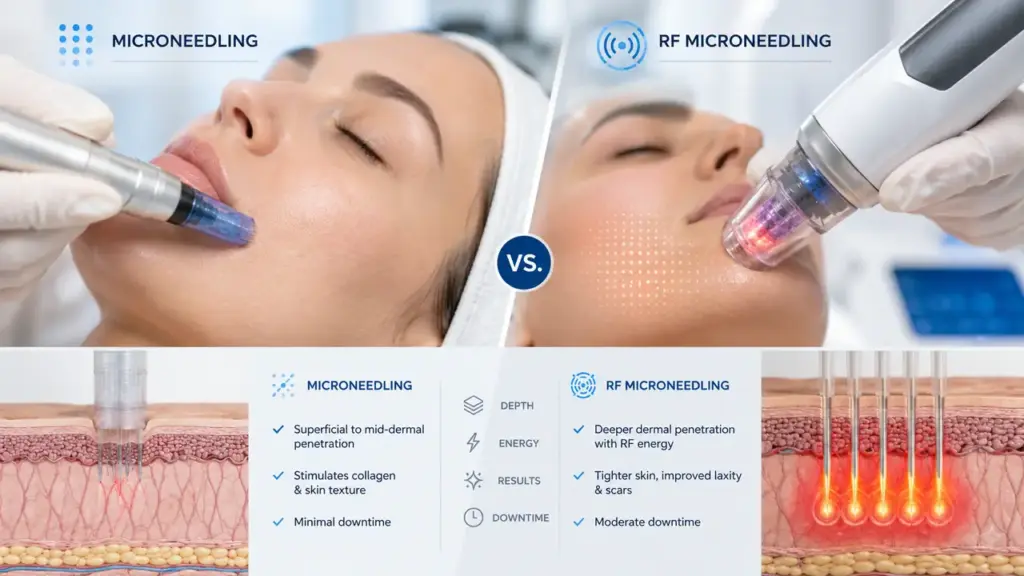
Traditional microneedling repeatedly moves fine needles into and out of the skin to create many controlled punctures. Some professional motorized devices let the operator adjust needle depth and speed. The skin responds to these micro-injuries by repairing itself and remodeling collagen.
In treatment terms, traditional microneedling is mechanical. The clinician still selects the device, needle cartridge, 깊이, coverage pattern, and treatment course, but RF does not create a heated tissue zone.
What RF adds to microneedling
RF microneedling keeps the needling action but gives the needles a second job: they act as electrodes that deliver radiofrequency energy into or below the skin. Tissue resistance converts that energy into localized heat, so the treatment combines mechanical micro-injury with controlled thermal energy. 미국. 식품의약품안전청 (FDA) describes RF microneedling in similar terms: microneedles deliver RF energy at set depths and produce small zones of intense heat.
The added heat is the reason to consider RF. The label alone does not show how a treatment will behave. The device, 전극 디자인, 치료 부위, 깊이, 에너지 전달, and operator technique all affect where and how heating occurs. 우리의 RF microneedling guide explains those technical variables; this article stays focused on the choice between treatment with and without RF.
Our manufacturer perspective
Traditional microneedling uses needles to start skin repair. RF microneedling adds localized heat. Compare them by asking what that extra heat can do for the concern you want to treat.
Which treatment better fits your main concern?
When traditional microneedling may be enough
그만큼 미국 피부과 학회 lists rough texture, 보이는 모공, 가는 선, and uneven skin tone among the concerns treated with traditional microneedling. Fine needle punctures stimulate skin repair and collagen production without RF heat. After a professional assessment, there is no reason to add RF simply because it sounds like an upgrade.
Traditional microneedling can also improve some depressed acne scars, but the scar type matters. Yale Medicine notes that deep, narrow ice-pick scars are usually harder to improve with microneedling than wider scars. More complex scars may need another treatment as part of the plan. Switching to RF does not automatically solve them. The treatment should match the scar rather than offer the most features.
RF price gap
At clinics we supply, comparable RF microneedling courses typically cost 35% 에게 45% more than traditional courses, largely because RF uses single-use needle cartridges. This supplier-side comparison covers similar courses; the public price ranges above combine different clinics, 장치, and treatment areas. If RF costs more than 1.5 times the traditional option, ask for an itemized explanation.
When RF microneedling may be considered
RF microneedling can be considered after professional assessment if you want to treat some depressed acne scars or if texture concerns come with mild laxity. RF heat adds another stimulus for collagen production, so one plan can address texture and some tightening. That extra heat should have a clear purpose for the concern you want to treat.
For acne scars, RF microneedling is one acne scar treatment, but scar type still matters. 깊은, narrow scars or depressions tethered to underlying tissue may need other treatments. Expect gradual improvement in scar depth and skin texture, not complete correction in one session.
Suitability also depends on the device, 치료 부위, and your skin. Darker skin tones and a history of post-inflammatory hyperpigmentation need careful assessment. A blanket claim that a treatment suits every skin tone is not enough.
How do the side effects and safety risks differ?
Risks shared by both treatments
With or without RF, microneedling penetrates the skin. 그만큼 FDA lists 홍반, 건조 함, 압박감, 필링, and pinpoint bleeding among possible reactions. These effects usually settle, but infection, pigment changes, and scarring can occur. Both treatments require proper technique and aftercare. Each session should use a new, single-use needle cartridge. A used cartridge should never be cleaned and reused, even on the same person.
Additional risks to consider with RF microneedling
RF microneedling heats tissue, so heat injury is an additional risk. The FDA has received reports of serious complications with certain uses, 화상을 포함하여, 흉터, 뚱뚱한 손실, 그리고 신경 손상. These injuries require medical care and are different from short-lived redness or tightness. Choose a provider who has been trained on the specific RF microneedling device.
FAQ
RF microneedling vs regular microneedling: 어느 것이 더 낫다?
RF microneedling is a better fit only when localized heat has a clear job in the treatment plan. Traditional microneedling remains a professional option for texture, 모공, 가는 선, and some acne scars. Compare the goal, evidence, 중단 시간, 위험, and total course. A more advanced-sounding name does not guarantee a better fit.
What is the downside of RF microneedling?
RF adds treatment complexity and heat-related risk. Results depend on the device, 치료 부위, 에너지 전달, 및 운영자 기술. A higher price should also have a clear reason. Serious complications reported to the FDA with certain uses include burns, 흉터, 뚱뚱한 손실, 그리고 신경 손상.
Which type of microneedling is most effective?
No single type is best for every concern. Start with the condition, scar pattern or degree of laxity, 피부색, 치료 부위, and acceptable downtime. The provider should explain why the chosen method fits those factors and what comes next if the first course falls short.
Are two RF microneedling sessions enough?
Two sessions may be enough to show improvement, but whether they are enough depends on the change you want. An initial RF microneedling course is often 3 에게 4 sessions about one month apart, adjusted to the individual. After the second session, give your skin time and compare progress at the follow-up. Photos taken in the same light and from the same angle are more useful than checking the mirror every day.
Can RF microneedling make you look older?
It can if unintended fat loss leaves the face looking more hollow or drawn. RF microneedling is intended to improve skin texture and firmness, but fat loss is a reported complication. If your face is already lean or preserving facial fullness matters to you, say so during the consultation and ask the clinician to include volume preservation in the treatment plan.
Can RF microneedling tighten jowls?
Mild laxity can be a reason to discuss RF microneedling. Before treating the jawline, ask how much change is realistic, how it will be documented with photos or another method, and whether the treatment area is close to regions where volume loss is unwanted.
How much do three microneedling sessions cost?
Based on public U.S. clinic prices, three traditional microneedling sessions cost about $600 에게 $2,100, while three RF microneedling sessions cost about $2,400 에게 $4,500. Use these ranges as a starting budget. Actual prices vary by treatment area, 장치, and clinic, and a three-session package may cost less than buying each session separately.
How should you choose?
Traditional microneedling is a complete treatment based on controlled mechanical needling. RF microneedling adds controlled heat, and that extra step should have a specific purpose.
If your main concerns are texture, 확대 된 모공, 가는 선, or some acne scars, traditional microneedling may already be a suitable professional option. If the plan has a defined thermal goal, such as remodeling some scars or treating mild laxity, RF deserves consideration. The provider should still explain the device, 치료 부위, course, 회복, and additional risk.
Use three checks: define the main concern, identify what RF adds to that goal, and compare the full course instead of one session. Then choose a qualified provider who can explain the safety tradeoffs clearly.
참고자료 & 출처
- 우리를. 식품의약품안전청: 마이크로 닝 장치
- 우리를. 식품의약품안전청: Potential Risks of Certain Uses of RF Microneedling
- 미국 피부과 학회: Microneedling Can Fade Scars, Uneven Skin Tone, and More
- Yale Medicine: 미세바늘
- 미국 피부과 학회: Acne Scar Treatment
- Comparing Microneedling Alone and in Combination for Acne Scars: Network Meta-Analysis of Randomized Trials
- 미세바늘: Is It Still a Good Treatment for Acne Scars? A Literature Review of 2020 에게 2024 증거
- Minimally Invasive Interventions for Atrophic Acne Scars: Phenotype-Guided Evidence Review
- 원자 램프, Microneedling and Combination Therapies for Moderate-to-Severe Atrophic Acne Scars: Network Meta-Analysis
- Fractional Radiofrequency Microneedling as a Monotherapy in Acne Scar Management: 체계적인 검토
- Effectiveness of Radiofrequency Microneedling in Dermatological Conditions: 체계적인 검토
- Radiofrequency and Radiofrequency Microneedling in Skin of Color: A Review
- Safety Profile for Microneedling: 체계적인 검토