
La plupart « tendances en matière d'équipement de beauté » articles pour 2026 sont rédigés à partir de présentations de rapports de marché. They quote the same Grand View Research and Coherent Market figures, declare AI and multi-function devices are « growing fast, » and stop there. None of that helps a clinic owner or distributor decide what to stock next quarter.
This article is written from the other side of the supply chain — what a Chinese B2B aesthetic-device manufacturer actually sees moving in 2026 buyer requests, where the order book diverges from the headline trends, and what we’d advise a buyer to put in (and leave out of) un 2026 RFQ. Data points come from the Recherche sur Grand View et Technavio aesthetic device forecasts and the Enquête mondiale ISAPS 2024; operator observations are labeled as such.
Le 5 Equipment Trends Actually Moving Orders in 2026
The global aesthetic devices market is projected to grow at roughly 9–12.6% CAGR through 2030 depending on which forecast you trust, with energy-based devices holding the largest revenue share. But macro growth tells you nothing about which categories are absorbing clinic capex tout de suite. Here is the order-book signal vs. the market-report signal.
| S'orienter | What the reports say | What we see in 2026 enquiries (Fotromed operator view) | Buyer signal |
|---|---|---|---|
| Multi-cartridge HIFU (7D / 12D / 22D / 25D) | « HIFU growing » | Cartridge count has become the spec buyers lead with; 4D is rarely requested | Strong |
| RF Miconeedling | « Skin tightening category growing » | The steadiest repeat-order category across med spas and dermatology clinics | Strong |
| Analyse de la peau par l'IA | « AI is revolutionizing beauty » | Bought for the consultation theater more than for the AI workflow; usage drops post-month-3 | Mixed |
| CO2 fractionné + 1927nm thulium | « Laser resurfacing expanding » | Two-camp split: CO2 for resurfacing/scarring, thulium for pigmentation/melasma | Strong |
| All-in-one / plateformes multifonctions | « Multi-function is the future » | Strong entry-level demand, but 12–18 months later many buyers return for specialized upgrades | Mixed |
The rest of this article goes through each of these in order, then ends with a Buyer Tip callout on what 2026 RFQs should actually contain.
Analyse de la peau par l'IA: Adoption Reality vs. Marketing Hype
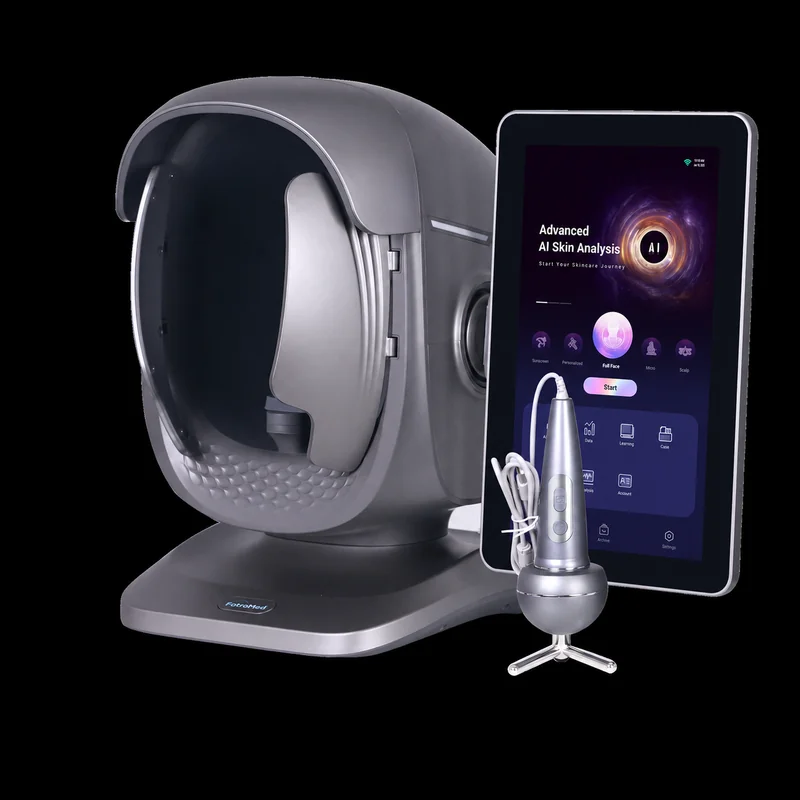
AI skin analysis is the trend most over-credited by 2026 industry decks. The category is genuinely growing — Grand View Research projects the global energy-based and adjacent device market to expand at 9.8% CAGR through 2033 — and consultation hardware sells well in front-desk and luxury-positioning contexts. The question is what it actually changes.
What it’s good for: Standardizing the consultation across staff with uneven training. Recording before/after for treatment-plan justification. Closing higher-ticket package deals when the client can see their own skin mapped on a screen.
What it’s not good for: Replacing a trained operator’s judgment. Driving repeat treatment bookings on its own. Generating ROI in salons that lack the consultation flow to use it.
Fotromed operator observation: Clinics that buy AI skin analysis systems use the AI scoring features heavily in the first 2–3 months, then settle into using only the photo capture and the side-by-side comparison view. Le « IA » part of the workflow has limited daily life unless the clinic has built the consultation script around it. Buyers asking for an AI Machine d'analyse de la peau should budget as much for consultation-script training as for the hardware itself; the device alone doesn’t drive sales.
Multi-Cartridge HIFU Platforms: What Clinics Actually Choose
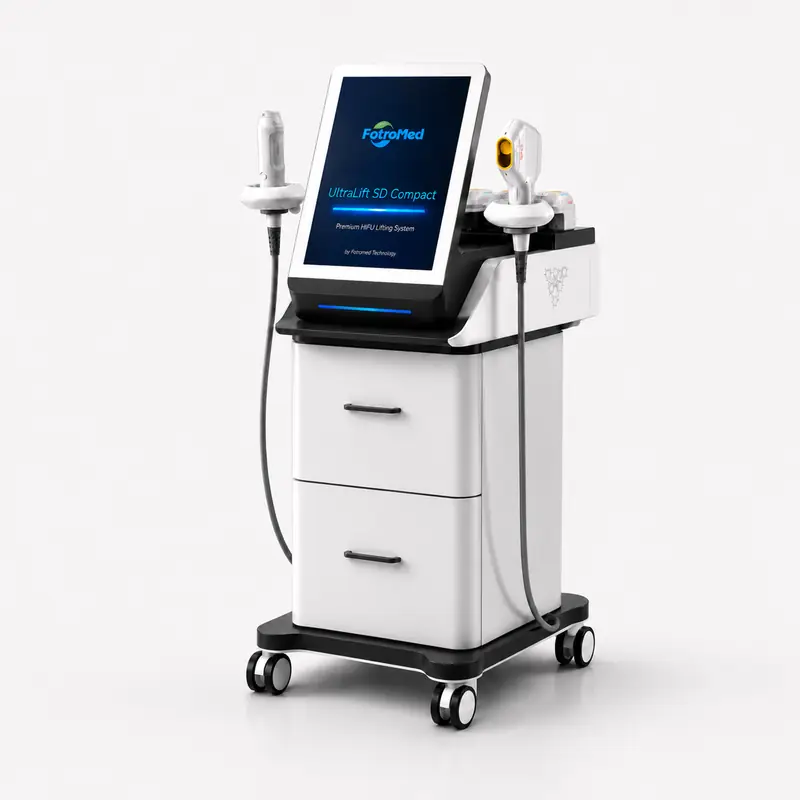
HIFU is the single most active equipment category in 2026 distributor enquiries we receive. But the conversation has shifted: buyers don’t ask for « a HIFU machine » anymore. They ask for a cartridge count — 7D, 12D, 22D, 25D — and a configuration.
A multi-cartridge HIFU platform combines focal depths (typiquement 1.5 mm, 3.0 mm, 4.5 mm) and treatment cartridges optimized for face, corps, or intimate indications on a single console. More cartridges = more indications coverable from one capital investment.
| Configuration | Typical indications coverage | Where it sits in 2026 demande |
|---|---|---|
| 4D | Face only, 3–4 depths | Fading; rarely requested in 2026 |
| 7D | Affronter + cou + body cellulite | Mid-tier; budget builds |
| 12D | Affronter + corps + resserrement vaginal | Currently the most-requested mid-premium tier |
| 22D / 25D | Visage complet, corps, intime, cuir chevelu | Niveau Premium; flagship demand |
Regulatory note (critical for buyer claims): Non « generic HIFU machine » category holds FDA 510(k) autorisation. As of 2026, the cosmetic HIFU devices with verifiable FDA 510(k) clearance are limited to specific brand systems — Ultherapy (Merz, cleared for brow, submental/neck, and décolleté), Sofwave (Sofwave Medical, cleared for facial fine lines and wrinkles), et liposonix (En liberté médicale, cleared for waist circumference reduction). Multi-cartridge HIFU platforms sold by Chinese manufacturers — Fotromed included — are CE-marked and built to international quality standards, mais CE marking is not equivalent to FDA clearance and should never be marketed as such. Distributors who plan to sell in the US market need to verify regulatory positioning at the SKU level, not the category level.
Fotromed operator observation: Among multi-cartridge configurations, 12D and 22D have moved from premium to default request in clinic RFQs over the past 12 mois. 4D is now an entry-level legacy spec — when a buyer asks for one, il’s usually a price-anchored objection rather than a real preference. Voir notre Machine HIFU catalog for the current cartridge configurations and indications.
Microneedling RF: Le 2026 Workhorse
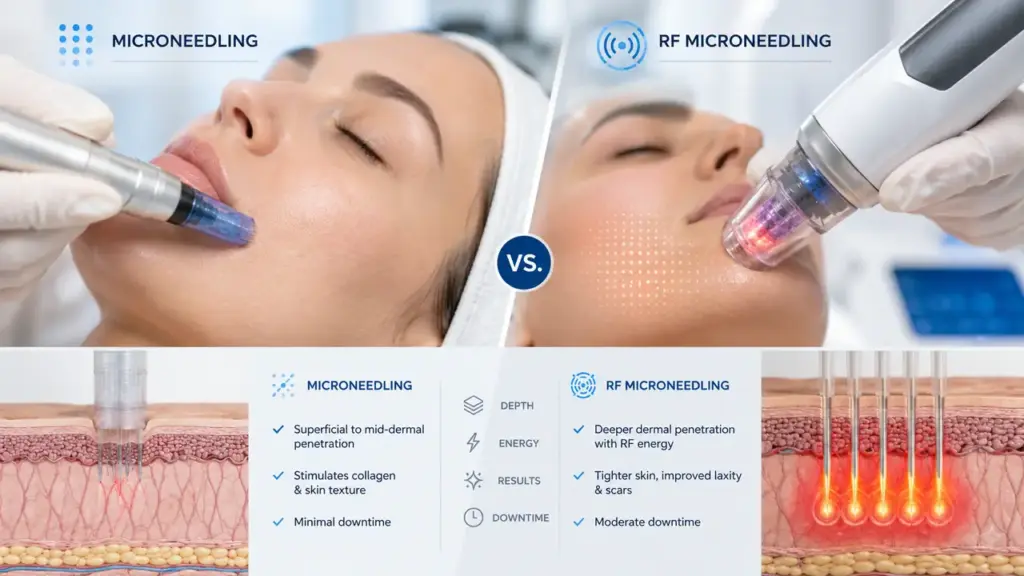
If multi-cartridge HIFU is the noisy headline, RF microneedling is the quiet category that consistently shows up on clinic capex lists. It combines mechanical microneedling (controlled dermal injury triggering wound-healing collagen response) with radiofrequency energy delivered through insulated or non-insulated needles for deeper-tissue thermal effect.
The buyer logic is simple: one platform addresses acne scarring, vergetures, rhytids, laxisme de la peau, and pore reduction — all categories that drive package sales and repeat bookings. Treatment is straightforward to train, downtime is short, and the consumable model (tip cartridges) gives manufacturers a recurring-revenue hook that distributors can build a service contract around.
Things 2026 RFQs should specifically clarify on any RF microneedling system:
- Needle count and depth range (typically 25–81 needles, depth adjustable from 0.5 mm à 3.5 mm).
- Insulated vs. non-insulated needles — insulated needles protect the epidermis from RF energy and matter for darker Fitzpatrick types; non-insulated allows shallower energy distribution for fine skin.
- Per-treatment consumable cost — the real operating cost of an RF microneedling business is the tip cartridge bill, pas la machine. Buyers who don’t model this in the first year are often surprised.
- RF energy delivery mode — monopolar, bipolaire, or fractionated bipolar.
Fotromed operator observation: RF microneedling enquiries are the most price-anchored of the four major categories in 2026. Buyers compare quotes line-by-line on needle count and tip cost. Manufacturers winning these deals are the ones who publish their consumable pricing transparently, not just the headline machine price. Notre Machine RF à micro-aiguilles range is configured around this — insulated-needle tip availability and disclosed consumable pricing are the two specs distributors keep coming back to ask about.
Laser Resurfacing Splits Into Two Camps: CO2 fractionné vs. 1927nm Thulium
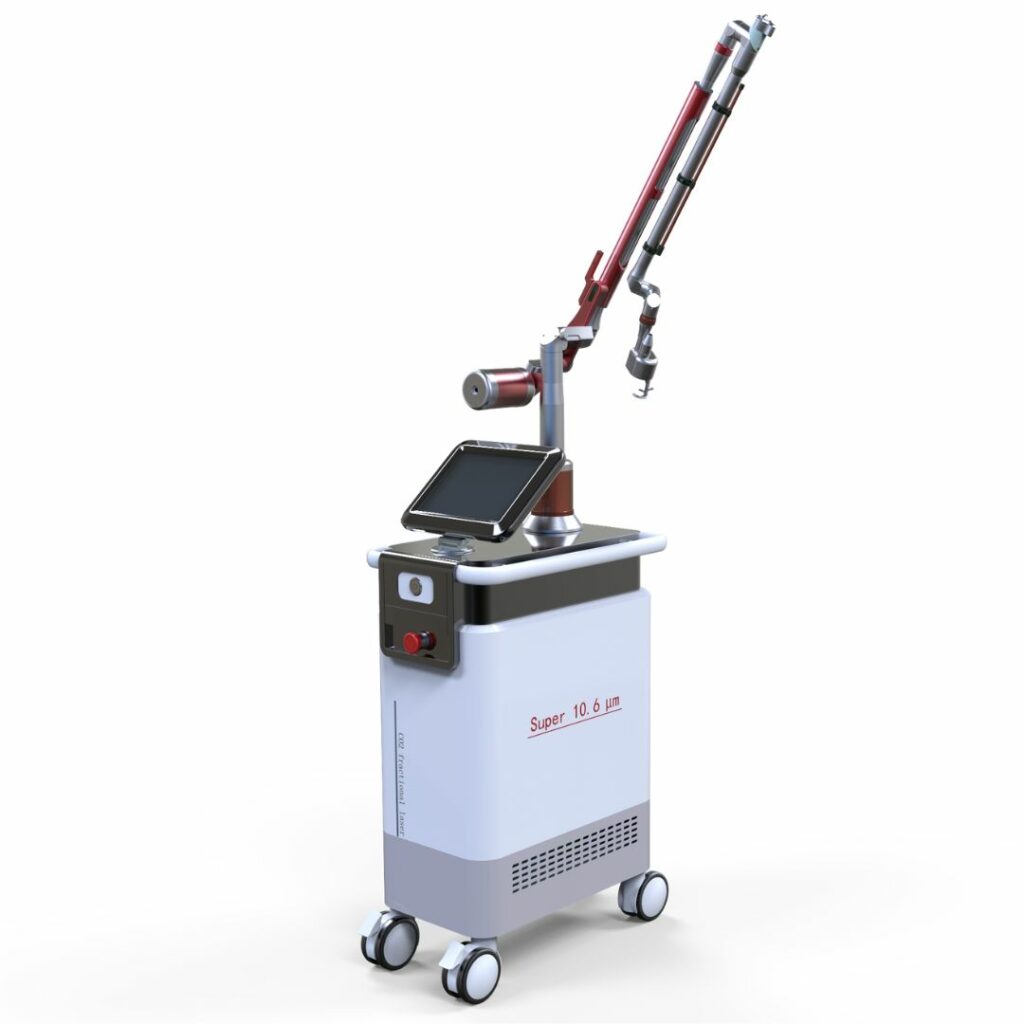
Through 2024, « resurfaçage laser » effectively meant fractional CO2. Dans 2026, the category has split. Lasers CO2 fractionnés (10,600 longueur d'onde nm) remain the workhorse for deeper resurfacing — scars, advanced photoaging, gynecology indications. Le 1927 laser à thulium nm, par contre, has emerged as the preferred non-ablative tool for melasma, pigmentation, and fine textural correction — historically the indications CO2 either over-treated or risked post-inflammatory hyperpigmentation on.
| Spec | CO2 fractionné (10,600 nm) | 1927 nm Thulium |
|---|---|---|
| Taper | Fractionnel ablatif | Non-ablative fractional |
| Primary indications | Cicatrices, rides profondes, Préchauffage, gynécologie | Mélasma, pigmentation, fine textural concerns |
| Temps d'arrêt | 5–10 jours | 1–3 jours |
| PIH risk on darker skin types | Plus haut | Inférieur |
| 2026 buyer signal | Stable demand from established med spas | Growing demand from dermatology and pigmentation-focused clinics |
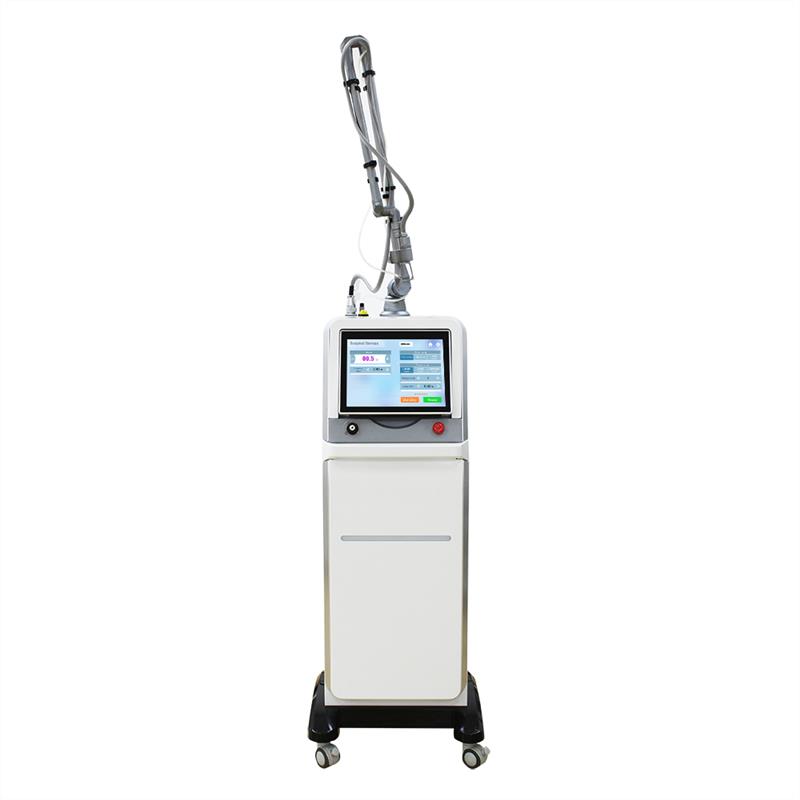
The practical implication for buyers: dans 2026, a clinic that already runs CO2 for resurfacing is more likely to add a 1927 nm thulium as a complementary platform than to upgrade their CO2 generation. The two lasers serve different clinical jobs; they are not substitutes. Voir notre Machine laser CO2 fractionnée range for the resurfacing side of this split.
« Tout-en-un » Platforms: When the Compromise Pays Off
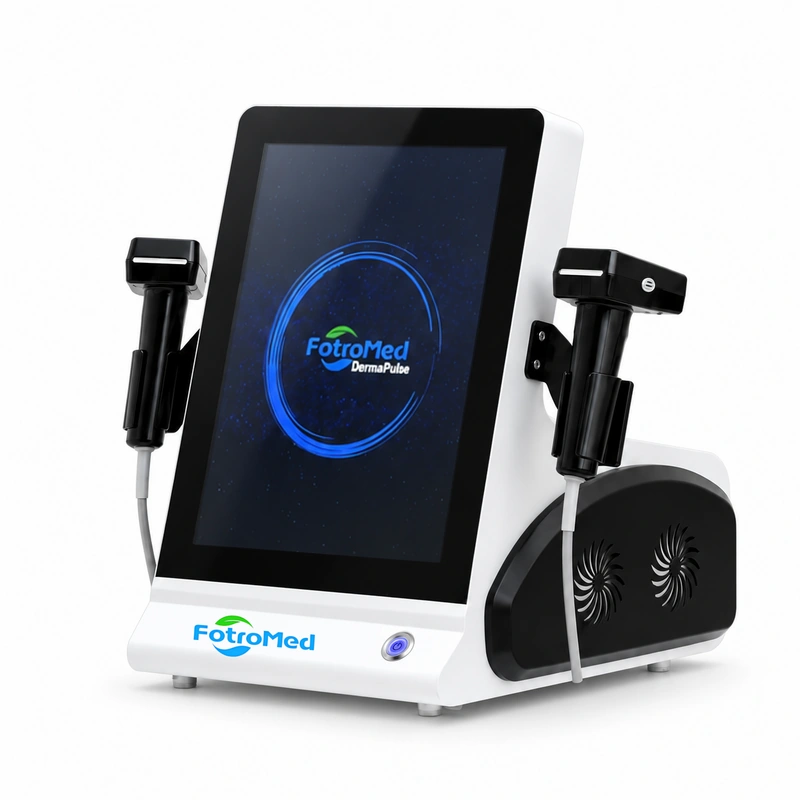
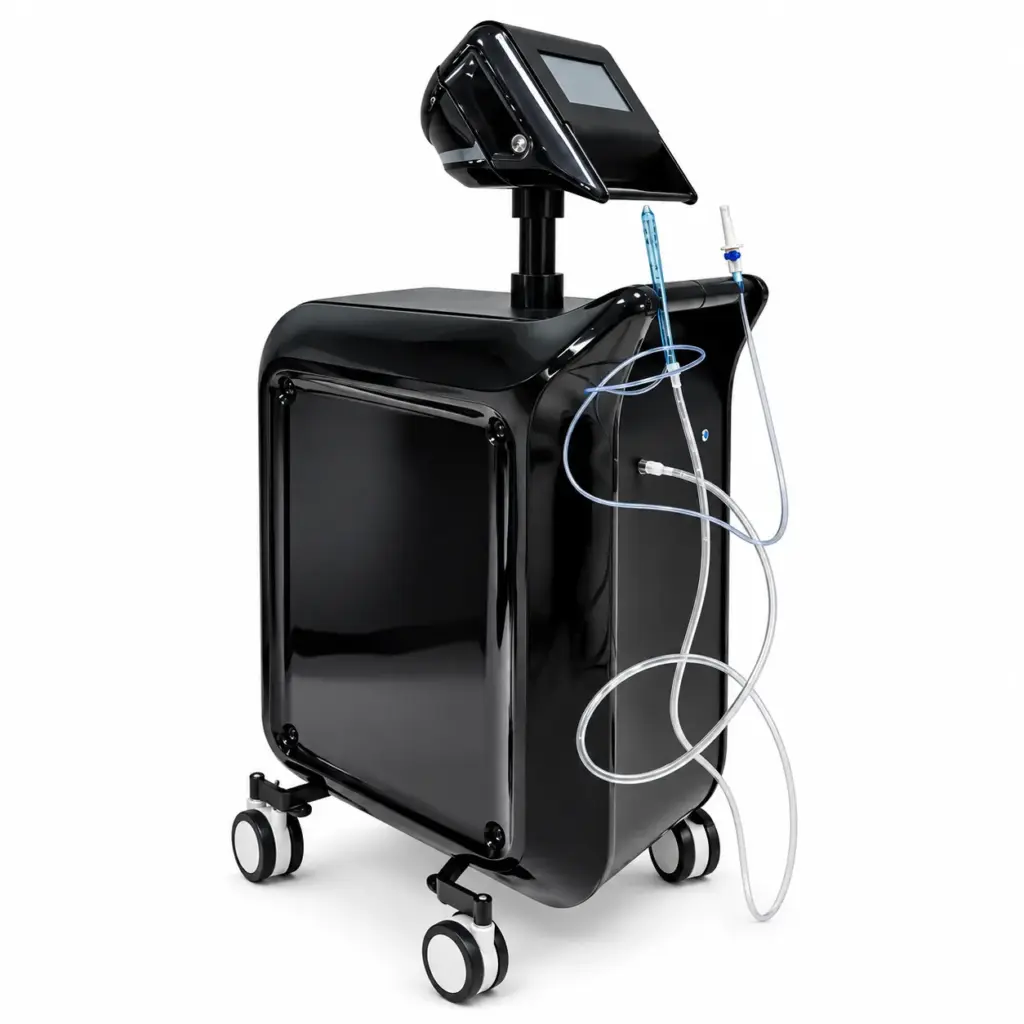
The all-in-one or multi-function platform — typically a single console combining 5–8 treatment heads (some combination of RF, cavitation, vide, SME, hydrofacial, ultrason, DIRIGÉ) — is genuinely useful for one customer profile and consistently disappointing for another.
Where it works: Entry-level salons and spas building their first machine inventory. Budget under $8,000–$12,000. Service menu still being defined. Small footprint required. The platform lets the owner test which treatments actually sell before committing to specialized equipment.
Where it doesn’t: Established med spas trying to upgrade. Clinics with defined treatment protocols. Anywhere the per-treatment energy density, influence, or cartridge spec actually matters — multi-function platforms compromise on every individual head to fit them all in one console.
Fotromed operator observation — what we see at the 12–18 month mark: A consistent pattern with all-in-one platform buyers is a return enquiry roughly 12–18 months after purchase, asking about a specialized HIFU or RF microneedling system. The pattern isn’t that the all-in-one platform failed; il’s that it succeeded at validating which treatments sell, and the buyer now wants the spec-grade version. We don’t try to talk early-stage buyers out of all-in-one — but we do warn them that it’s typically a stepping-stone purchase, not a destination one.
What We’d Wait Out in 2026
Two categories are getting more marketing oxygen than the order book justifies:
- « Alimenté par l'IA » feature retrofits on legacy hardware. Adding an AI consultation app to a 2022 skin analyzer is not the same as building an AI-grade imaging system. Buyers should ask to see the imaging hardware spec (camera resolution, lighting standardization, spectral channels) — not just the app demo.
- Deep-discount no-name HIFU clones. Below roughly $3,000 wholesale, un « Machine HIFU » is almost certainly cartridge-limited, lacks any verifiable certification, and will be very difficult to service. Distributors selling these to clinics often see the device dead inside 12 months with no spare-cartridge supply chain to keep it alive. The cost of the failed installation almost always exceeds the savings on the upfront price.
What Smart 2026 Buyers Put in an RFQ
This is the section most « trends 2026 » articles skip — what the buyer should actually request when they email three manufacturers for quotes. From the receiving end of those quote requests, here is what separates the RFQs that lead to good outcomes from the ones that don’t.
UN 2026 aesthetic-device RFQ should ask for:
- The SKU’s actual regulatory documentation. Not « FDA / CE / OIN 13485 » as a generic logo line. Ask for: the specific 510(k) K-number if claimed; the CE certificate copy with notified body number; l'ISO 13485 portée du certificat. Verify these against public FDA and EU NANDO databases yourself.
- Per-treatment consumable cost. Cartouche / conseil / handpiece replacement cost per treatment session. This number determines whether the business model works.
- Training scope. On-site, online, ou les deux. Heures. Whether protocol documents are provided. Whether parameter presets are factory-set or operator-configurable.
- Spare parts lead time and warranty terms. Specifically: what is the typical lead time on a replacement handpiece, and is there a forward-stocking arrangement available in the buyer’s region.
- Reference installation in the buyer’s market or vertical. Not a generic case-study PDF — a contact at a clinic running the same SKU.
- Quoi’s specifically NOT included. Consumables for the first year? Installation? Customs clearance support? Many quote disputes trace back to assumptions on these line items.
The Fotromed heuristic we share with first-time international distributor buyers: the supplier whose RFQ response includes the awkward line items voluntarily — consumable cost, training caveats, lead time on parts — is almost always the supplier worth a second call. The supplier whose quote is unusually short or unusually low is unusually likely to disappoint at month six.
Beauty Equipment Trends 2026: Buyer FAQ
Quels équipements de beauté sont à la mode 2026?
Multi-cartridge HIFU platforms (7D, 12D, 22D, 25D), Systèmes de micro-aiguilletage RF, and the split between fractional CO2 and 1927 nm thulium lasers are the categories absorbing the most clinic capex in 2026. AI skin analysis is growing but is more often used as a consultation tool than a workflow tool. Energy-based devices overall are forecast to grow at roughly 9–12% CAGR through 2030.
Are multi-function aesthetic devices worth buying?
Oui, for entry-level salons and spas building their first inventory under a $12,000 budget — multi-function platforms validate which treatments sell before specialized capex. They are usually a poor fit for established med spas, which find the compromise on individual treatment-head specs limits clinical outcomes. Plan for an upgrade enquiry within 12–18 months.
Which HIFU devices are FDA cleared in 2026?
For aesthetic indications, FDA 510(k) clearance applies at the brand/system level, not the category. Verifiable aesthetic-HIFU clearances include Ultherapy (Merz), Sofwave (Sofwave Medical), et liposonix (En liberté médicale). Generic « Machine HIFU » listings without a 510(k) K-number are not FDA cleared, and CE marking is not equivalent to FDA clearance — the two are separate regulatory pathways.
How much do new aesthetic machines cost in 2026?
Wholesale ranges vary widely by category and certification. Multi-function entry platforms typically start around $2,000–$8,000. Mid-tier RF microneedling and multi-cartridge HIFU systems generally run $8,000–$25,000. Premium fractional CO2 and high-cartridge HIFU systems can exceed $25,000 wholesale. Below roughly $3,000, energy-based device claims should be verified carefully — see « What We’d Wait Out » au-dessus de.
What should a 2026 clinic equipment RFQ include?
Six items: specific regulatory document numbers (510(k) K-number or CE certificate with notified body), per-treatment consumable cost, training scope and hours, spare-parts lead time in the buyer’s region, a reference installation, and an explicit list of what’s not included in the quoted price. Suppliers who provide these voluntarily are usually the ones worth shortlisting.
Is AI skin analysis worth it for a clinic?
It can be — primarily as a consultation and treatment-plan tool, not a clinical workflow tool. Adoption tends to drop after the first 2–3 months unless the clinic builds its consultation script around the system. Budget at minimum equal weight on staff consultation training as on the hardware itself. Skip systems that retrofit an AI app onto legacy imaging — verify imaging hardware specs first.
À propos de ce guide
This article is written from the perspective of Fotromed, a Chinese B2B aesthetic-device manufacturer supplying clinics, distributeurs, and med spas in 30+ pays. External market figures are sourced from Grand View Research, Technavio, Coherent Market Insights, and the ISAPS Global Survey 2024 — cited in line and listed below. Regulatory statuses (FDA 510(k), Marquage CE) are verified against public FDA and EU NANDO databases at time of writing; readers should re-verify at the SKU level before making procurement decisions, as clearances are updated periodically. Statements labeled « Fotromed operator observation » are based on patterns we see across distributor and clinic enquiries; they are reported as our internal experience, not as independently established findings.
Références & Sources
-
- Global Energy-Based Aesthetic Devices Market — Grand View Research
- Aesthetic Devices Market Growth Analysis 2026–2030 — Technavio
- Aesthetic Devices Market Size, Share and Forecast 2026–2033 — Informations cohérentes sur le marché
- Enquête mondiale 2024 — Full Report — ISAPS (Société internationale de chirurgie plastique esthétique)
- 510(k) Base de données de notifications préalables à la commercialisation - NOUS. Administration des aliments et des médicaments
- 510(k) Summary — Ulthera System (K134032) - NOUS. Administration des aliments et des médicaments
- Next-Gen Ultrasound Technology — Dermatology Times
- Ultrasound Technologies for Dermatologic Applications — Journal of Drugs in Dermatology
Articles connexes
- 4D, 7D, 12D, 22D & 25Machine HIFU D: Quoi’c'est la différence?
- Appareils de microneedling approuvés par la FDA pour les professionnels et les cliniques
- Systèmes laser CO2 fractionnés abordables pour les spas médicaux: UN 2026 Acheteur B2B’Guide
- Laser CO2 fractionné: Comment ça marche, Ce qu'il traite, et comment choisir la bonne machine