Two clinics can buy what is functionally the same Korean-built RF microneedling platform and pay prices that differ by $60,000 — because one bought it through a U.S. distributor under a familiar brand name, and the other traced it back to the factory. That gap exists because the RF microneedling market runs on a three-layer structure most price lists never show: the brand you know, the manufacturer that builds the device, and the distributor that sells and services it in your country. Until you can see all three layers, you are not comparing machines; you are comparing marketing budgets.
This guide maps the ten manufacturers behind the major RF microneedling systems sold in 2026, explains what FDA “cleared,” “approved,” and “registered” actually mean on a quote sheet, and breaks down realistic price tiers — including the consumable costs that decide your margin long after the purchase order. Sources: FDA fee schedules and device databases, peer-reviewed literature, manufacturer and distributor documentation, and Fotromed’s own manufacturing and export records across 50+ countries.
Who actually makes RF microneedling machines?
Start with the map. The table below pairs each major system with the company that manufactures it and the channel that sells it in the United States.
| # | Brand / system | Manufacturer | Manufactured in | U.S. sales channel | U.S. regulatory status |
|---|---|---|---|---|---|
| 1 | Morpheus8 | InMode Ltd. | Israel | InMode (direct) | 510(k) cleared |
| 2 | Genius, Infini | Lutronic | South Korea | Lutronic (direct) | 510(k) cleared |
| 3 | Secret RF, Secret PRO | ilooda | South Korea | Cutera (distributor) | 510(k) cleared |
| 4 | Potenza | Jeisys Medical | South Korea | Cynosure (distributor) | 510(k) cleared |
| 5 | VirtueRF | ShenB | South Korea | Cartessa Aesthetics (distributor) | 510(k) cleared |
| 6 | Sylfirm X | VIOL | South Korea | Benev (distributor) | 510(k) cleared |
| 7 | Exion (RF microneedling applicator) | BTL | Europe | BTL Aesthetics (direct) | 510(k) cleared |
| 8 | Intensif (EndyMed PRO) | EndyMed | Israel | EndyMed (direct) | 510(k) cleared |
| 9 | Pixel8-RF | Rohrer Aesthetics | USA | Rohrer (direct) | 510(k) cleared |
| 10 | AWNS(OEM/ODM) | Fotromed | China | Direct from factory | 510(k) cleared |
Regulatory statuses reflect publicly listed clearances as of mid-2026; confirm the specific model and indication against the FDA’s 510(k) database before purchase, because clearances are model-specific and change.
Read down the manufacturer column and a pattern appears that the brand column hides: six of the ten best-known “American market” systems are built by four countries’ factories, and five of those systems reach U.S. clinics through a distributor rather than the manufacturer itself.
Global brand platforms: InMode, BTL, EndyMed
These three manufacture their own devices and sell through their own subsidiaries. What you pay for is vertical integration: in-house R&D, published clinical protocols, direct training academies, and a service network under one roof. Morpheus8 is the clearest example — InMode designs, builds, clears, and sells it, which is part of why it carries the segment’s highest price tag and the strongest patient-facing brand recognition.
The Korean manufacturing tier: Lutronic, ilooda, Jeisys, ShenB, VIOL
South Korea builds more of the world’s premium RF microneedling systems than any other country — five of the ten systems in the table above. Three of them (Secret RF, Potenza, VirtueRF) are sold in the U.S. under distribution agreements with American aesthetics companies, which means the name on the invoice (Cutera, Cynosure, Cartessa) is not the name on the manufacturing line (ilooda, Jeisys, ShenB). For a buyer this matters in two practical ways: warranty and parts flow through the distributor, not the factory; and the same manufacturer may sell the equivalent platform under a different name in other regions at a different price.
U.S.-assembled platforms: Rohrer Aesthetics
Rohrer’s Pixel8-RF occupies the value tier of the branded market — a 510(k)-cleared bipolar RF microneedling system typically quoted well below the flagship platforms. It shows that “buying American” in this category usually means U.S. assembly and support rather than a fundamentally different technology stack.
Chinese OEM and ODM manufacturers: Fotromed and the direct-from-factory tier
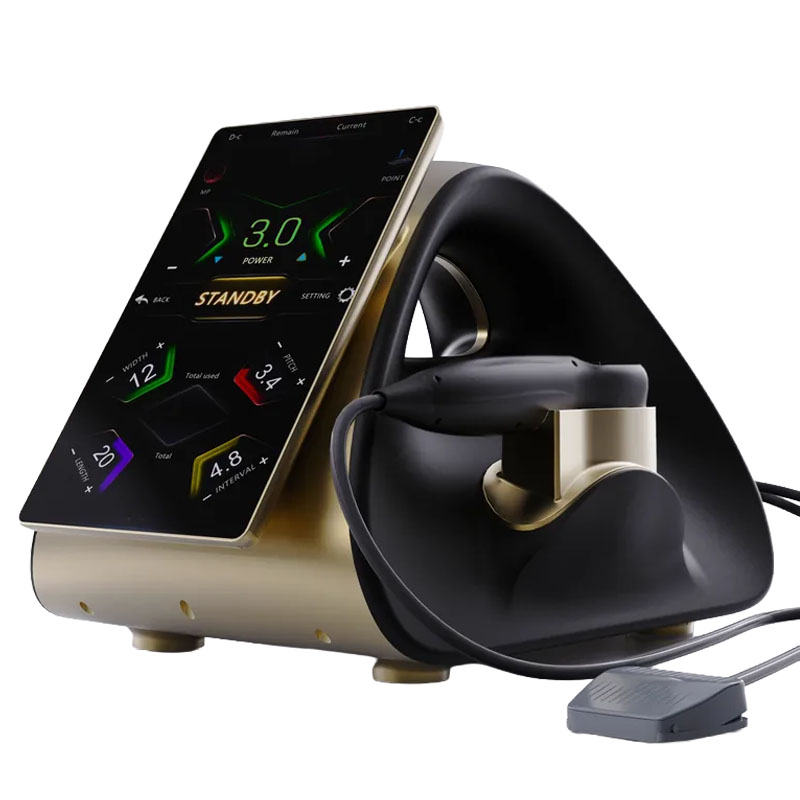
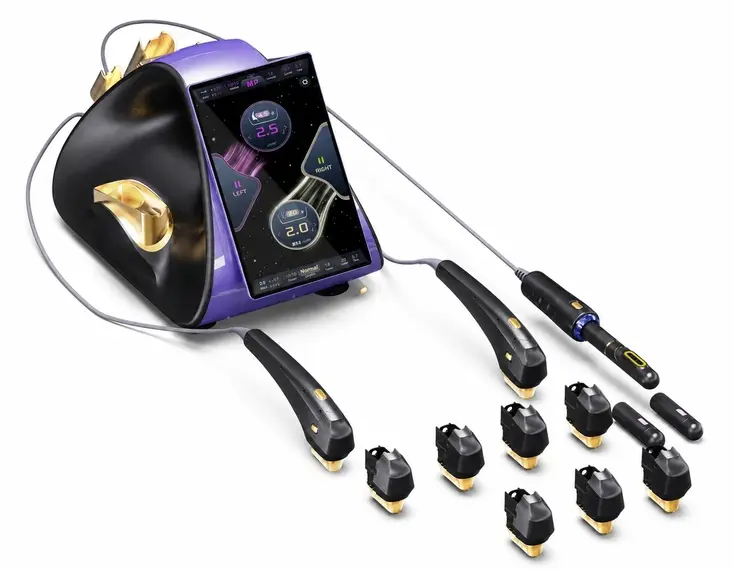
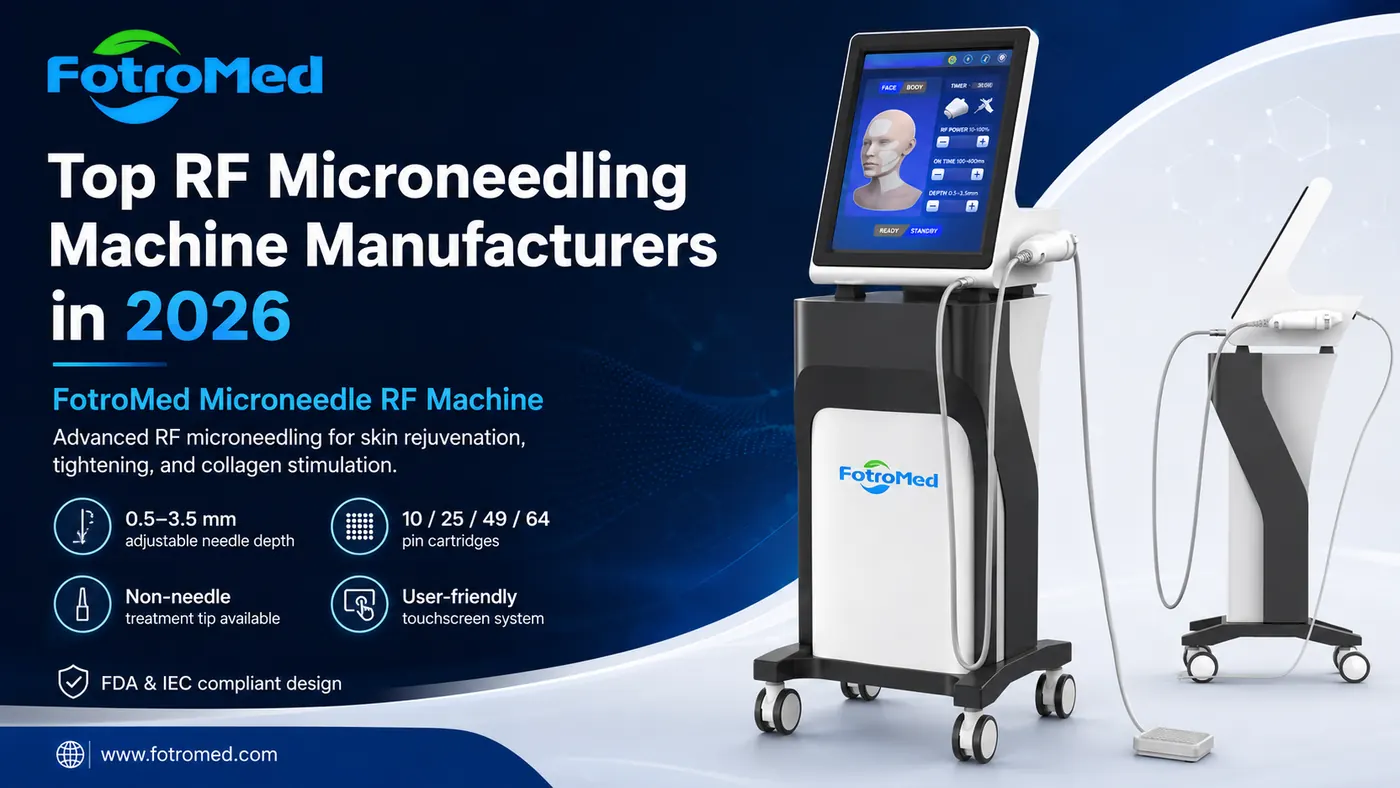
China’s role in this market is the factory layer itself: OEM (building systems sold under other companies’ brands) and ODM (designing and building complete systems a buyer can private-label). Fotromed manufactures the Máquina de radiofrecuencia con microagujas line on this model — CE-marked, built under an ISO 13485 quality system, exported directly to clinics and distributors without a branded-distributor markup. And the tier is no longer synonymous with “no U.S. clearance”: Fotromed’s AWNS fractional RF microneedling system holds its own 510(k) clearance. The trade-offs that do remain are worth stating plainly: you gain a 60–90% lower acquisition cost and direct factory communication; you give up a U.S. showroom and a household brand name for patient marketing.
📐 Engineering note: across tiers, the components that separate a stable system from a problematic one are the same three: the RF generator’s output consistency under load, the needle-drive motor’s depth accuracy, and cartridge manufacturing tolerances. Ask any prospective supplier — branded or OEM — for output test data on exactly these three items. A factory that runs per-unit QC will produce it within days; a trading company reselling someone else’s build usually cannot.
FDA approved vs. cleared vs. registered: what the labels mean when you’re buying
Here is the sentence that saves you the most time in supplier conversations: no RF microneedling system on the market is “FDA approved.” Approval is the PMA pathway reserved for Class III high-risk devices. RF microneedling systems are Class II and reach the U.S. market through 510(k) premarket notification — a clearance, which establishes that the device is substantially equivalent to one already legally marketed. Morpheus8, Potenza, Secret RF, Sylfirm X: all cleared, none approved. A supplier who tells you their machine is “FDA approved” has just told you something useful about their regulatory literacy.
One rung below clearance sits registration. Any establishment that manufactures devices for the U.S. market must register with the FDA and list its products — a compliance step that costs an $11,423 annual fee in FY2026 and involves no review of the device whatsoever. The FDA’s own guidance states that registration does not denote approval or clearance. “FDA registered” on a spec sheet means the paperwork and the fee, nothing more.
So why do most Chinese manufacturers stop at CE marking and ISO 13485 rather than pursuing 510(k)? Economics, not engineering. The FY2026 standard 510(k) review fee alone is $26,067, and the testing, predicate analysis, and consulting behind a submission typically multiply that figure several times over, per device, per indication — for access to one market. A factory whose order book is Europe, the Middle East, Southeast Asia, and Latin America serves those markets with CE marking under the EU MDR and a certified ISO 13485 quality system. The regulatory path a manufacturer chooses tells you where it sells, not how well it builds.
The five labels you will meet on quote sheets, side by side:
| Label | What it actually is | Reviews the device? | Typical holders in this category | Where to verify |
|---|---|---|---|---|
| FDA approved (PMA) | Pathway for Class III high-risk devices | Yes — full clinical review | None — no RF microneedling system holds it | FDA PMA database |
| FDA 510(k) cleared | U.S. market authorization via substantial equivalence | Yes — comparative review | All major branded platforms; Fotromed AWNS | FDA 510(k) database |
| FDA registered | Annual establishment listing ($11,423/yr fee) | No | Any manufacturer or importer that pays the fee | FDA registration database |
| CE marked | EU conformity under MDR | Yes — via notified body | Most export-oriented manufacturers incl. Fotromed | EUDAMED / notified body no. |
| ISO 13485 | Factory quality-management system certificate | No — audits the factory, not the device | Any certified manufacturer | Issuing certification body |
The practical rule: match the certificate to where the machine will actually operate — not to the seller’s or buyer’s passport. For patient treatment inside the U.S., that means a 510(k)-cleared system, which is exactly why the factory-direct tier now includes cleared models like the AWNS rather than ceding that scenario to branded platforms. Outside the U.S. — Dubai, São Paulo, Madrid, Riyadh — the operative certificate is CE marking plus the buyer’s national registration requirements, and the absence of a 510(k) changes nothing about a machine’s suitability for those markets: the same production line serves both. Distributors buying for re-export follow the destination market’s rule, not the port of purchase. Treat a missing 510(k) as the market-strategy signal it is, not a quality verdict. Production quality is evidenced elsewhere: the ISO 13485 certificate’s scope and issuing body, named component sources, warranty terms in writing, and the factory’s willingness to show output test data.
⚠️ Buyer pitfall: the phrase “FDA approved” in RF microneedling marketing is a red flag regardless of who says it — including U.S. resellers. Either the seller doesn’t know the difference between approval and clearance, or is hoping you don’t. In both cases, verify every other claim on the quote twice.
How much does an RF microneedling machine cost?
Realistic 2026 price bands, by tier. These are typical transaction ranges observed across distributor quotes and Fotromed’s export experience, not list prices — treat them as negotiation reference points, and expect configuration (handpiece count, cartridge bundle, training package) to move the number.
| Tier | Typical price range | What the price includes |
|---|---|---|
| Flagship branded platforms (Morpheus8, Potenza, Secret RF, Sylfirm X, VirtueRF, Exion, Genius) | $70,000–$180,000+ | Device, distributor warranty, on-site or academy training, marketing assets, financing options |
| U.S. value platforms (Pixel8-RF and comparable) | $40,000–$60,000 | Device, manufacturer warranty, remote training |
| Direct-from-factory OEM/ODM systems (AWNS, DermaPulse and comparable) | $2,000–$10,000 | Device, factory warranty (typically 12–24 months), remote training and protocol documentation |
The spread inside the flagship tier is mostly channel structure — a distributor’s margin, showroom, sales commissions, and patient-brand advertising are all in the price — plus the amortized cost of U.S. clearance and clinical studies. What the spread is no is a proportional difference in hardware cost: needle cartridges, RF boards, and motors are sourced from overlapping supplier ecosystems.
The consumable line item most quotes leave out
Every RF microneedling treatment consumes a single-use needle cartridge, and cartridge pricing varies more between tiers than the machines themselves. Branded proprietary tips commonly run $150–$300 each; open-format or factory-direct cartridges run $15–$50 (market observation, mid-2026). A three-year picture for a modest clinic doing 20 treatments a month — illustrative example only:
| Cost line (3 years, 20 treatments/month) | Flagship branded platform | Factory-direct OEM system |
|---|---|---|
| Machine purchase | $120,000 | $5,000 |
| Cartridge unit price | $200 | $30 |
| Consumables per month | $4,000 | $600 |
| Consumables over 3 years | $144,000 | $21,600 |
| 3-year total cost of ownership | $264,000 | $26,600 |
| Cost per treatment (720 treatments) | ~$367 | ~$37 |
At that volume the annual consumable gap alone is roughly $40,000 — larger than the entire purchase price difference between some tiers, and the line that actually sets your minimum viable treatment price. Before signing anything, get the cartridge price, the minimum order, and the guaranteed supply term in the contract, because a proprietary cartridge is also a switching cost: the day tip prices rise, your only alternatives are paying or parking the machine.
💡 Pro tip: whichever tier you buy in, ask for a written cartridge supply commitment — price ceiling, lead time, and availability horizon (5 years is reasonable to request). Manufacturers can sign this directly; distributors have to go ask the factory, and the speed of that answer tells you how the relationship will work after the sale.
Buying direct from an OEM/ODM manufacturer: how it actually works
The direct-from-factory process is simpler than most first-time buyers expect, and knowing the standard sequence helps you evaluate any supplier — including us. From Fotromed’s side of several thousand export transactions, the honest version:
MOQ. Reputable OEM manufacturers, Fotromed included, sell single units — MOQ 1 is standard for clinic buyers. Volume pricing starts to move at 5–10 units, which is where distributor conversations begin.
Lead time. In-stock configurations ship in 3–7 working days; customized builds (private label, UI language packs, regional plug and voltage) typically run 15–25 working days. A quoted lead time under a week for a “customized” machine usually means nothing is being customized.
What can be customized — and what can’t. ODM customization realistically covers housing color and branding, handpiece configuration, cartridge formats, software language and UI skin, and packaging. It does not cover the core RF board architecture or safety-critical firmware — a factory that offers to rewrite those for a single-unit order is describing an untested device, not a service.
After-sales structure. Factory-direct support runs on remote diagnostics (most current systems log fault codes readable over a video call), spare-part dispatch with 12–24 month warranty coverage, and replacement handpieces shipped rather than repaired on-site. That is the genuine trade against a distributor’s local technician — plan for it: clinics that keep one spare handpiece on the shelf eliminate most of the downtime risk that matters.
If you want to see how a factory-direct spec sheet reads against the branded systems in the table above, the AWNS fractional RF microneedling system page lists its 510(k)-cleared configuration with 1MHz bipolar RF output, cartridge formats, and the same documentation we send in quote packages.
Sourcing for spas and small studios
Spas, medspas, and single-operator studios buy differently from clinic chains, and the manufacturer map above reads differently from that seat. Three adjustments:
Buy for your treatment menu, not the spec ceiling. A studio running facial rejuvenation and post-acne texture work uses a fraction of a flagship platform’s configuration. The specs that actually constrain a small operation are cartridge cost per session (it sets your minimum viable treatment price), handpiece weight over a 6-treatment day, and depth range for the indications you actually offer — typically 0.5–3.5 mm coverage is sufficient.
Financing changes the tier math. Flagship distributors lead with monthly financing ($1,500–$3,000/month over 5 years is a common shape), which reads affordable until you add the proprietary-cartridge line from the section above. A $3,000–$6,000 factory-direct system paid outright often reaches breakeven inside 15–30 treatments at typical session pricing — count the treatments, not the monthly payment.
Training weight. Los operadores de spas sin directores médicos internos se apoyan aún más en la capacitación. Pregunte a cualquier proveedor —de marca u OEM— exactamente qué capacitación se incluye, en qué formato y si la documentación de los protocolos cubre su menú de tratamientos específico. Obtenga la respuesta por escrito antes de realizar el depósito, ya que “capacitación completa incluida” abarca desde una academia de tres días hasta un PDF.
Frequently asked questions
¿Quién fabrica la máquina Morpheus8?
Morpheus8 es fabricado por InMode Ltd., una empresa israelí de dispositivos médicos, y se vende en EE. UU. directamente a través de la propia organización de ventas de InMode con autorización 510(k). Es uno de los pocos sistemas principales de microagujas por RF donde la marca, el fabricante y el vendedor en EE. UU. son la misma empresa.
¿Qué marca de dispositivo de microagujas se considera la mejor?
No existe una única mejor opción: las plataformas insignia difieren principalmente en el diseño de la pieza de mano, el control de impulsos y la estructura de soporte, mientras que la elección correcta depende de su mercado, combinación de pacientes y nivel de presupuesto. Para obtener el desglose modelo por modelo según el tipo de clínica, consulte nuestra guía para elegir la mejor máquina de microagujas por RF.
¿Cuánto cuesta una máquina de microagujas por RF en 2026?
Rangos típicos de transacción: $70,000–$180,000+ para plataformas insignia de marca, $40,000–$60,000 para plataformas económicas de EE. UU. y $2,000–$10,000 para sistemas OEM directos de fábrica. Añada los consumibles: los cartuchos de un solo uso cuestan $150–$300 (propietarios) o $15–$50 (directos de fábrica) por tratamiento, lo que a menudo supera la diferencia de precio de la máquina en un año.
¿Por qué a algunos cirujanos plásticos no les gusta la microaguja por RF?
Las principales críticas profesionales son la dependencia del operador para los resultados y un marketing que supera las evidencias en algunas afirmaciones. La base clínica está madurando: una revisión sistemática de 2026 de 22 estudios (558 participantes) halló una mejora estética constante con eventos adversos predominantemente leves y transitorios (Journal of Cosmetic Dermatology). Las decisiones de compra aún deben basarse en indicaciones autorizadas, no en promesas amplias.
¿Vale la pena comprar máquinas de microagujas por RF usadas?
A veces: una plataforma insignia usada puede costar entre un 40 y un 60% menos que una nueva. Verifique tres cosas primero: que el fabricante o distribuidor transferirá la garantía y la elegibilidad de servicio (muchos no lo harán), que los cartuchos para esa generación de modelos sigan en producción y el recuento de disparos de la pieza de mano. Una plataforma usada con consumibles descontinuados es solo un soporte para monitor.
Acerca de esta guía. Compilado por el equipo editorial de Fotromed a partir de las tablas de tarifas y bases de datos de dispositivos de la FDA, documentación regulatoria de la UE, literatura revisada por pares, materiales públicos de fabricantes y distribuidores, y los registros de fabricación y exportación de Fotromed como fabricante de microagujas por RF con certificación ISO 13485 que realiza envíos a más de 50 países, cuyo sistema AWNS cuenta con la autorización 510(k) de la FDA. Los rangos de precios son observaciones de mercado actualizadas a mediados de 2026, proporcionadas como referencia de adquisición; los estados regulatorios deben volver a verificarse con las bases de datos oficiales al momento de la compra.
¿Planea realizar una compra? Envíe fotromed su menú de tratamientos y volumen mensual, y le enviaremos una cotización de configuración de DermaPulse con precios de cartuchos y un compromiso de suministro en un plazo de un día hábil.
Referencias y fuentes
- Notificación previa a la comercialización 510(k) — Administración de Alimentos y Medicamentos de EE. UU.
- Enmiendas sobre las tarifas para usuarios de dispositivos médicos (MDUFA): Tarifas — Administración de Alimentos y Medicamentos de EE. UU.
- Base de datos de notificaciones previas a la comercialización 510(k) — Administración de Alimentos y Medicamentos de EE. UU.
- CE marking — Comisión Europea
- ISO 13485:2016 Dispositivos médicos — Sistemas de gestión de la calidad — Organización Internacional de Normalización
- Microagujas de radiofrecuencia para el rejuvenecimiento facial: una revisión sistemática — Journal of Cosmetic Dermatology, 2026