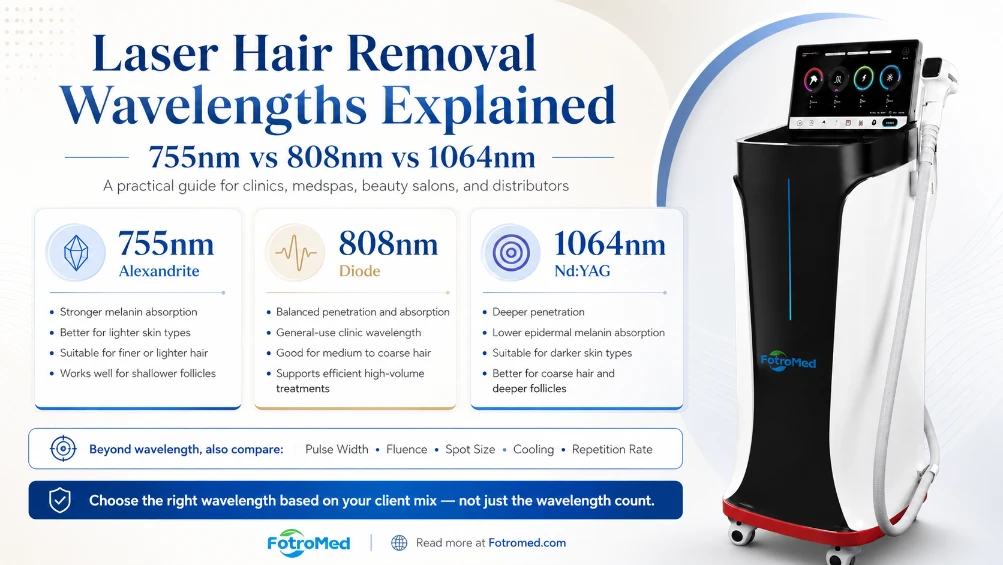
For clinics, medspas, beauty salons, and distributors buying professional hair removal equipment, 755nm, 808/810nm, and 1064nm are not just numbers on a specification sheet. They affect which chromophores absorb the light, how deeply the energy can reach, and how operators should think about pulse width, fluence, spot size, and cooling.
This guide explains the main laser hair removal wavelengths from a buyer’s point of view. After reading it, you should be able to judge which wavelength direction fits your client base, why a multi-wavelength platform is not automatically better, and which technical parameters matter beyond wavelength when you compare a diode laser hair removal system.
Quick answer: 755nm vs 808nm vs 1064nm
| Wavelength | Common laser type | Main value in hair removal | Better fit in hair removal | Pigment and other dermatology related uses |
|---|---|---|---|---|
| 755nm | Alexandrite, or a multi-wavelength platform with 755nm | Stronger melanin absorption; suits shallower follicles and finer or lighter hair | Lighter Fitzpatrick types, finer hair, and shallower follicles on the face or limbs | In other modes, 755nm also treats pigment such as age spots and freckles—see DermNet’s alexandrite laser treatment |
| 808/810nm | Diode laser, single- or multi-wavelength | A mid-range diode wavelength balancing penetration and melanin absorption | General clinic hair removal, medium to coarse hair, and higher-throughput multi-area menus | Works around follicular melanin, not a first-choice pigment wavelength; pigment work usually uses Q-switched or picosecond 532/755/1064nm |
| 1064nm | Nd:YAG, or a platform with 1064nm capability | Deeper penetration with lower epidermal melanin absorption; helps darker-skin risk management | Fitzpatrick IV–VI, coarse hair, and deeper follicles on the back, chest, or bikini line | 1064nm also treats deeper pigment and tattoo ink—see DermNet’s Nd:YAG laser treatment |
These points are based on public medical sources such as DermNet, NCBI Bookshelf, JDD, Health Science Reports, and Our Dermatology Online, then cross-checked against Fotromed’s public product page where Fotromed specifications are mentioned. The pigment-related column explains how wavelength and pulse duration shape device use. It does not mean every hair removal device has a pigmentation indication. Whether a device can be used for pigmentation, tattoo work, or another skin concern depends on its registered indications, device mode, pulse width range, energy output, and local regulations.
Why laser hair removal wavelength matters
A laser device does more than emit light. It delivers a specific wavelength, pulse duration, and fluence to a specific target in the skin. The main skin chromophores include melanin, hemoglobin, and water. Hair removal mainly relies on light absorption by melanin in the hair shaft and surrounding follicular structures, followed by heat diffusion into the follicle.
NCBI Bookshelf’s Laser Treatment of Pigmented Lesions gives a useful explanation of selective photothermolysis: a laser effect depends on whether the target chromophore absorbs that wavelength and whether the pulse duration suits the target tissue’s thermal relaxation time. In plain language, wavelength affects where the energy goes and who absorbs it. Pulse width affects how long heat stays in the target. Fluence affects how much heat is delivered.
For hair removal, wavelength alone is not enough. A buyer should read these parameters together:
| Parameter | What it means for a hair removal buyer |
|---|---|
| Wavelength | Determines whether the light is more strongly absorbed by melanin or reaches deeper tissue |
| Pulse width | Controls heat delivery time. Fine hair and coarse hair do not need the same pulse behavior |
| Fluence | Usually measured in J/cm2. It describes how much energy is delivered per unit area |
| Spot size | Affects treatment coverage and can influence tissue behavior |
| Cooling | Helps reduce epidermal heat load, especially for darker skin types and high-frequency operation |
| Repetition rate | Affects treatment speed, but it must match energy stability and cooling capacity |
Dermatology Online’s review of laser hair removal parameters notes that follicles may sit roughly 2 to 7 mm below the skin surface, and that hair thickness can affect pulse width selection. Fine hair heats quickly but does not retain heat as easily. Coarse hair often needs a longer pulse width. For buyers, this matters because a useful machine is not defined by 755nm, 808nm, or 1064nm alone. It also needs enough pulse width and fluence control for real clinic cases.
The same wavelength can serve different purposes in different pulse modes. Long-pulsed 755nm or 1064nm can be used in hair removal. Q-switched or picosecond 755nm and 1064nm are more often discussed in tattoo ink, pigment particles, or pigmented lesions. DermNet’s picosecond laser page explains that picosecond lasers use extremely short pulses to treat endogenous pigment and exogenous tattoo ink. A buyer should not assume that two devices have the same function just because both mention 1064nm. The device platform and pulse mode matter.
755nm Alexandrite: strong melanin absorption for lighter skin and finer hair
755nm is usually associated with alexandrite laser technology. Its main feature is stronger melanin absorption, which makes it useful in lighter skin types, finer hair, and shallower follicle cases. For clinics that serve many Fitzpatrick I-III clients, 755nm can be an important wavelength.
In hair removal terms, 755nm is attractive because melanin absorbs it readily. That can help when the hair is fine or the hair shaft has less dense pigment. The trade-off is also clear: when the epidermis contains more melanin, parameter control and cooling become more important. On darker skin, excessive fluence or an unsuitable pulse width can increase epidermal heat risk.
A 2026 Health Science Reports split-body study, Effectiveness of Single-Wavelength 755 nm Laser Compared to Dual-Wavelength 755 nm and 1064 nm Laser in Hair Removal, compared single 755nm treatment with combined 755nm and 1064nm treatment for axillary hair removal. It involved 20 Syrian women aged 20-33 with Fitzpatrick II-III skin types, using 40 treated axillae. Under that study design, single 755nm showed 92% overall hair reduction compared with 69% for the dual-wavelength side. This is useful evidence for a specific setting, not a universal rule for every device, body area, or skin type.
When evaluating 755nm, buyers should ask more than “does the machine have this wavelength?” Ask whether 755nm is independently selectable, what pulse width range is available, and whether the supplier provides darker-skin limits with cooling and training guidance.
808nm / 810nm Diode: a common general-use wavelength in diode hair removal
808nm or 810nm is one of the most common wavelengths in diode laser hair removal. Its value is not that it is extreme in one direction. It sits in a practical middle ground between penetration depth, melanin absorption, and clinic efficiency. That is why diode systems are common in daily hair removal work.
In a buying decision, 808/810nm usually matters for three reasons. It suits many medium-depth follicles, it can handle many medium to coarse hair cases, and when paired with a larger spot size, stable cooling, and suitable frequency, it can support high-volume clinic operation.
808nm should not be presented as a universal wavelength. For finer hair on lighter skin, 755nm may be more targeted. For darker skin, coarse hair, and deeper follicles, 1064nm is often worth closer attention. A more accurate description is “common general-use diode wavelength,” not “the best wavelength for every case.”
Compared with 755nm and 1064nm, 808/810nm is not the usual language of pigmentation treatment. For a diode hair removal platform, the main buying value of 808/810nm is hair removal efficiency, parameter adjustability, cooling stability, and handpiece durability.
Buyers can focus on these checks:
| Question | Why it matters |
|---|---|
| Can 808/810nm be adjusted independently? | This tells you whether the operator has real control for different clients |
| What is the pulse width range? | It defines the adjustment room for fine hair, coarse hair, and different skin types |
| Is the energy or fluence stable? | Stability affects consistency and operator confidence |
| Is the spot size practical for larger areas? | It affects treatment efficiency on legs, back, chest, and similar areas |
| Can cooling support continuous treatments? | Cooling affects epidermal protection, comfort, and day-to-day workflow |
1064nm Nd:YAG: deeper penetration for darker skin risk management
1064nm is usually associated with Nd:YAG laser technology. DermNet’s Nd:YAG laser treatment page notes that 1064nm Nd:YAG can reach deeper skin layers than some other lasers. In hair removal, this is why 1064nm is often discussed for darker skin types, coarse hair, and deeper follicles.
The advantage of 1064nm is not that it is “stronger.” It reaches deeper and is less strongly absorbed by epidermal melanin. For Fitzpatrick IV-VI skin types, or for clients with higher tanning-related risk, a longer wavelength can help reduce competitive absorption in the epidermis. It still needs careful operation: conservative settings, suitable pulse width, reliable cooling, and patch testing where the protocol requires it.
For procurement, 1064nm deserves close attention in these areas:
- Does the supplier provide Fitzpatrick IV-VI parameter guidance?
- Is the pulse width range suitable for darker skin and coarse hair?
- Can the cooling system protect the epidermis during repeated shots?
- Can operators adjust settings manually, or are they limited to fixed presets?
- Does the supplier provide contraindication guidance and written protocols?
How to choose the right laser hair removal machine after comparing wavelengths
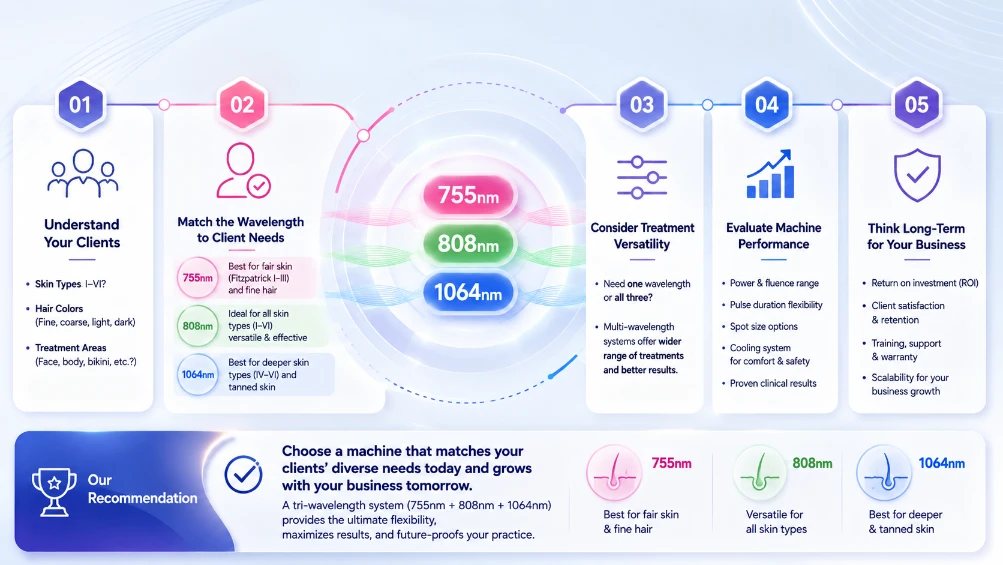
Once you understand the wavelengths, map them to your real business. A clinic serving mostly lighter skin and fine hair should not buy with the same priorities as a distributor serving mixed markets. Do not start with “which wavelength is best?” Start with “what range of control does my client mix require?”
| Buyer scenario | Wavelength direction to examine | Why it matters | What to confirm before buying |
|---|---|---|---|
| Many lighter-skin and fine-hair clients | 755nm or a platform with 755nm | Stronger melanin absorption can help with shallow follicles and finer hair | Whether 755nm is independently selectable and whether darker-skin limits are documented |
| General clinic with mostly medium hair | 808/810nm diode | Mid-range diode wavelength for a broad treatment menu | Whether fluence, pulse width, spot size, and cooling are stable |
| Many darker-skin clients | 1064nm-capable system | Lower epidermal melanin absorption can help with risk management | Whether Fitzpatrick IV-VI parameter charts and training are provided |
| Coarse hair, deeper follicles, back or chest areas | 1064nm or multi-wavelength platform | Deeper penetration may matter more for deeper follicles | Whether pulse width, cooling, and comfort management are sufficient |
| Distributor or multi-service clinic | Triple or four-wavelength diode platform | Broader coverage helps serve different markets | Whether wavelengths are independently controllable or fixed in blended output |
| Clinic that also wants pigment services | Evaluate a separate Q-switched or picosecond platform | Pigment work requires different pulse durations and indications | Do not sell a diode hair removal machine as a pigmentation device unless the device is indicated and configured for that use |
Single, triple, or four-wavelength systems: which configuration fits?
A single-wavelength machine can work well when the clinic’s client profile is clear. A practice focused on lighter skin and finer hair may value 755nm. A practice focused on darker skin and coarse hair may value 1064nm. The advantage is focus. The limitation is a narrower treatment menu.
Triple-wavelength diode systems usually combine 755nm, 808/810nm, and 1064nm. Their commercial value is broader coverage: lighter skin, general hair removal, darker skin, and coarse hair can all sit within one platform discussion. A 2020 JDD triple-wavelength hair removal study used a simultaneous 755nm, 810nm, and 1064nm device in a retrospective cohort of 11 male participants with 27 treatment sites and Fitzpatrick III-V skin types. The treatment parameters included 7-9 J/cm2 fluence, 9-10 Hz frequency, and up to 6 treatments spaced 6-8 weeks apart. The study supports the clinical relevance of a specific multi-wavelength device and protocol, but it does not prove that every triple-wavelength machine performs the same way.
Four-wavelength diode systems often add 940nm to 755nm, 808nm, and 1064nm. For distributors and multi-service clinics, the business value is wider positioning and clearer product differentiation. A professional buyer still needs to ask how 940nm participates in the output. Is it independently controllable? Does it have a documented protocol? Or is it mainly a marketing specification?
What clinical evidence says about wavelength selection
Clinical evidence does not crown one wavelength as the permanent answer. It gives buyers boundary conditions. You need to know who was studied, what skin types were included, what body area was treated, what device was used, and which parameters were applied.
| Evidence | What it showed | How a buyer should use it |
|---|---|---|
| 755nm vs 755/1064nm split-body study | In 20 women with Fitzpatrick II-III skin types and axillary hair removal, single 755nm showed higher reported hair reduction than dual 755/1064nm under that protocol | Useful for understanding that combined wavelengths are not automatically superior. Do not generalize it to all skin types, all body areas, or all devices |
| JDD triple-wavelength study | In a small retrospective cohort, simultaneous 755/810/1064nm treatment showed positive outcomes in Fitzpatrick III-V treatment sites | Useful support for multi-wavelength clinical relevance, but limited by sample size, study design, and device-specific protocol |
| Review of laser hair removal parameters | Parameters such as follicle depth, pulse width, fluence, frequency, skin type, and cooling affect outcomes | Useful as the broader framework for comparing machines beyond wavelength count |
For B2B buyers, the value of evidence is not that it chooses the wavelength for you. It keeps you from relying only on sales claims. Review the study population, skin type, body area, device parameters, and operator protocol before turning a paper into a buying decision.
Machine specifications that matter beyond wavelength
This is the part of the buying decision that often gets missed. Many pages explain 755nm, 808nm, and 1064nm, but they do not show buyers how to read a device specification sheet. In practice, the quotation sheet often tells you more about day-to-day usability than the wavelength count does.
| Specification | What to check | Buying meaning |
|---|---|---|
| Energy / fluence | Energy range, units, and stability | Shows whether the machine has enough room for different skin and hair conditions |
| Pulse width | Minimum and maximum pulse width | Affects fine hair, coarse hair, and darker-skin risk management |
| Frequency | Frequency range and output stability during continuous use | Affects efficiency on large treatment areas |
| Spot size | Spot dimensions and handpiece coverage area | Affects speed on legs, back, chest, and other large areas |
| Cooling | Contact cooling, TEC, sapphire cooling, or other design | Affects epidermal protection and continuous-use comfort |
| Handpiece life | Handpiece lifetime, warranty, and consumable cost | Affects long-term operating cost and downtime risk |
| Parameter records | Whether client parameters can be recorded | Helps with repeat visits and multi-operator consistency |
| Certification documents | CE, FDA cleared or FDA-related documents, ISO13485 information | Supports import, distribution, and institutional purchasing trust |
Fotromed’s public product page lists the LaseSmooth Pro diode laser hair removal system as a four-wavelength platform with 755nm, 808nm, 940nm, and 1064nm. The same public page lists 1-120 J/cm2 energy, 1-10 Hz frequency, 1-370 ms pulse width, a 16 x 35 mm spot size, 1600 W laser power, 3000 W output power, 2 years or 20 million shots warranty, and CE, FDA, ISO13485, GOST-P, and EAC certification information. These are Fotromed’s published product specifications. Buyers should still review the actual certificate documents, market requirements, and training materials before purchase.
Example: a four-wavelength diode laser platform for clinics
For clinics or distributors that want wider client coverage, a four-wavelength platform gives more flexibility. LaseSmooth Pro’s configuration can be read through the framework above: 755nm is relevant for shallower and finer hair, 808nm is the general-use diode wavelength, 1064nm matters for darker skin and coarse hair, and 940nm adds another layer of platform differentiation.
That does not mean the product should be described as suitable for every client or guaranteed to deliver every outcome. A better claim is narrower and more credible: a four-wavelength platform gives clinics a wider parameter and service menu, while final performance still depends on operator training, parameter selection, client screening, cooling, and local compliance requirements.
If the reader is comparing diode hair removal devices, Fotromed’s Hair Removal Series is the right category page to review before discussing configuration and quotation details.
FAQ
Is 808nm better than 755nm for laser hair removal?
808nm is not automatically better than 755nm. 808/810nm diode systems are often used as general clinic wavelengths, while 755nm can be more targeted for lighter skin and finer hair. The better choice depends on skin type, follicle depth, fluence, pulse width, cooling, and operator protocol.
Is 1064nm safer for dark skin?
1064nm is often more suitable for darker-skin risk management because it has lower competitive absorption in epidermal melanin. It still needs suitable fluence, pulse width, cooling, patch testing when appropriate, and trained operation. It is a suitable option, not an absolute safety guarantee.
Can 755nm and 1064nm be used for pigmentation?
They can be used for pigment-related treatments in specific device modes, but they are not interchangeable with hair removal settings. 755nm alexandrite, 1064nm Nd:YAG, and 532nm Nd:YAG are common in pigment and tattoo literature, usually with Q-switched or picosecond platforms. Whether a diode hair removal machine can treat pigmentation depends on its registered indications and technical mode.
Which wavelength is best for fine hair?
755nm is often discussed for finer hair on lighter skin because it has stronger melanin absorption. Fine hair is not decided by wavelength alone. Hair color, skin type, treatment area, pulse width, and energy settings all matter.
Are triple-wavelength diode lasers always better than single-wavelength lasers?
No. Triple-wavelength systems cover more client scenarios, which can help multi-service clinics and distributors. Single-wavelength systems may suit clinics with a clearer client profile. The device choice should come down to control, cooling, protocols, service support, and the client mix you actually serve.
What is the difference between 808nm and 810nm?
For most buyers, the label difference between 808nm and 810nm matters less than the full machine design. Pay more attention to fluence range, pulse width, spot size, cooling capacity, handpiece life, service support, and training quality.
Why do some machines include 940nm?
Some four-wavelength diode systems add 940nm to widen platform coverage and product differentiation. Buyers should ask how 940nm participates in output, whether it can be controlled independently, and whether parameter protocols support it. Do not treat it as proof that “more wavelengths means better.”
About this guide
This guide is written for professional buyers, including clinic owners, medspa operators, beauty salons, distributors, and OEM/ODM buyers evaluating laser hair removal equipment. It combines SERP analysis, public dermatology references, journal literature, Fotromed public product information, and B2B equipment procurement logic.
This article is not medical advice for patients and does not provide self-treatment instructions. Treatment settings and client suitability should be determined by trained professionals according to local regulations, device labeling, certificate documents, and clinic protocols.
References & Sources
- Alexandrite laser treatment – DermNet
- Nd:YAG laser treatment – DermNet
- Picosecond laser – DermNet
- Laser Treatment of Pigmented Lesions – NCBI Bookshelf
- Effectiveness of Single-Wavelength 755 nm Laser Compared to Dual-Wavelength 755 nm and 1064 nm Laser in Hair Removal – Health Science Reports
- A Combined Triple-Wavelength (755nm, 810nm, and 1064nm) Laser Device for Hair Removal: Efficacy and Safety Study – Journal of Drugs in Dermatology
- Properties and parameters for effective laser hair removal: A review – Our Dermatology Online
- LaseSmooth Pro diode laser hair removal system – Fotromed
- Certification – Fotromed