
Direct answer
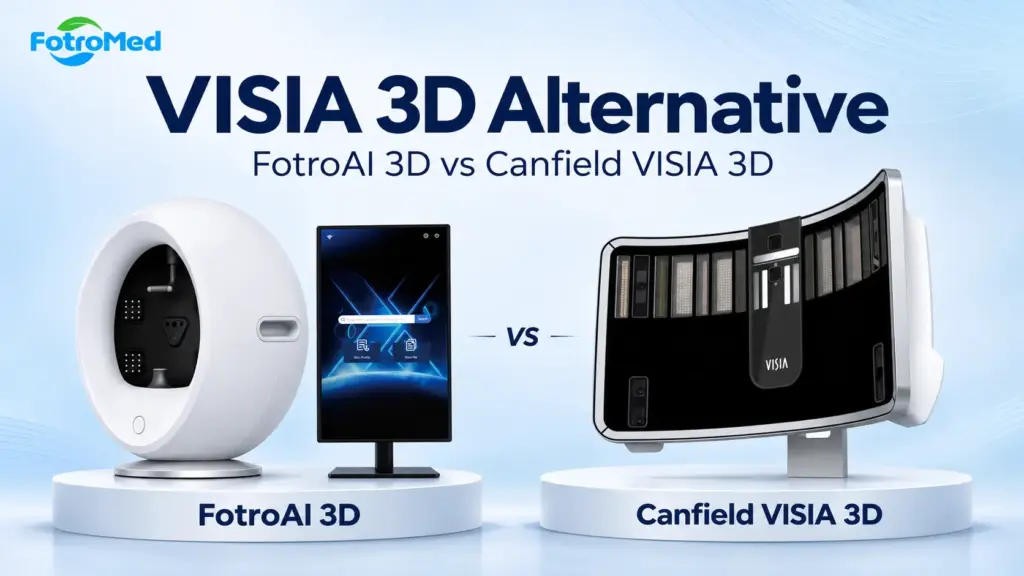
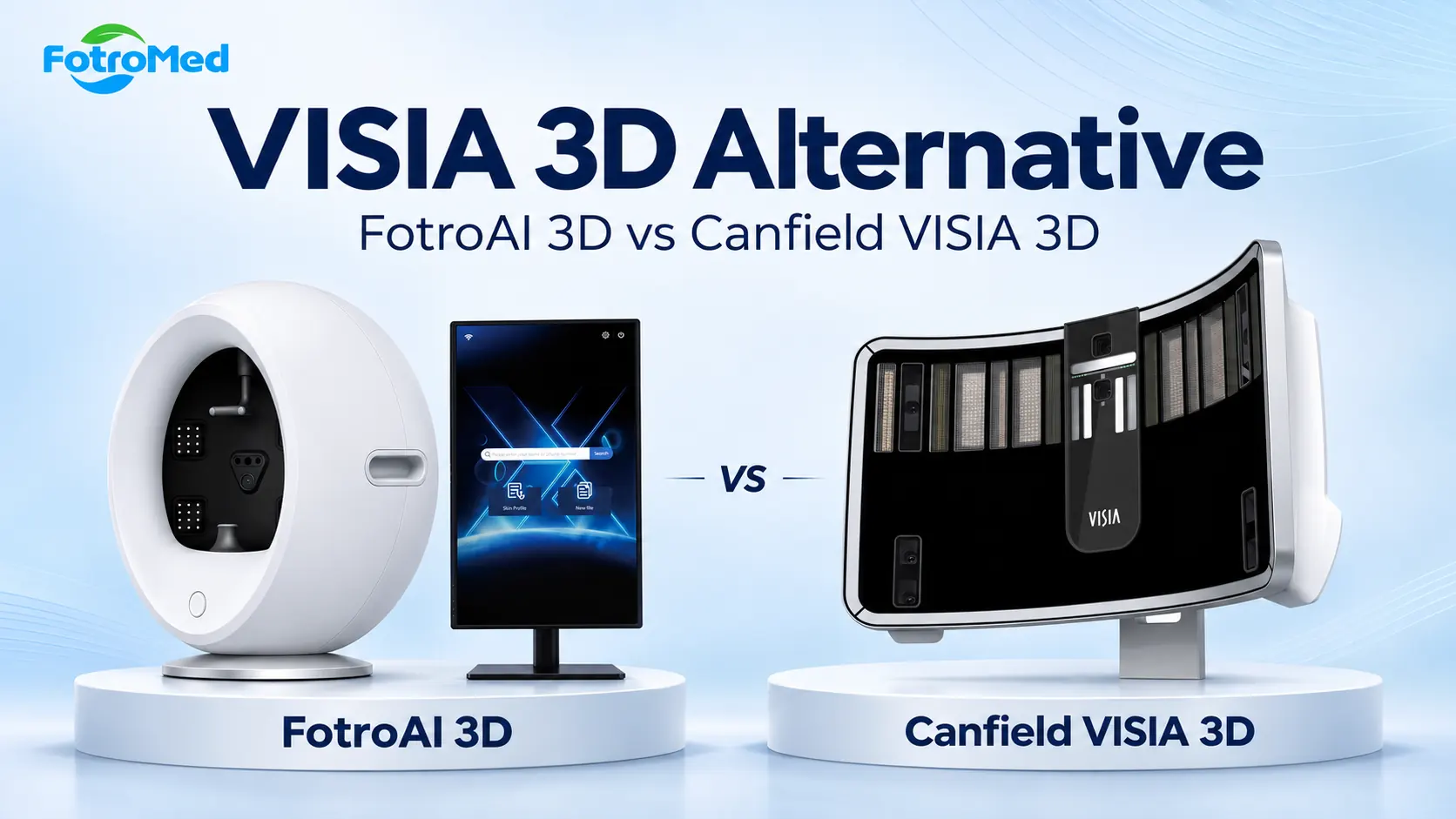
FotroAI 3D is a practical Canfield VISIA 3D alternative for dermatology clinics, facial plastic surgeons, and med spas that want true 3D facial imaging and multi-light skin views without a steep upfront bill or yearly software renewals. FotroAI 3D sits in a confirmed USD 8,500–15,000 equipment range with USD 0 per month for its included software, whereas complete Canfield VISIA 3D packages run an estimated USD 27,500–38,500 before adding a separate high-spec computer and annual Canfield Care fees.
When a patient comes back after cheek filler, Botox, or laser work and asks, “What really changed since day one?”, clear 3D contours and matched skin photos let you look at the proof together. If you are a dermatologist, facial plastic surgeon, injector, or med spa owner weighing a Canfield VISIA 3D quote, this guide walks through 3D facial capture, lighting views, room wiring, and three-year ownership costs so you can choose with confidence before booking a live demo.
At a glance
| Tính năng | Canfield VISIA 3D | FotroAI 3D |
|---|---|---|
| 3D capture | Multi-camera 2D, 3D, and video | Structured-light 3D (three 20 MP cameras) |
| 3D accuracy | Millimeter figure not listed publicly | 0.2 mm (manufacturer spec) |
| Contour tools | Volume map, gray mode, 3D sliders | Rotatable 3D model across all angles |
| Camera lights | 3 chế độ (Tiêu chuẩn, Phân cực chéo, UV) | 4 chế độ (adds Parallel-Polarized) |
| Skin views | 8 scored features + RBX + TruSkinTuổi | 8 skin views + 48-color ColorChecker |
| Screen layouts | Side-by-side + before/after slider | Mirror, Dual-Screen, and Tri-Screen |
| Kích cỡ & cân nặng | 52.1 × 50.2 × 20.9 cm · 9 kg pod | 62.0 × 65.6 × 39.5 cm · 10 kg unit |
| máy tính & network | Core i9 / 32 GB PC + wired LAN only | Intel i5 / 16 GB + Wi-Fi or Ethernet |
| Yearly software fee | Xấp xỉ. USD 1,100–3,300/yr (Canfield Care) | USD 0/year for included software |
| Device budget | Xấp xỉ. USD 27,500–38,500 estimate | USD 8,500–15,000 confirmed range |
Why Clinics Look for a Canfield VISIA 3D Alternative
How 3D Facial Scanning Helps in Daily Consultations
Standard 2D photos press a curved face onto a flat screen. They show brown spots and surface redness well, yet subtle cheek fullness or a cleaner jawline after filler often looks understated under ordinary room lights. True 3D facial imaging fixes this by mapping surface depth across the nose, Má, cằm, và hàm, so you can turn one digital model of the face on screen and inspect every curve with your patient (PubMed validation study on 3D facial surface imaging).
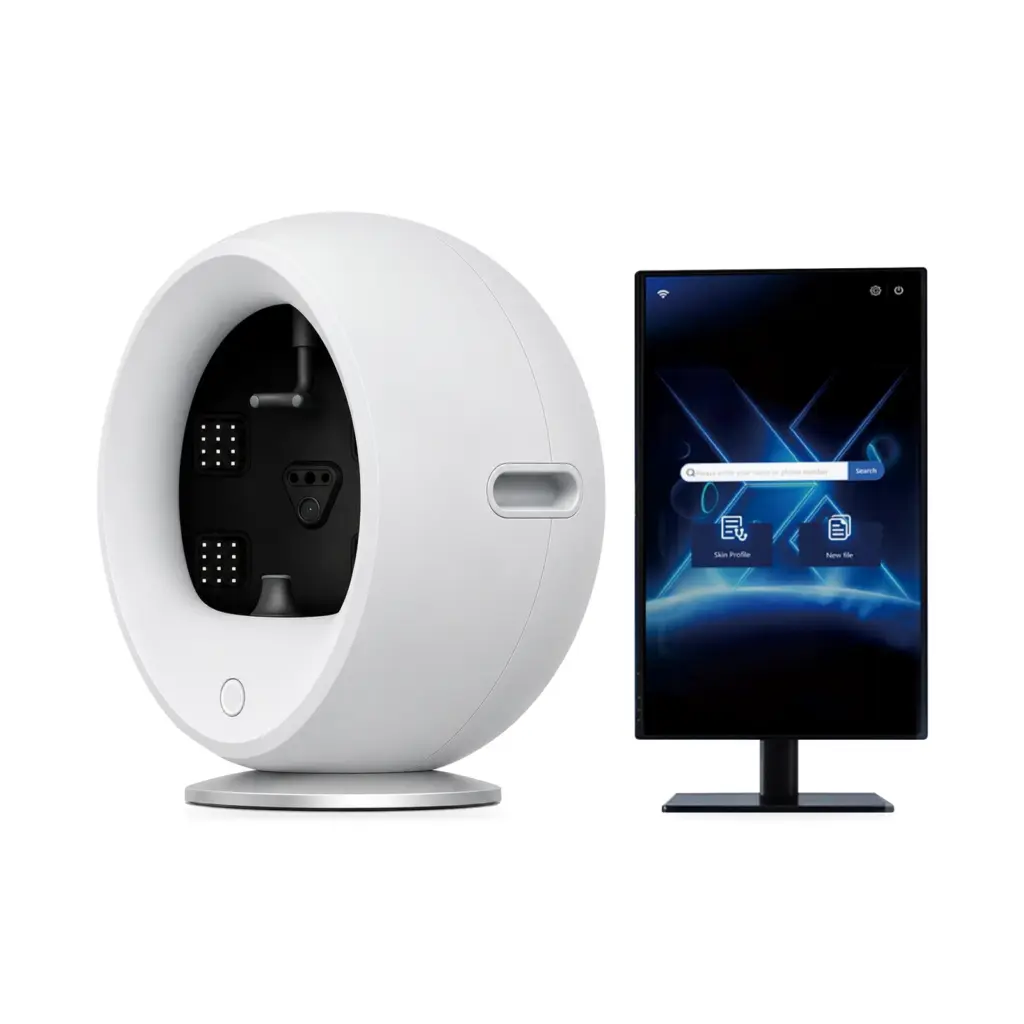
Canfield added true 3D capture to its flagship complexion line in March 2026 with VISIA 3D, combining 2D skin photos, 3D facial models, and short video clips in a tabletop pod (Canfield VISIA 3D specifications, Landsberg VISIA 3D release). FotroAI 3D reaches that same consultation goal through structured-light scanning. The unit shines a safe preset light grid onto the face, three synchronized cameras record how that grid bends across facial curves, and the software builds a rotatable 3D model alongside multi-light skin views.
Three Practical Hurdles Behind VISIA 3D Quotes
Canfield VISIA 3D carries strong clinical name recognition, yet three everyday realities lead many practices to compare alternatives before signing an order:
- High upfront hardware budget. Complete VISIA packages with advanced modules run an estimated USD 27,500–38,500 before tax, and you still buy a high-end computer workstation separately—plus an optional motorized lift counter if you want push-button height adjustment.
- Strict room wiring rules. Canfield’s published network specs require a 2.5 Gbps Ethernet link to the capture pod and a 1 Gbps hardwired office network. Connecting a consultation computer to a shared database over Wi-Fi is unsupported.
- Recurring annual service bills. Keeping Canfield Care active—which bundles software updates, hardware support, and the ViewMyConsult client web portal—adds roughly USD 1,100–3,300 per year (SEME October 2026 comparative study).
If your team is still building a broader shortlist across camera styles and price tiers, see our guide to the 8 best professional skin analysis machines for clinics.
FotroAI 3D vs Canfield VISIA 3D: Side-by-Side Clinic Comparison
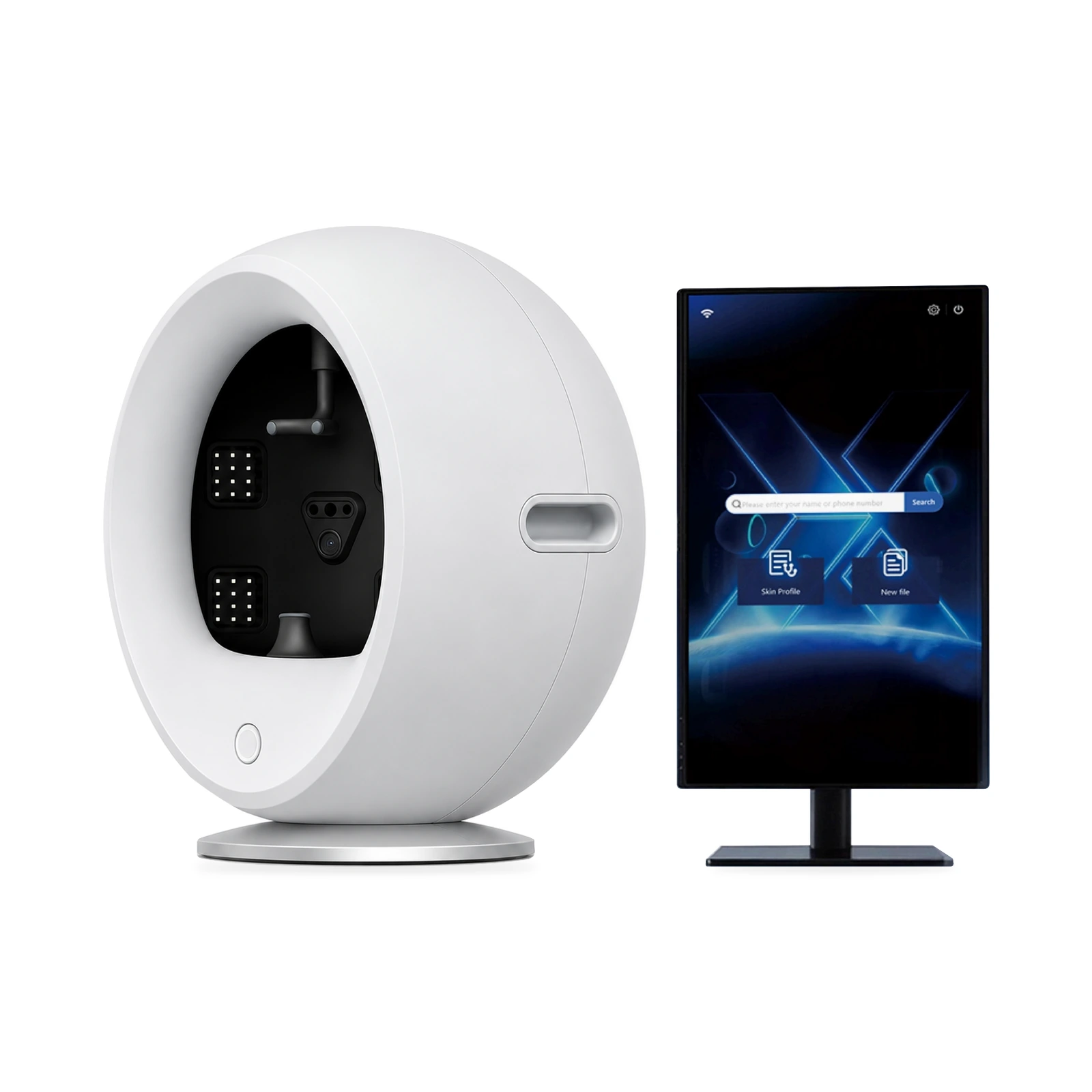
Both systems turn subjective mirror checks into clear visual conversations. Here is how Canfield VISIA 3D and FotroAI 3D compare across five everyday clinic decisions.
3D Facial Models, Sự chính xác, and Contour Tools
FotroAI 3D combines structured-light projection with three synchronized 20 MP cameras—using large 1-inch CMOS light sensors to capture 45 million full-face 3D pixels—for a manufacturer-specified 0.2 mm surface reconstruction accuracy. During a Botox, dermal filler, thread-lift, hoặc Hifu (ultrasound skin-tightening) consult, you can turn one 3D face smoothly across front, angled (oblique), and side-profile views to talk through cheek volume, chin projection, and jawline balance.
Canfield VISIA 3D captures 2D, 3D, and video, standing out when your consultations center on virtual surgical previews. Its 3D Sculptor tools include automated facial measurements, a color distance map with one-click volume difference, a color-free Gray Mode for pure shape checks, and slider-based 3D simulation—such as previewing nose reshaping or cheek volume changes on screen. Canfield’s public VISIA 3D page does not list a millimeter reconstruction accuracy figure or camera megapixel count, while FotroAI 3D focuses on documenting real pre-treatment and follow-up 3D surfaces rather than predictive morphing sliders.
Lighting Modes, Skin Views, and Age Scoring
FotroAI 3D uses four physical camera light modes to generate eight skin views, adding a dedicated ánh sáng phân cực song song mode alongside natural RGB, phân cực chéo, và tia cực tím:
- Natural RGB and Parallel-Polarized light. Natural daylight-balanced light records baseline skin tone, visible spots, and post-acne marks, while parallel-polarized light boosts surface reflection so enlarged pores, oil shine, and fine lines stand out sharply.
- Cross-Polarized light, Red-Zone, Brown-Zone, and Red-Vein views. Cross-polarized light filters out surface glare so deeper redness, visible vessels, and uneven brown pigment show clearly across separate vascular and pigment maps.
- UV light and Grayscale view. UV light reveals fluorescence patterns and surface pigmentation, while grayscale strips away color so skin relief is easy to read—backed by 48-color ColorChecker calibration that keeps skin tones consistent from visit to visit.
Across those eight views, FotroAI 3D organizes routine skin reviews around five everyday concerns—acne blemishes, sắc tố không đồng đều, facial redness, lỗ chân lông mở rộng, and wrinkles—grading visible severity from mild to severe so providers can match skincare or light-based treatments clearly.
Canfield VISIA 3D uses three camera lights—standard white, phân cực chéo, và tia cực tím (including UV fluorescence to highlight porphyrins, the bacterial byproducts inside pores linked to acne)—paired with Canfield’s RBX technology to separate red and brown color signatures. VISIA 3D scores eight skin features, estimates TruSkin Age against Canfield’s multi-ethnic database, and adds AI lip and eyelash grading, aging simulation up to age 80, và một 200+ item product library. Independent clinical studies confirm strong repeatability on raw VISIA scores when head position stays strict, while noting that slight posture shifts and darker Fitzpatrick V–VI skin tones (deeper brown to very dark skin) can reduce scoring consistency (PMC VISIA repeatability study).
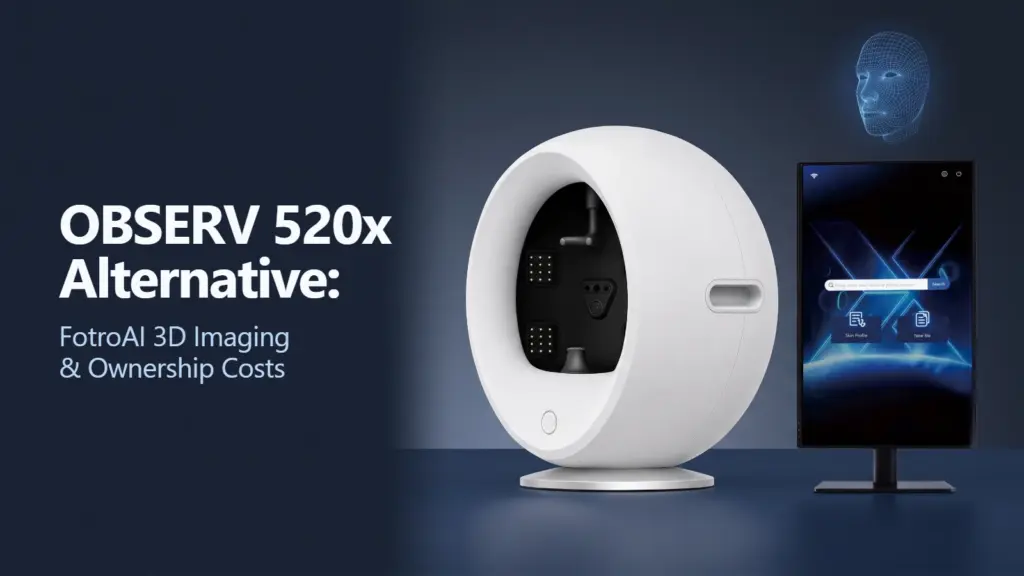
Clinics also evaluating hood-style multi-light booths can read our OBSERV 520x vs 3D skin analyzer comparison.
Before-and-After Screens and Client Sharing
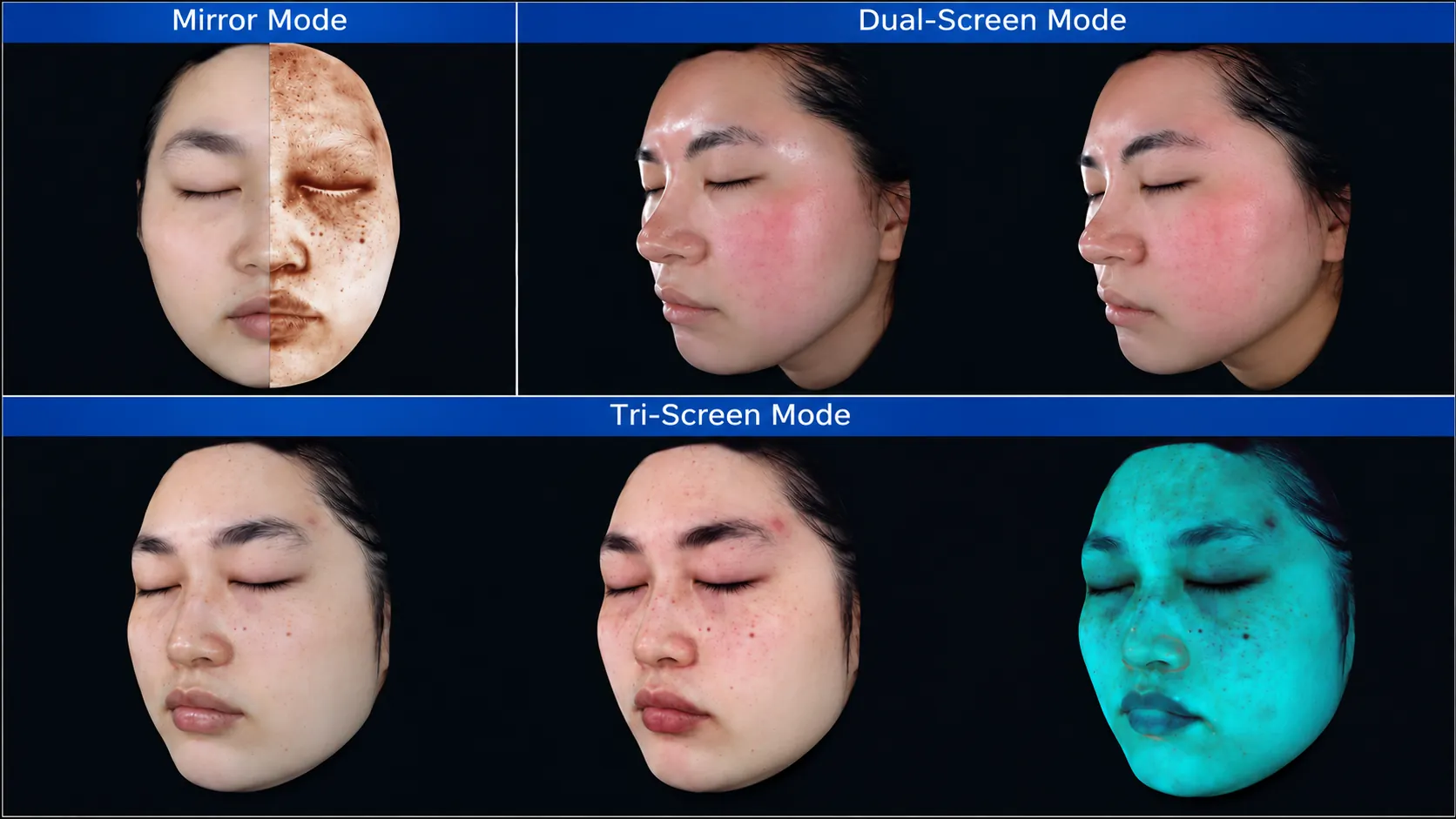
FotroAI 3D keeps chairside follow-ups straightforward with three screen layouts. Mirror Mode splits one face down the center to compare two light layers from the same visit, Dual-Screen Mode puts baseline and follow-up scans side by side, Và Tri-Screen Mode lines up three visit dates—such as pre-filler, two-week check, and three-month review—on one monitor.
Canfield VISIA 3D provides side-by-side 2D and 3D views, a drag slider that wipes across before-and-after changes, synchronized zoom, and printed reports. Clinics with an active Canfield Care plan can also upload consultation sessions to Canfield’s HIPAA-compliant ViewMyConsult web portal so patients can review their images and treatment notes at home.
Scan Speed, Room Size, and Computer Setup
FotroAI 3D completes an active full-face scan in 20 seconds once the patient is seated and aligned. The scanner measures 62.0 × 65.6 × 39.5 cm, weighs 10 kg on a tabletop or rolling cart, runs on a straightforward Windows 10 setup (Intel i5 processor, 16 RAM GB, built-in 512 GB SSD), and connects over either Wi-Fi or Ethernet. Fotromed also includes free one-to-one live video training and a 24-hour technical response commitment.
Canfield VISIA 3D uses a compact 9 kg tabletop pod (52.1 × 50.2 × 20.9 cm) and offers an optional 56.7 kg (125 lb) motorized Automated Lift Counter (111.1 × 43.8 cm floor footprint with the pod installed). Canfield does not list an active scan-second figure on its public page, and its hardware sheet requires a separate high-power computer plus hardwired room cabling.
Check computer and room wiring first
Canfield’s VISIA 3D specs require a separate Windows 11 Pro workstation (14th-Gen Intel Core i9 or Ultra 9, 32 RAM GB, 4 GB+ dedicated NVIDIA or AMD graphics card; Windows Home unsupported) hoặc a 2023+ Apple M3/M4 Mac with 32 RAM GB. You also need a 2.5 Gbps booth cable and a 1 Gbps wired office LAN because remote database access over Wi-Fi is unsupported, whereas FotroAI 3D runs on an Intel i5 / 16 GB spec with a 512 GB SSD over Wi-Fi or Ethernet.
Multi-Room Records and Clinic Software Links
FotroAI 3D stores images on its built-in 512 GB local SSD and links clinic branches through a unified multi-location patient database. Doctors and aestheticians can pull up client profiles on a PC, viên thuốc, web browser, or mobile mini program without paying per-seat software fees. Fotromed does not list pre-built links to named U.S. electronic medical record (EMR) platforms on its public page, and offers a custom API—a direct software bridge for exchanging patient records—on qualifying larger orders.
Canfield VISIA 3D recommends at least 500 GB of free disk space on the capture workstation and a 1 TB wired SQL Server (a dedicated local database server) for multi-room clinics; storing live databases on cloud drives such as AWS, Azure, or Google Cloud is unsupported. For practices running established U.S. aesthetic software, Canfield connects with Canfield Mirror software and offers documented integrations with PatientNow Pro, ModMed EMA, and TouchMD.
Canfield VISIA 3D vs FotroAI 3D Price, 3-Year Cost & ROI
Upfront Equipment Budgets and 3-Year Ownership Cost
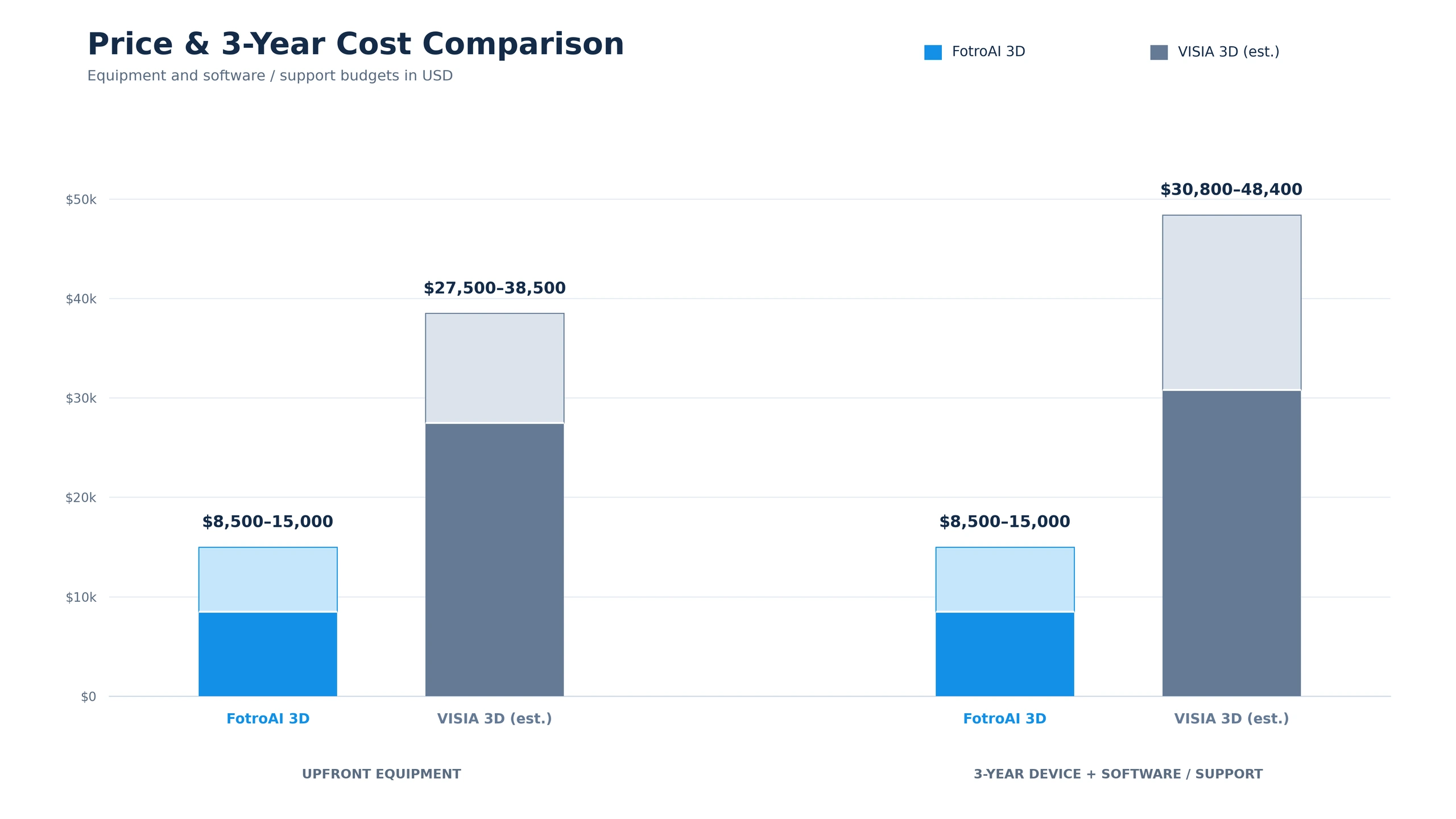
If you search online for “VISIA skin analysis cost,” most pages show the USD 50–200 fee a clinic charges a patient for a single facial scan (RealSelf VISIA session cost). Buying the machine for your clinic is a much bigger investment. Canfield quotes VISIA 3D privately after a sales demo, whereas Fotromed publishes a confirmed USD 8,500–15,000 equipment range for FotroAI 3D.
To see what each system costs to own over 36 months before tax, vận chuyển, or optional furniture, add three years of listed software or support renewals to the upfront device budget: 3-year subtotal = Upfront device budget + (3 × Yearly software or support fee).
| Cost item | Canfield VISIA 3D | FotroAI 3D |
|---|---|---|
| Upfront device budget | Xấp xỉ. USD 27,500–38,500 (ex-VAT estimate) | USD 8,500–15,000 (confirmed range) |
| Computer hardware | Separate Core i9 PC or 32 GB M3/M4 Mac | Published Intel i5 / 512 GB SSD spec |
| Yearly software & ủng hộ | Xấp xỉ. USD 1,100–3,300/yr (Canfield Care) | USD 0/year for included software |
| 3-year device + phần mềm | Xấp xỉ. USD 30,800–48,400 (before PC/tax) | USD 8,500–15,000 (before freight/tax) |
How we estimated VISIA 3D pricing
On November 18, 2026, we reviewed 49 public sources and recorded 32 giá cả. In its October 8 report, the Spanish Society of Aesthetic Medicine (SEME) listed EUR 25,000–35,000 before VAT for a full VISIA system with advanced modules and EUR 1,000–3,000 per year for maintenance and updates. At the November 17 European Central Bank reference rate of USD 1.0989 per euro, the rounded estimates are USD 27,500–38,500 for the system and USD 1,100–3,300 per year for maintenance and updates.
Before signing any order, ask each vendor for an itemized written USD quote confirming the scanner, tabletop stand or motorized counter, monitor and computer hardware, room network adapters, vận chuyển, thuế, warranty length, và đào tạo nhân viên (ECB daily reference rates). Our guide on what to look for when buying a skin analysis machine includes a practical demo checklist to bring to that call.
Payback Time and 1-Year Cash ROI Example
Payback time counts how many months of extra net cash flow it takes to earn back your upfront purchase price, and simple 1-year cash ROI shows how much of that upfront cost comes back within the first 12 tháng (CHÚNG TA. SBA break-even calculator, BDC payback guide).
Shared assumptions for this payback table
Suppose clearer 3D consults help a clinic book 20 extra paid treatments per month, keeping USD 50 per treatment after supplies and provider pay (USD 1,000 monthly margin) and spending USD 100 per month on power and routine care. That leaves USD 900 per month—or USD 10,800 per year—in net cash before software renewals. In the final row, adding a USD 2,000/year (USD 166.67/month) support contract trims net cash to USD 733.33 mỗi tháng (USD 8,800/year). Swap in your own monthly volume, PC cost, vận chuyển hàng hóa, and tax on your worksheet.
Payback (Tháng) = Upfront Equipment Cost ÷ Monthly Net Cash
1-Year Cash ROI (%) = [ (Annual Net Cash − Upfront Equipment Cost) ÷ Upfront Equipment Cost ] × 100%
| Hệ thống & price point | Chi phí trả trước | Payback | 1-year ROI |
|---|---|---|---|
| FotroAI 3D (thấp) | USD 8,500 | 9.4 tháng | +27.1% |
| FotroAI 3D (cao) | USD 15,000 | 16.7 tháng | −28.0% |
| VISIA 3D est. (thấp, $0/yr fee) | USD 27,500 | 30.6 tháng | −60.7% |
| VISIA 3D est. (cao, $0/yr fee) | USD 38,500 | 42.8 tháng | −71.9% |
| VISIA 3D est. (mid + $2k/yr Care) | USD 33,000 | 45.0 tháng | −73.3% |
At that same USD 900 monthly net cash flow, FotroAI 3D pays for itself in 9.4 ĐẾN 16.7 tháng, whereas a USD 27,500–38,500 hardware outlay pushes payback past 2.5 ĐẾN 3.5 years—even before adding a Core i9 workstation or annual support contract. Plug your clinic’s numbers into our skin analysis machine ROI calculation guide, or explore Fotromed’s full lineup of professional skin analysis machines to compare lighter tabletop options.
Which 3D Skin Analysis Machine Fits Your Clinic?
Choose Canfield VISIA 3D if your practice has a USD 30,000+ hardware and IT budget, relies on slider-based 3D surgical simulations (such as rhinoplasty or cheek volume previews), wants TruSkin Age peer percentiles and ViewMyConsult home portal access under an annual Canfield Care plan, or needs direct integrations with PatientNow Pro, ModMed EMA, or TouchMD over a hardwired gigabit network.
If your practice prioritizes verified 0.2 mm structured-light 3D contours, four camera lights (including parallel polarization for clear surface texture), straightforward three-visit Tri-Screen comparison, and flexible tablet access over office Wi-Fi—all within an accessible USD 8,500–15,000 budget with zero annual software subscription fees—FotroAI 3D delivers a practical, high-value alternative. Before finalizing your equipment decision, Bạn có thể schedule a live FotroAI 3D video demonstration and request an itemized USD quote to see firsthand how its 20-second capture and multi-view consultation flow fit your clinic’s daily routine.
Câu hỏi thường gặp
Does Canfield VISIA 3D capture true 3D images like FotroAI 3D?
Đúng. Both Canfield VISIA 3D and FotroAI 3D capture true 3D facial models. VISIA 3D adds slider-based 3D surgical simulations and automated volume maps, while FotroAI 3D uses structured light and three 20 MP cameras (0.2 mm specified accuracy) to document real baseline and post-treatment 3D contours alongside eight skin views.
How much does a Canfield VISIA 3D machine cost compared with a single patient scan?
Clinics typically charge patients USD 50–200 for a single VISIA consultation scan. Buying a complete Canfield VISIA system with advanced or 3D modules runs an estimated USD 27,500–38,500 before tax, computer hardware, and annual Canfield Care fees, compared with FotroAI 3D’s confirmed USD 8,500–15,000 equipment range.
Does FotroAI 3D charge monthly or annual software fees?
KHÔNG. FotroAI 3D includes its 3D facial imaging, eight-view skin analysis, and multi-location patient management software with USD 0 in monthly or yearly subscription fees, and its LEDs are rated for 10,000+ hours without per-scan disposables.
What computer and room internet setup do VISIA 3D and FotroAI 3D need?
Canfield VISIA 3D requires a separate Windows 11 Pro PC (14th-Gen Core i9, 32 RAM GB, 4 GB+ dedicated GPU) hoặc a 32 GB Apple M3/M4 Mac, Một 2.5 Gbps booth cable, và một 1 Gbps wired LAN because Wi-Fi remote database access is unsupported. FotroAI 3D runs on an Intel i5 / 16 GB configuration with a 512 GB local SSD and connects over Wi-Fi or Ethernet.
What does FotroAI 3D’s 0.2 mm accuracy and 20-second scan time cover?
Fotromed từ 0.2 mm figure is the manufacturer’s specification for recreating facial surface shape in one scan, Và 20 seconds covers the active camera capture once the patient is seated. During your demo, time the full visit from creating a client profile and pinning hair back to opening the 3D model on screen.
What should clinics confirm on a written FotroAI 3D or VISIA 3D quote?
Ask for an itemized USD quote listing the scanner, stand or motorized lift counter, display monitor and computer specs, network adapters, vận chuyển, sales tax or import duties, warranty term, live staff training, and any Year-2 software or support renewal fees.
Tài liệu tham khảo & Nguồn
- Fotromed FotroAI 3D Skin Analysis Machine product page and technical specifications
- Canfield Scientific official VISIA 3D features, workstation, and network specifications
- Canfield Scientific ViewMyConsult patient portal and Canfield Care overview
- Canfield Scientific Mirror medical imaging software overview
- Landsberg First Class Aesthetic March 2026 VISIA 3D product release
- PubMed validation study on 3D structured-light facial surface imaging
- PubMed Central clinical evaluation of Canfield VISIA repeatability and positioning sensitivity
- Spanish Society of Aesthetic Medicine (SEME) October 2026 comparative analysis and European pricing review
- European Central Bank daily euro foreign exchange reference rates (November 17, 2026)
- PatientNow Help Center guide to PatientNow Pro and Canfield integration
- ModMed synapSYS marketplace listing for Canfield VISIA integration
- TouchMD official partner integrations directory including Canfield
- RealSelf patient cost overview for single-session VISIA skin analysis
- CHÚNG TA. Small Business Administration break-even point calculator
- Business Development Bank of Canada (BDC) financial analysis and payback guide