Fractional CO2 laser systems for medical spas now span a price range from roughly $4,500 kết thúc $150,000 — a 30× spread that reflects channel structure and brand positioning as much as the underlying technology. Đối với chủ phòng khám, medspa operator, or distributor evaluating an entry-tier purchase, the practical question is not “what is the cheapest device” Nhưng “what is the lowest total cost of ownership that still meets FDA or CE clearance for my indications and serves my patient population safely.”
This guide covers 2026 pricing tiers across the affordable-to-premium spectrum, a 5-year total cost of ownership (TCO) breakdown that most quotes leave out, break-even math for a representative medspa, safety considerations for clinics serving darker skin types, and a procurement checklist of what to verify before signing a purchase order.
At-a-glance: What Makes a Fractional CO2 Laser “Medical-Grade” TRONG 2026
Before getting into shortlists or prices, three technical and regulatory baselines separate a medical-grade fractional CO2 laser from a consumer-tier device. A system that fails any of these is not affordable — it is unsellable in a clinical setting.
| Đường cơ sở | What to Confirm | Tại sao nó lại quan trọng |
|---|---|---|
| Regulatory clearance | FDA 510(k) clearance for US use, or CE marking under EU MDR for European use, with the specific indications documented | A device cleared only for “general cosmetic use” cannot be billed for scar revision, gynecological applications, or surgical incision |
| Laser source | 10,600 bước sóng nm, RF metal tube (not glass tube), rated 15,000+ operating hours | Glass-tube systems degrade rapidly and produce inconsistent fluence over time; this is covered in detail later in the guide |
| Scanning system | Galvo-based fractional scanner with adjustable density, độ sâu, and ideally a randomized scanning pattern | Required for safe protocols on Fitzpatrick III–VI skin types and for variable treatment depth |
các 2026 market spans roughly $4,500 kết thúc $150,000 for systems that meet all three baselines. The remainder of this guide explains where in that range to look for what, and what to verify before signing.
Cái gì “Có thể chi trả” Actually Means in This Category
“Có thể chi trả” is one of the most abused words in aesthetic-device marketing. Đối với người mua B2B, only one definition matters: the lowest total cost of ownership that still meets clinical and regulatory requirements for your market.
That means three non-negotiables before price even enters the conversation:
- Regulatory clearance for your target market. US clinics need FDA 510(k) clearance for the indications they’ll bill. EU clinics need CE marking under MDR. Other markets accept one or both, plus local registration. A device that’s cheap but holds neither is not affordable — it is unsellable.
- Medical-grade construction. RF metal tube laser source (not glass tube), articulated arm with Galvo scanning (not stamping pattern), proper smoke evacuation compatibility, and a documented tube lifespan of at least 15,000 giờ.
- Manufacturer or distributor service that will actually answer a phone call when something fails in month 14.
A fractional CO2 system that satisfies all three at the $4,500–$7,000 level is achievable through a B2B direct-sourcing model — the supply structure the next section describes.
How Fotromed’s B2B Direct Pricing Works
The $4,500–$7,000 acquisition range for the CeloLaser CO2 reflects a B2B direct-sourcing model rather than a traditional distributor relationship. Three structural choices keep the entry-tier price viable without compromising on FDA 510(k) clearance or medical-grade construction.
Single-unit MOQ with full customization included. Fotromed accepts orders of one unit, including configuration choices — handpiece set, scan-tip set, voltage configuration, and language interface — without minimum-order penalties. This is meaningful for startups buying their first system, and for established clinics adding a second machine without committing to bulk inventory.
Global warehouse network with 1–2 month lead time. Fotromed maintains regional inventory across major markets. The typical timeline from purchase order to delivery is 4–8 weeks, including production scheduling, customs handling, and final shipping — coordinated through a single channel rather than handed across multiple intermediaries.
Direct supplier-to-buyer service and training relationship. Warranty handling, parts replacement, and operator training are coordinated through one point of contact with the supplier, rather than routed through a separate regional distributor’s service desk.
This model is not the right fit for every buyer. Clinics that strongly prefer a local technician on a 24-hour service SLA, or that need bundled financing through a US- or EU-based brand, are usually better served by traditional distributor channels at their corresponding price points. The B2B direct model serves a different procurement profile — operators who prioritize unit economics, cấu hình linh hoạt, and a single accountable supplier over local channel familiarity.
Notable Fractional CO2 Laser Systems on the Market
The fractional CO2 category includes a wide range of systems from B2B suppliers, mid-tier distributor-channel brands, and premium imported platforms. The table below lists notable systems by origin and distinguishing features. Acquisition prices vary substantially by region, cấu hình, and channel — confirm current pricing directly with each supplier.
| Hệ thống | Origin | Notable Features |
|---|---|---|
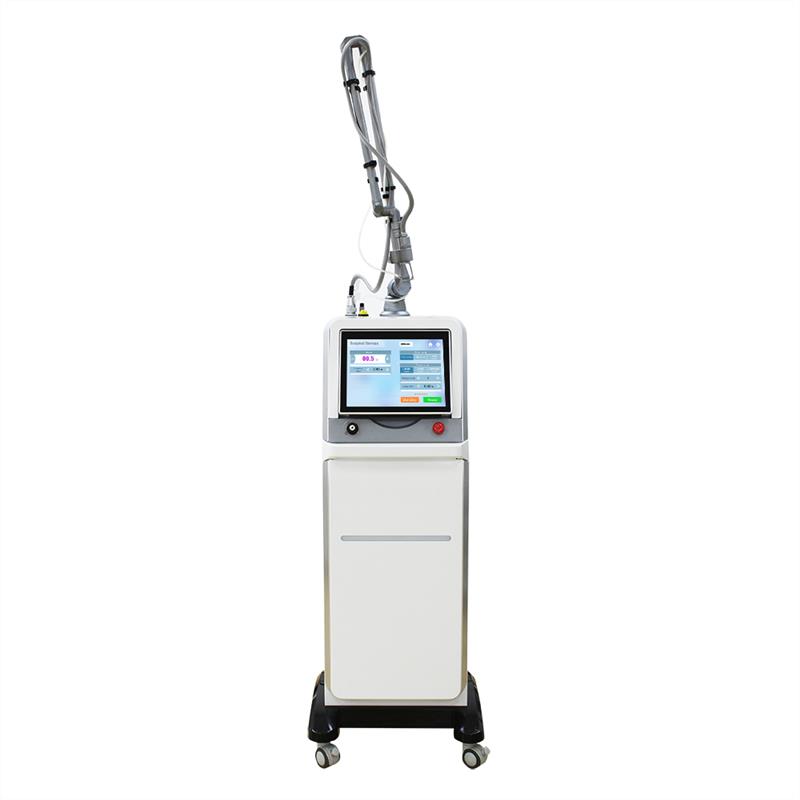
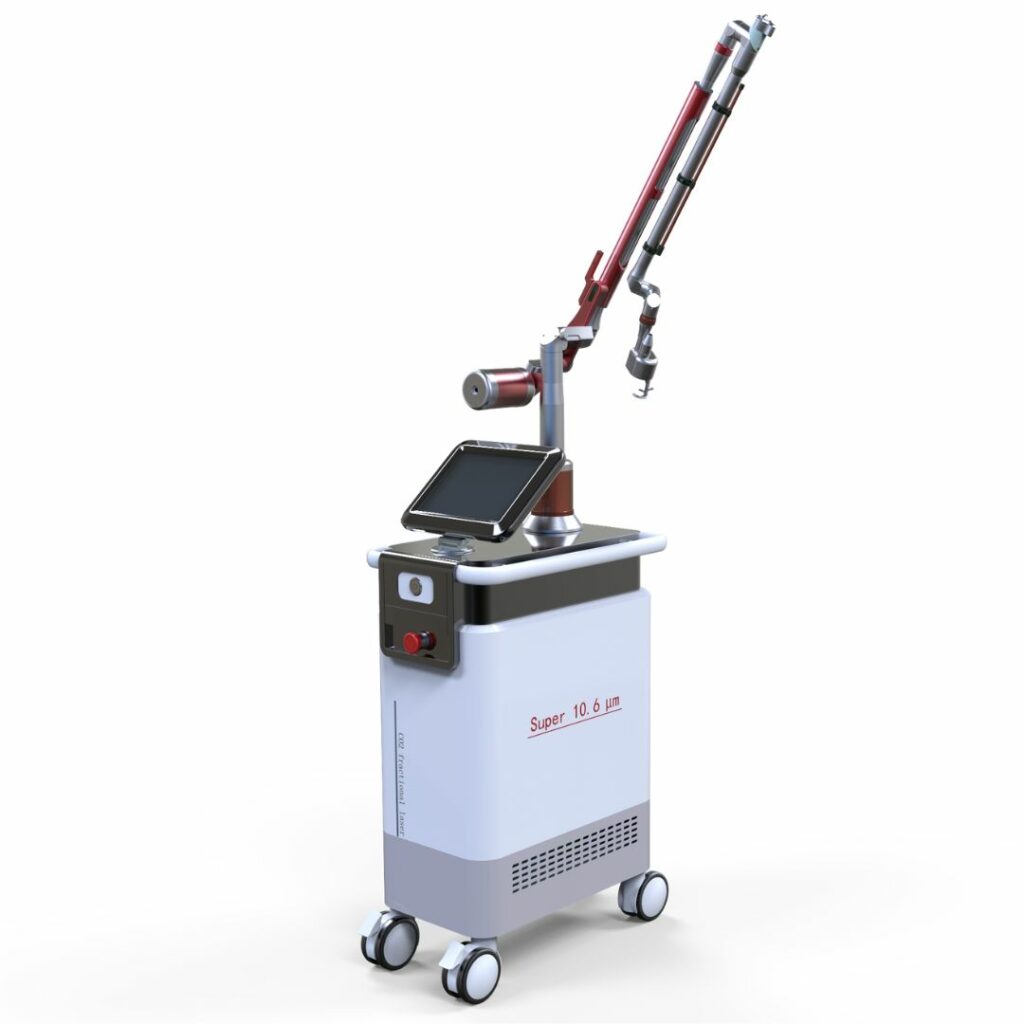
| Máy CeloLaser CO2 Fotromed | Trung Quốc (B2B direct) | 40 W RF metal tube, 10,600 nm; 7-joint Korean articulated arm with Galvo scanning; 4 tay khoan (phân số, phẫu thuật, vaginal, vulva); 4 scan tips spanning Ultra Ablative through Ultra Non-Ablative; rated 20,000+ hours tube life; FDA 510(k) cleared for skin resurfacing |
| Lutronic eCO2 | Hàn Quốc | Adjustable pulse profile; long track record in scar-revision clinical literature |
| DEKA SmartXide | Ý | SmartPulse and DOT scanning technologies; the MonaLisa Touch configuration is documented in peer-reviewed gynecological literature |
| GSD CO2 Fractional | Trung Quốc | Common in Asia-Pacific clinical markets; configurations vary by distributor |
| Lumenis UltraPulse | Hoa Kỳ / Israel | Deep-coring SCAAR FX handpiece; widely cited industry reference for severe scarring and full-face ablative resurfacing |
For startups and growing medspas, the practical decision is rarely “Fotromed vs Lumenis” — those are different procurement problems at different price points. The more relevant comparison is usually between a B2B direct-sourced medical-grade system and a distributor-channel mid-tier branded alternative reaching for similar clinical use cases.
For configuration details on Fotromed’s own systems, xem Máy Laser CO2 phân đoạn category page.
5-Year Total Cost of Ownership: What the Sticker Price Hides
Sticker price is a fraction of what a CO2 laser will cost your spa across its operating life. Here is the realistic breakdown, drawing on published industry guides and Fotromed’s own supplier data.
| Danh mục chi phí | Năm 1 | Years 2–5 (Cumulative) | Ghi chú |
|---|---|---|---|
| Acquisition (CeloLaser CO2 mid-config) | $5,500 | - | Single capital expense |
| Laser tube refill / replacement | $0 (under warranty) | $0–$2,000 | RF metal tubes typically rated 15,000–20,000+ hours; glass tubes need replacement every 1,500–2,000 hours |
| Annual calibration & preventive service | $300–$800 | $1,200–$3,200 | In-house with manufacturer training, or paid service visit |
| Protective lens / handpiece consumables | $150–$300 | $600–$1,200 | Replaced 1–2× per year in moderate-volume clinics |
| Laser Safety Officer training (initial + làm cho khỏe lại) | $400–$800 | $400–$800 | Per ANSI Z136.3 standard |
| Disposable treatment supplies (gauze, kem gây tê, chăm sóc sau) | $1,500–$3,000 (volume-dependent) | $6,000–$12,000 | Scales with patient throughput, not machine cost |
| Điện | $200–$400 | $800–$1,600 | 1.5–2 kW operating draw |
| 5-Year TCO (mid-config, moderate volume) | - | $9,000 - $20,000 | Total acquisition + 5 years of ownership |
Two observations matter more than the totals.
Đầu tiên, fractional CO2 is one of the lowest-consumable laser modalities on the market. Unlike RF microneedling (single-use tips at $30–$80 per patient) or some hair-removal platforms (cooling-gel and crystal replacement), a properly maintained CO2 laser has almost no per-patient consumable cost. The economics improve, not degrade, with volume.
Thứ hai, the gap between a $5,500 acquisition and a $35,000 acquisition does not close over time — operating costs are similar in both cases, so the up-front spread is the lifetime spread. This is why factory-direct, when the regulatory and service requirements are met, is structurally advantaged.
Real Break-Even Math for a CeloLaser CO2 in a Growing Medspa
A useful B2B article quantifies payback. Here is the calculation, with sources for the per-session revenue assumption.
Inputs (conservative):
- Acquisition cost: $5,500
- Annual fixed operating cost (calibration, vật tư tiêu hao, điện, LSO): ~$1,500
- Average revenue per full-face fractional CO2 session in 2026: $1,500–$3,500 (per HuiMain 2026 cost analysis and Cocoon clinical ROI guide)
- Per-session variable cost (kem gây tê, gauze, post-care kit): ~$50–$100
- Net contribution per session at $1,500 bán lẻ: ~$1,400
Break-even:
- Sessions to recover acquisition: $5,500 ÷ $1,400 ≈ 4 phiên
- Tại 1 session per week: payback in ~1 month
- Tại 2 phiên mỗi tuần: payback in ~2 weeks
- First-year ROI at 2 buổi/tuần: roughly 2,400%
Để so sánh, the same math applied to a hypothetical premium-channel acquisition of $60,000 requires roughly 43 sessions to break even — about 5–6 months at the same throughput. Both can be profitable practices; the entry-tier system is simply less exposed to cash-flow risk during the patient-acquisition ramp-up phase. các $60,000 figure here is illustrative only; current pricing for any specific premium platform should be confirmed directly with the manufacturer.
These figures are illustrative and depend on local pricing, khu điều trị, and patient volume — but the order-of-magnitude conclusion holds.
RF Metal Tube vs Glass Tube: The Lifespan Economics
If you have shopped at the very bottom of the market — sub-$3,000 units on B2B marketplaces — you have probably seen “fractional CO2 lasers” với glass tube laser sources. These are not the same product category as medical-grade machines, and the long-term cost math is unforgiving.
| Thành phần | RF Metal Tube (medical-grade) | Glass Tube (entry consumer-grade) |
|---|---|---|
| Rated lifespan | 15,000–20,000+ hours | 1,500–2,000 hours |
| Chi phí thay thế | $1,500–$3,000 per unit | $800–$1,500 per unit |
| Replacements over 5 năm (moderate clinical use ~2,000 hrs/yr) | 0–1 | 5–7 |
| 5-year tube replacement total | $0–$3,000 | $4,000–$10,000+ |
| Beam stability over lifespan | Cao; FDA-cleared output range | Degrades; output drifts |
MỘT $2,500 glass-tube unit can easily cost $12,500+ over five years once tube replacements, thời gian ngừng hoạt động, and inconsistent clinical results are accounted for. MỘT $5,500 RF-metal-tube system with zero tube replacements stays at $5,500.
The lesson is not “cheap is bad.” The lesson is that the laser source is the single component that most determines lifetime cost. Always confirm laser-source type in writing before placing an order.
Safety in Fitzpatrick Skin Types III–VI: An Underdiscussed Procurement Criterion
If your clinic serves a market with significant proportions of patients in Fitzpatrick skin types III through VI — most of Latin America, Trung Đông, South Asia, Đông Nam Á, and significant immigrant populations in Western markets — this is the single most important selection criterion that almost no buyer’s guide discusses.
The dominant clinical risk in fractional CO2 resurfacing on darker skin is tăng sắc tố sau viêm (PIH). Peer-reviewed dermatology literature has documented elevated PIH risk in Fitzpatrick III–VI patients undergoing ablative fractional resurfacing, and the mitigation strategies are well-established: lower fluence, mật độ thấp hơn, randomized scanning patterns (rather than sequential), and adequate inter-treatment intervals. (Nhìn thấy Alexis et al., 2017, summarizing laser safety considerations across the Fitzpatrick scale.)
What this means for procurement:
- Randomized scanning pattern is not a marketing feature; it is the operational difference between safe and unsafe darker-skin protocols. Verify that the device’s scan controller offers it.
- Adjustable density and depth across at least three discrete levels (Ultra Ablative through Non-Ablative). A system that only offers fixed parameters cannot run conservative protocols.
- Pre-treatment with tyrosinase inhibitors (hydroquinon 4%, kojic acid, or equivalents) for 4–6 weeks is a clinic-side protocol, not a device feature — but the device must support the low-fluence settings the protocol requires.
The Fotromed CeloLaser CO2’s four scan-tip configurations (Ultra Ablative, Micro Ablative, Non-Ablative, Ultra Non-Ablative) and Galvo-based randomized scanning are specifically suited to mixed-skin-type clinical practice. This is genuinely a deciding factor in markets like Brazil, the Gulf states, và Ấn Độ, and we mention it because most buyer guides written for US dermatology omit it entirely.
What to Ask Before You Sign a Purchase Order (RFQ Checklist)
Most buying mistakes in this category are not made at the demo. They are made in the silence between the demo and the wire transfer, when the questions that should have been asked never get asked. Here is what to put in writing before you commit.
- FDA 510(k) clearance status and the specific indications it covers. Da tái tạo bề mặt, surgical incision, and vaginal/gynecological applications are separate clearances — confirm the device is cleared for the procedures you intend to bill.
- CE certificate (if EU-bound) — full document, not a screenshot of a logo. Note the notified body number.
- Laser source type, rated wattage, and rated tube hours. RF metal vs glass — get it in the spec sheet.
- Articulated arm joint count and origin. Seven-joint Korean arms are the current industry reference; lower joint counts limit working angles.
- Scanning system. Galvo with randomized pattern, or stamping. Required for safe darker-skin practice.
- Included handpieces, mẹo quét, and any required upgrades to perform the procedures your business plan calls for. Vaginal handpieces in particular are often a separate SKU.
- Warranty terms — what is covered (laser source? arm? scanner?), for how long, and the response-time commitment for warranty repairs.
- Training included vs paid (in-person, virtual, certification documentation provided).
- Lead time from PO to delivery, customs handling, who acts as importer of record.
- Local regulatory registration support — for non-US/EU markets, ask whether the manufacturer assists with ANVISA (Brazil), SFDA (Saudi Arabia), TGA (Úc), CDSCO (Ấn Độ), or the equivalent in your market.
A supplier who answers these in writing without hedging is a supplier worth buying from. A supplier who deflects on any of them is a supplier you will regret in month 14.
Câu hỏi thường gặp
What makes a fractional CO2 laser system “có thể chi trả” for a medical spa?
Affordable means the lowest total cost of ownership consistent with FDA or CE clearance for the indications you intend to bill. TRONG 2026, B2B direct-sourced medical-grade systems with FDA 510(k) clearance start around $4,500, while distributor-channel and premium imported platforms span a much wider range that includes brand, R&D, and local-service infrastructure costs.
Is a $5,000 fractional CO2 laser actually FDA cleared?
Đúng. Several B2B medical-grade fractional CO2 systems in the $4,500–$7,000 range hold FDA 510(k) clearance for skin resurfacing, chỉnh sửa vết sẹo, and related indications. The price reflects supply-chain structure — direct B2B sourcing rather than distributor or premium-brand channels — not regulatory status. Always request written documentation of the cleared indications before purchase.
Máy laser CO2 phân đoạn tồn tại được bao lâu?
A medical-grade system with an RF metal tube typically has a 15,000–20,000+ hour laser source lifespan, equivalent to 7–10 years of moderate clinical use. Glass-tube systems last 1,500–2,000 hours and require frequent tube replacement that erodes their initial price advantage.
What is the real ROI on a fractional CO2 laser for a medspa?
At an acquisition cost of $5,500 and an average per-session revenue of $1,500, the unit pays for itself in approximately 4 full-face sessions. A clinic running 2 sessions per week recovers acquisition cost in roughly 2 tuần, with first-year ROI exceeding 2,000%.
Can a fractional CO2 laser safely treat darker skin types?
Đúng, with appropriate protocols. Devices must offer adjustable density, multiple ablation depths, and randomized scanning patterns. Operators must use conservative fluence and pre-treat with tyrosinase inhibitors for 4–6 weeks. Without these safeguards, post-inflammatory hyperpigmentation risk is elevated in Fitzpatrick III–VI patients.
What is the annual maintenance cost of a fractional CO2 laser?
Realistic annual operating cost for a moderate-volume clinic is $1,500–$3,000, covering calibration, lens/handpiece consumables, điện, and LSO certification. RF metal tube systems require no annual tube replacement, unlike glass-tube alternatives.
Should I buy new or refurbished?
New is the default recommendation for any clinic relying on this machine for revenue. Refurbished systems often carry voided manufacturer warranties, unverifiable usage hours, and degraded laser sources. The savings versus a factory-direct new unit are usually under $2,000, which does not compensate for the service risk.
About This Guide
This guide was prepared by the Fotromed editorial team using Fotromed’s manufacturing and after-sales records, public FDA 510(k) and CE registration databases, peer-reviewed clinical literature on fractional CO2 resurfacing, and 2025–2026 cost data published by independent industry sources. Acquisition prices in the $4,500–$7,000 range refer to Fotromed factory-direct pricing for the CeloLaser CO2; competitive ranges are indicative and sourced from publicly available distributor and clinic data current as of June 2026.
Fotromed is a Chinese B2B manufacturer of FDA 510(k)-cleared and CE-marked medical-aesthetic devices, supplying clinics, thuốc điều trị, và nhà phân phối tại 30+ các nước. The angles in this guide that are described as Fotromed operator experience reflect our own factory and after-sales observations and are labeled as such.
Ready to Compare CeloLaser CO2 With Your Current Shortlist?
Request a configuration quote, FDA 510(k) tài liệu, and a written response to the RFQ checklist above. We respond within one business day with full specifications, regulatory documents, and a per-unit price quote — no distributor in between.
Browse current configurations on the Máy Laser CO2 phân đoạn page or contact Fotromed directly via fotromed.com.
Tài liệu tham khảo & Sources
- CHÚNG TA. Cục Quản lý Thực phẩm và Dược phẩm. 510(k) Cơ sở dữ liệu thông báo tiếp thị trước. https://www.accessdata.fda.gov/scripts/cdrh/cfdocs/cfpmn/pmn.cfm
- Laser Institute of America. ANSI Z136.3 — Safe Use of Lasers in Health Care. https://www.lia.org/resources/laser-safety-information/laser-safety-resources/ansi-z1363
- Alexis, A.F., et al. Laser hair removal and other aesthetic procedures in skin of color: Selection criteria, technique modifications and safety considerations. J Clin Aesthet Dermatol, 2017. https://www.ncbi.nlm.nih.gov/pmc/articles/PMC5675578/
- Roohaninasab, M., et al. Efficacy of fractional CO2 laser in combination with stromal vascular fraction (SVF) compared with fractional CO2 laser alone in the treatment of burn scars: a randomized controlled clinical trial. Stem Cell Res Ther, 2023. https://www.ncbi.nlm.nih.gov/pmc/articles/PMC10518108/
- Lee, S.Y., et al. Fractional CO2 Laser Treatment Is Safe and Effective for the Management of Genitourinary Syndrome of Menopause in Korean Women. PMC, 2023. https://www.ncbi.nlm.nih.gov/pmc/articles/PMC10254000/
- Cocoon Laser. Cost of Professional CO2 Laser Machine: 2025 Clinical Deep Dive & ROI Guide for Clinics. https://www.cocoonlaser.com/cost-of-professional-co2-laser-machine-2025-clinical-deep-dive-roi-guide-for-clinics/
- HuiMain Beauty. CO₂ Fractional Laser: Chi phí & Những lợi ích 2026. https://www.huimainbeauty.com/bolg/co2-fractional-laser-machine-costs/