Choosing the best professional HIFU machine for a clinic is difficult because the differences that affect daily operation are often split across separate quotations, brochures, cartridges, training plans, warranties, and regulatory documents. In 2026, buyers should compare treatment depths, guidance features, cartridge life, training, after-sales support, and local-market documentation instead of treating labels such as 4D, 7D, 12D, or MPT as proof of performance.
This guide combines Fotromed’s experience in aesthetic-equipment selection, customer consultation, OEM/ODM customization, and international delivery with model-specific technical and regulatory evidence. It compares 10 HIFU machine brands and models—six established international platforms and four direct-from-China machines—across the same 10 purchasing dimensions. Buyers can first review our HIFU machine range to understand the available configurations, then remove machines that do not fit their treatment menu or budget and take two or three finalists into demonstrations, like-for-like quotations, and document review.
Quick Answer
- Work backward from the treatment menu. Facial lifting, body contouring, and combination treatments require different depths, applicators, and workflows.
- Do not use marketing labels as performance grades. A larger “D” number or more cartridges does not replace a comparison of firing modes, energy control, treatment areas, and operator guidance.
- Consumables determine long-term margin. Cartridge life, replacement price, and shots used per treatment must be calculated with the console price.
- Training, service, and spare parts affect utilization. A machine only produces revenue when the team can operate it consistently and obtain cartridges, repairs, and parts without long interruptions.
- Reduce the final shortlist to two or three machines. Ask each supplier for the same quotation format, then compare demonstrations, training, warranties, consumables, and model-level documents.
What Is a Professional HIFU Machine?
A professional HIFU machine is a high-intensity focused ultrasound system operated by trained staff in a clinic or Med Spa, with selectable treatment depths, energy, and shot settings for specific tissue layers, plus a defined supply path for training, cartridges, technical service, and local-market documents.
For a buyer, “professional” means more than higher power or more applicators. Before treatment, a trained operator must assess laxity, fat thickness, facial anatomy, and contraindications, then select the appropriate depth, energy, and number of shots. Common facial cartridges include 1.5, 3.0, and 4.5 mm for superficial and deeper dermal or subcutaneous targets and the SMAS/fascial layer. Deeper body cartridges may support contouring, but only when that use is included in the exact model’s intended treatment range.
Results also need to be assessed over time. Collagen remodeling develops gradually, so tightening and contour improvement may become more visible over several weeks or months. A 2026 prospective study in Lasers in Medical Science recorded measurable change at one month, the strongest overall improvement at three months, and follow-up through six months after one MFU treatment. A practical clinic protocol is to retain baseline photographs and reassess at one, three, and six months rather than promise one fixed timeline for every patient.
Home-use beauty devices do not provide the same operating framework. A consumer cannot reliably identify tissue layers, screen contraindications, control depth and dose across different areas, or maintain standardized imaging and follow-up alone. Home-use HIFU devices also lack the training, consumable supply, repair pathway, and model-level market documentation required for a clinic-grade service.
In practical terms, a professional HIFU machine should provide a clear treatment target, defined depths, controllable parameters, a repeatable workflow, reviewable results, and ongoing training and support. If a supplier cannot answer these questions clearly, a larger “D” number or a longer cartridge list does not make the machine more professional.
How We Selected and Scored These HIFU Machines
The machines are not ordered by brand popularity. The shortlist covers different professional purchasing routes: premium reference platforms, multi-mode systems, combination-technology devices, compact machines, and direct-factory models.
Each machine receives a purchasing decision score out of 30. The 10 dimensions come from our work in aesthetic-equipment selection, treatment configuration, OEM/ODM projects, and after-sales delivery. Model-specific technical documents, regulatory records, and clinical sources were used to calibrate key facts. The score helps buyers compare capability, ownership cost, and long-term operating conditions before choosing which machines should enter the demonstration and quotation stage.
| Score | Meaning |
|---|---|
| 0 | The official site does not disclose the information, or no evidence tied to the exact model was located. |
| 1 | Basic capability is present, but the range or purchasing advantage is limited. |
| 2 | The capability is clearly defined and supports routine professional use. |
| 3 | The capability is a clear purchasing advantage within this comparison. |
The 10 dimensions are treatment guidance, core technology, treatment depths and applicator range, facial and body treatment breadth, workflow and safety control, consumable cost, training and after-sales support, supply and spare-parts continuity, exact-model FDA/CE evidence, and OEM/ODM or configuration customization. “Training and after-sales support” covers training, warranty, repair, and technical response. “Supply and spare-parts continuity” covers authorized or factory-direct supply, cartridges, parts, and the ability to support buyers across regions.
Why is treatment comfort not included in the total score? Buyers often ask how UltraLift SD Compact compares with conventional HIFU in comfort. We can describe our own testing, applicator design, and customer feedback, but we cannot test the other nine machines on the same people, area, energy, and protocol. Comfort is therefore kept outside the score. Clinics should compare it during shortlisted-machine demonstrations using the same area and closely matched settings.
Top 10 Best Professional HIFU Machines for Clinics in 2026
1. Ultherapy PRIME
Ultherapy PRIME is a key reference for clinics that place treatment visualization ahead of cartridge count. The system uses real-time ultrasound imaging so the operator can view tissue layers while planning and delivering treatment. Six DeepSEE transducers cover treatment depths of 1.5, 3.0, and 4.5 mm, with visualization to a maximum depth of 8 mm.
The professional materials also list the face, neck, décolletage, upper arms, abdomen, and knees. Buyers should evaluate the premium platform investment together with the ongoing cost of proprietary transducers and the availability of authorized service in their market.
Machine purchasing checklist
- Purchasing focus: whether real-time imaging will be incorporated into the clinic’s standard workflow, and the long-term cost of proprietary transducers and authorized service
- Configuration: six transducers; 1.5, 3.0, and 4.5 mm treatment depths
- Main difference: real-time ultrasound visualization
| Scoring dimension | Score | Basis |
|---|---|---|
| Treatment guidance | 3 | DeepSEE displays tissue layers in real time, with visualization to 8 mm. |
| Core technology | 2 | Microfocused ultrasound combined with DeepSEE ultrasound imaging. |
| Depths and applicators | 2 | Six transducers cover 1.5, 3.0, and 4.5 mm treatment depths. |
| Face and body breadth | 3 | Listed areas include the face, neck, décolletage, upper arms, abdomen, and knees. |
| Workflow and safety control | 3 | Real-time ultrasound confirms tissue layers and transducer position before and during firing. |
| Consumable cost | 1 | DeepSEE transducers are proprietary and supplied through the Ultherapy/Merz network; rated line count is not disclosed on the official site. |
| Training and after-sales | 3 | Online and on-site clinical training, SPT courses, installation training, and continuing education are available. |
| Supply and spare parts | 3 | Authorized distribution, proprietary transducers, and the My Merz service system support supply. |
| Exact-model FDA/CE evidence | 3 | FDA: yes; K233996 identifies the PRIME control unit. CE: an exact-model certificate was not located on the official page. |
| OEM/ODM customization | 0 | This proprietary platform is not sold as a private-label or OEM/ODM route. |
Purchasing decision score: 23/30
2. Ultraformer MPT
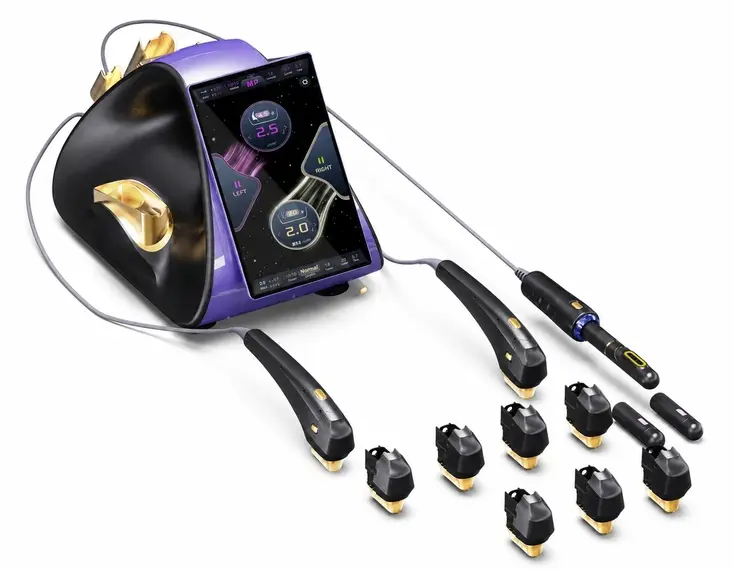
Ultraformer MPT is a useful reference for established clinics that want broad treatment coverage without making real-time imaging a primary requirement. The platform provides four treatment modes, a 2+1 handpiece configuration, 10 cartridges, and treatment depths from 1.5 to 13.0 mm. MP mode is designed for faster firing than Normal mode.
The range supports broader face-and-body planning than a facial-only platform. At 37 kg, however, it is a fixed-room system. Clinics should assess expected procedure volume, operator training capacity, cartridge inventory, and available floor space before paying for the full configuration.
Machine purchasing checklist
- Purchasing focus: whether four modes and 10 cartridges can be used across the existing service menu, and whether the treatment room can accommodate a 37 kg platform
- Configuration: four modes, 2+1 handpieces, 10 cartridges, 1.5–13.0 mm
- Main difference: multiple firing modes and a broad depth range
| Scoring dimension | Score | Basis |
|---|---|---|
| Treatment guidance | 1 | No real-time imaging or contact sensor is listed; the operator selects Normal, MP, and other modes with the corresponding cartridge on the console. |
| Core technology | 3 | Microfocused and macrofocused ultrasound with four modes, including Normal and MP. |
| Depths and applicators | 3 | Ten cartridges cover 1.5–13.0 mm. |
| Face and body breadth | 3 | Facial cartridges cover 1.5, 2.0, 3.0, and 4.5 mm; body cartridges cover 6.0, 9.0, and 13.0 mm. |
| Workflow and safety control | 2 | The 2+1 interchangeable handpieces support handpiece-button and foot-pedal triggering; MP mode fires 2.5 times faster than Normal mode. |
| Consumable cost | 1 | The platform uses 10 proprietary cartridge types; rated shots per cartridge are not disclosed on the official site. |
| Training and after-sales | 2 | Product consultation and dedicated service lines are available, but a model-specific standard training course is not published. |
| Supply and spare parts | 3 | CLASSYS provides head-office service contacts and an international distribution network. |
| Exact-model FDA/CE evidence | 2 | FDA: no verifiable 510(k) located. CE: yes; CLASSYS identifies Ultraformer MPT as CE MDR certified. |
| OEM/ODM customization | 0 | The platform is not positioned as a private-label or model-customization purchase. |
Purchasing decision score: 20/30
3. New Doublo 2.0
New Doublo 2.0 is a strong reference for buyers evaluating a multi-function workflow rather than comparing cartridge count alone. It combines MFU, RF, dot and linear firing, four handpieces, and 20 cartridges. An optional RM handpiece extends the platform into RF microneedling.
Contact sensing, movement sensing, and a handpiece display support day-to-day operation. These controls matter because clinical consistency depends not only on maximum depth, but also on how the system displays status, changes functions, and manages contact and movement during firing.
Machine purchasing checklist
- Purchasing focus: whether the handpieces, sensors, and optional RF microneedling can form a clear, sellable treatment menu instead of adding unused functions
- Configuration: MFU and RF, dot and linear firing, four handpieces, 20 cartridges
- Main difference: contact sensor, movement sensor, and secondary handpiece display
- Optional expansion: RM handpiece for RF microneedling
| Scoring dimension | Score | Basis |
|---|---|---|
| Treatment guidance | 2 | The handpiece display shows system status, while Auto and Manual modes provide settings for different treatment areas. |
| Core technology | 3 | MFU, RF, dot and linear firing, with optional RF microneedling expansion. |
| Depths and applicators | 3 | Twenty cartridges cover 1.5, 2.0, 3.0, 4.5, 6.0, and 9.0 mm. |
| Face and body breadth | 3 | MFU applicators cover facial and body contouring; the optional RM handpiece supports RF microneedling services for texture concerns. |
| Workflow and safety control | 3 | The contact sensor stops firing without skin contact, and the movement sensor helps prevent repeated firing on one spot. |
| Consumable cost | 3 | HIRONIC’s BuyKorea listing states 12,000–24,000 shots per cartridge. |
| Training and after-sales | 3 | H-Academy and a customer center are available; after-sales handling uses serial number and used-shot information. |
| Supply and spare parts | 3 | HIRONIC provides a global distributor network, customer center, and a two-year machine warranty policy. |
| Exact-model FDA/CE evidence | 2 | FDA: yes, but K251334 covers the RM handpiece only. CE: yes; the official site lists CE LVD. |
| OEM/ODM customization | 0 | The platform is not positioned as a private-label or OEM/ODM purchase. |
Purchasing decision score: 25/30
4. LinearZ
LinearZ is built around a clear operating difference: dot and linear ultrasound firing. Four adjustable-depth cartridge families cover 1.5–6.0 mm for the skin, SMAS, and subcutaneous fat, plus 9.0, 11.0, and 13.0 mm for deeper fat. This gives the platform a broad facial and body treatment range.
The handpiece LED displays mode, depth, and firing time, while cartridge-temperature information adds another layer of operator feedback. At 51 kg, LinearZ is a fixed-room clinic platform rather than a compact or portable machine.
Machine purchasing checklist
- Purchasing focus: the expected mix of dot and linear treatments, cartridge-temperature monitoring, and the floor space required for a 51 kg platform
- Depths: four adjustable cartridge families covering 1.5–6.0 mm, plus 9.0, 11.0, and 13.0 mm
- Weight: 51 kg
- Main difference: handpiece LED showing mode, depth, and firing time
| Scoring dimension | Score | Basis |
|---|---|---|
| Treatment guidance | 2 | The handpiece LED displays mode, depth, and current firing time. |
| Core technology | 2 | Focused ultrasound with dot and linear firing. |
| Depths and applicators | 3 | BASIC, ESSENTIAL, CORE, and CONTOUR cartridge families cover 1.5–13.0 mm. |
| Face and body breadth | 3 | Official uses include tightening, double-chin treatment, fat reduction, and thigh skin tightening. |
| Workflow and safety control | 2 | The handpiece shows transducer position and cartridge temperature; DWR stabilizes cartridge temperature and Z-shaped firing reduces end-point overlap. |
| Consumable cost | 1 | Four proprietary cartridge families are used. The official material states about 37 seconds per 100 shots but does not disclose rated total shots per cartridge. |
| Training and after-sales | 3 | An education calendar is published; new-equipment training is free and additional training can be requested. |
| Supply and spare parts | 3 | JEISYS operates an official store, customer service, and an after-sales service center. |
| Exact-model FDA/CE evidence | 0 | FDA: no verifiable 510(k) located. CE: not disclosed on the official site. Korea MFDS: yes. |
| OEM/ODM customization | 0 | The platform is not positioned as a private-label or model-customization purchase. |
Purchasing decision score: 19/30
5. Liftera 2
Liftera 2 is useful for buyers comparing two applicator styles. Its product information describes line-type and pen-type applicators, 1.5, 3.0, and 4.5 mm facial depths, and a 15-inch touchscreen. The brand also lists TDIP pulse thermal diffusion, TDT focused energy, and UDP digital energy control.
The operating difference is straightforward: the line applicator supports faster coverage, while the pen applicator provides another path for facial contouring and smaller areas. The value of the platform therefore depends on how a clinic assigns both applicators within its facial service menu.
Machine purchasing checklist
- Purchasing focus: how line and pen applicators will be assigned to full-face, contour, eye-area, and smaller precision treatments, and whether factory training covers both workflows
- Configuration: line and pen applicators; 1.5, 3.0, and 4.5 mm; 15-inch screen
- Main difference: pen-type applicator for localized operation
| Scoring dimension | Score | Basis |
|---|---|---|
| Treatment guidance | 1 | The 15-inch touchscreen is used to set parameters; line and pen applicators provide separate coverage and localized workflows. |
| Core technology | 3 | TDIP pulse thermal diffusion, TDT focused energy, and UDP digital energy control. |
| Depths and applicators | 2 | Line and pen applicators cover 1.5, 3.0, and 4.5 mm. |
| Face and body breadth | 2 | Bidirectional line and point applicators cover the eye area, facial contour, and full-face services. |
| Workflow and safety control | 2 | UDP digital control supports separate line and pen operating paths. |
| Consumable cost | 0 | Line and pen applicators use proprietary consumables; rated total shots are not disclosed by the official source. |
| Training and after-sales | 3 | The brand requires professional operators to complete formal Asterasys factory education. |
| Supply and spare parts | 2 | Supply is handled through local authorization and certified-clinic channels. |
| Exact-model FDA/CE evidence | 0 | FDA: no verifiable 510(k) located. CE: an exact-model certificate is not disclosed on the official site. |
| OEM/ODM customization | 0 | The platform is not positioned as a private-label or OEM/ODM purchase. |
Purchasing decision score: 15/30
6. Focus Dual
Focus Dual has a clearly defined combination-technology position. It combines HIFU with RF microneedling in one system; the RF function here uses microneedles rather than surface radiofrequency. The platform includes multiple HIFU focal depths, adjustable RF microneedling depth from 0.5 to 3.5 mm, vacuum-assisted needle contact, and the Safety Assist Transducer system for controlling HIFU overlap.
Its support program is also a meaningful difference. It includes clinical training, technical support, marketing materials, a customer portal, and six coaching sessions. For a clinic launching or expanding its service menu, this implementation support can be as important as the number of handpieces.
Machine purchasing checklist
- Purchasing focus: whether HIFU lifting and RF microneedling skin-quality services can form a profitable combination pathway, and whether the team needs clinical education and business coaching
- Configuration: multiple HIFU focal depths; 0.5–3.5 mm RF microneedling; vacuum-assisted RF microneedling
- Main difference: Safety Assist Transducer overlap control and a broad implementation-support package
| Scoring dimension | Score | Basis |
|---|---|---|
| Treatment guidance | 2 | The SAT system controls HIFU overlap, while vacuum supports stable RF microneedling contact. |
| Core technology | 3 | HIFU and vacuum-assisted RF microneedling form a two-technology platform. |
| Depths and applicators | 2 | HIFU covers 1.5, 3.0, 4.5, 6.0, and 13.0 mm; RF microneedling covers 0.5–3.5 mm. |
| Face and body breadth | 3 | HIFU supports tightening, fat reduction, and body contouring; RF microneedling supports services for acne scars, enlarged pores, and stretch marks. |
| Workflow and safety control | 3 | SAT overlap control, vacuum assistance, and adjustable RF microneedling depth are included. |
| Consumable cost | 0 | HIFU cartridges and RF microneedling tips are both proprietary consumables; rated life per item is not disclosed on the official page. |
| Training and after-sales | 3 | Focus Dual practical training, live-model sessions, continuing clinical education, and technical after-sales support are provided. |
| Supply and spare parts | 3 | Lynton provides installation, a customer portal, technical support, and continuing after-sales service. |
| Exact-model FDA/CE evidence | 2 | FDA: no verifiable 510(k) located. CE: yes; the product page describes the system as CE certified. |
| OEM/ODM customization | 0 | The platform is not positioned as a private-label or OEM/ODM purchase. |
Purchasing decision score: 21/30
7. Fotromed UltraLift SD Compact
Fotromed’s UltraLift SD Compact is designed for clinics, Med Spas, and distributors that want next-generation MFU+RF technology in a compact platform. The SD applicator combines MFU and bipolar RF in one handpiece. Its smaller, more precise focal points and more even energy distribution are designed to reduce the discomfort and swelling often associated with conventional HIFU. A separate FL linear HIFU handpiece supports faster coverage. The HIFU handpiece has its own touchscreen for viewing and adjusting treatment parameters without returning to the console.
Ten treatment heads cover 1.5–9.0 mm. A single cartridge supports up to 20,000 shots, a standard 300-shot treatment can be completed in about five minutes, and the machine weighs 15 kg. As a manufacturer certified to the ISO 13485 medical-device quality-management standard, Fotromed can customize the software interface, body logo, and exterior color. Delivery support includes step-by-step clinical guidance, one-to-one video training, and 24/7 technical after-sales assistance.
Machine purchasing checklist
- Purchasing focus: how next-generation MFU+bipolar RF and linear HIFU fit the service menu, and how 20,000-shot cartridges, compact size, and private-label customization affect operating value
- Configuration: next-generation MFU+bipolar RF, linear HIFU, 10 treatment heads, 1.5–9.0 mm
- Weight: 15 kg
| Scoring dimension | Score | Basis |
|---|---|---|
| Treatment guidance | 2 | The HIFU handpiece has a touchscreen for viewing and adjusting treatment parameters at the handpiece, reducing time spent returning to the console. |
| Core technology | 3 | Next-generation MFU+bipolar RF with linear HIFU. The FL handpiece creates smaller, more precise focal points than conventional HIFU for a more comfortable treatment experience. |
| Depths and applicators | 2 | Ten treatment heads cover 1.5–9.0 mm. |
| Face and body breadth | 3 | Depths from 1.5 to 9.0 mm cover superficial skin, dermis, fascia, and body-fat layers for facial lifting and body-contouring services. |
| Workflow and safety control | 2 | SD dot and FL linear handpieces divide precision treatment and rapid coverage, reducing mid-treatment applicator changes; about 300 shots can be delivered in five minutes. |
| Consumable cost | 2 | One cartridge supports up to 20,000 shots. |
| Training and after-sales | 3 | Step-by-step clinical guidance, one-to-one video training, and 24/7 technical after-sales support are provided. |
| Supply and spare parts | 3 | Fotromed supplies cartridges, spare parts, and OEM/ODM orders directly from the factory. |
| Exact-model FDA/CE evidence | 0 | FDA: no. CE: yes. |
| OEM/ODM customization | 3 | Software interface, logo, and exterior-color customization are available. |
Purchasing decision score: 23/30
8. PZLASER MFUpro
MFUpro is a direct-manufacturer option for buyers who want defined facial and body depths together with operator-control features. Ten cartridges cover 1.5–9.0 mm. The platform provides MFU and SD firing, a contact sensor, gyroscope-based movement detection, an oscillator, and a dedicated facial interface.
The manufacturer also offers OEM and ODM routes, partner training materials, professional support, 24/7 technical support, and after-sales service. Buyers can therefore compare sensor-assisted workflow, customization scope, and continued supply in the same quotation.
Machine purchasing checklist
- Purchasing focus: whether contact detection, movement detection, and facial-zone UI improve the team’s workflow, and whether the OEM/ODM configuration meets the target market
- Configuration: 10 cartridges, 1.5–9.0 mm, MFU and SD firing
- Main difference: contact sensor, gyroscope movement detection, oscillator, and dedicated facial UI
- Supply route: OEM and ODM options
| Scoring dimension | Score | Basis |
|---|---|---|
| Treatment guidance | 2 | The zone-based UI counts shots on the left and right sides of the face and shows reference settings after a cartridge change. |
| Core technology | 2 | MFU linear firing and SD overlapping firing. |
| Depths and applicators | 2 | Ten cartridges cover 1.5–9.0 mm. |
| Face and body breadth | 2 | 2.0 mm is listed for the forehead, neck lines, and eye area; 6.0 mm for double chin, arms, and chest side; 9.0 mm for abdomen, flanks, and inner thighs. |
| Workflow and safety control | 3 | Contact detection, movement detection, an oscillator, and a dedicated UI are documented. |
| Consumable cost | 1 | Ten proprietary cartridge types are used; rated shots per cartridge are not disclosed on the official site. |
| Training and after-sales | 3 | Training, educational materials, continuing professional support, and 24/7 technical after-sales service are available. |
| Supply and spare parts | 3 | Factory-direct supply is combined with dedicated partner support and OEM/ODM fulfillment. |
| Exact-model FDA/CE evidence | 1 | FDA: no verifiable 510(k) located. CE: yes; the manufacturer states EU CE. |
| OEM/ODM customization | 2 | Housing, color, and model customization are available. |
Purchasing decision score: 21/30
9. HUIMAIN 7D HIFU
HUIMAIN 7D HIFU focuses on broad treatment depths and customization. Its product page lists cartridges from 1.5 to 16.0 mm, facial and body applications, multi-line firing, and touchscreen operation. The manufacturer can also customize the logo, exterior, functional parameters, and interface language through OEM and ODM.
The treatment range and customization path are clear, but the official site does not state rated shots per cartridge. Long-term consumable cost is therefore the main missing figure when comparing this machine with other factory-direct options.
Machine purchasing checklist
- Purchasing focus: whether the 1.5–16.0 mm range matches the planned service menu, and how far the logo, interface language, exterior, and functional modules need to be customized
- Configuration: multi-line HIFU, 1.5–16.0 mm cartridges, touchscreen console
- Customization: logo, exterior, functional modules, interface language, UI, and related configuration
- Main difference: broad OEM/ODM scope
| Scoring dimension | Score | Basis |
|---|---|---|
| Treatment guidance | 1 | The touchscreen selects cartridges, firing mode, and energy; no real-time imaging or contact sensor is listed. |
| Core technology | 2 | 7D multi-line focused ultrasound. |
| Depths and applicators | 3 | Cartridges cover 1.5–16.0 mm. |
| Face and body breadth | 3 | Listed areas include the face, neck, décolletage, abdomen, arms, thighs, and buttocks. |
| Workflow and safety control | 1 | Multi-line focused-ultrasound firing is listed; contact detection, movement detection, and overlap control are not listed on the public product page. |
| Consumable cost | 0 | Cartridges are replaceable consumables; rated shots per cartridge are not disclosed. |
| Training and after-sales | 2 | Manufacturer training, technical support, preventive maintenance, and spare-parts service are available. |
| Supply and spare parts | 2 | Factory-direct supply includes spare parts, software updates, and cross-border after-sales support. |
| Exact-model FDA/CE evidence | 1 | FDA: no verifiable 510(k) located. CE: yes; the official site displays CE (EMC). |
| OEM/ODM customization | 3 | Logo, exterior, functional modules, and interface customization are available. |
Purchasing decision score: 18/30
10. ADSS FG 660-D+
ADSS FG 660-D+ is a direct-from-China model built for international B2B purchasing. Its product page lists 4 MHz and 7 MHz focused ultrasound, a 15-inch touchscreen, and five treatment depths: 1.5, 3.0, 4.5, 7.0, and 13.0 mm. The 3.0 and 4.5 mm cartridges are standard and rated for 10,000 shots each; other depths are optional for eye-area and body services. Net weight is 20 kg.
The purchasing terms are also relatively clear. ADSS offers free one-to-one clinical-operation training, a two-year warranty, long-term consultation, and customization of system language, logo, body color, shell, interface, and handpieces. The page also makes general CE, FDA, and TÜV certificate claims, but it does not list an FG 660-D+ certificate number or an FDA 510(k), so no regulatory score is awarded.
Machine purchasing checklist
- Purchasing focus: whether the quotation includes optional depths beyond the standard 3.0 and 4.5 mm cartridges, and the exact scope of language, interface, housing, and handpiece customization
- Configuration: 4/7 MHz HIFU, 15-inch touchscreen, five depths from 1.5 to 13.0 mm
- Support: free one-to-one training, two-year warranty, long-term consultation, and OEM/ODM
| Scoring dimension | Score | Basis |
|---|---|---|
| Treatment guidance | 1 | The 15-inch touchscreen displays the selected cartridge and firing settings; no real-time imaging or sensor guidance is listed. |
| Core technology | 2 | 4 MHz and 7 MHz high-intensity focused ultrasound. |
| Depths and applicators | 2 | Five treatment depths cover 1.5–13.0 mm. |
| Face and body breadth | 3 | Eye-area, facial, neck, and body cartridges are listed. |
| Workflow and safety control | 1 | Facial and body firing length can be adjusted from 5 to 25 mm in 1 mm steps. |
| Consumable cost | 2 | The standard 3.0 and 4.5 mm cartridges are rated for 10,000 shots. |
| Training and after-sales | 3 | Free one-to-one clinical-operation training, a two-year warranty, and long-term consultation are provided. |
| Supply and spare parts | 3 | The factory supplies machines, cartridges, and customized parts directly and offers cross-border shipping. |
| Exact-model FDA/CE evidence | 0 | FDA: no exact-model 510(k). CE: no FG 660-D+ certificate number is listed on the page. |
| OEM/ODM customization | 3 | Language, logo, color, shell, interface, and handpiece customization are available. |
Purchasing decision score: 20/30
HIFU Machine Score Summary
The same 10 dimensions are used for all machines. “Technology” means core technology, “Supply” means supply and spare-parts continuity, “Regulatory” means exact-model FDA/CE evidence, and “Customization” means OEM/ODM and configuration customization.
| Machine | Guidance | Technology | Depth | Applications | Control | Consumables | Training | Supply | Regulatory | Customization | Total | Best fit |
|---|---|---|---|---|---|---|---|---|---|---|---|---|
| Ultherapy PRIME | 3 | 2 | 2 | 3 | 3 | 1 | 3 | 3 | 3 | 0 | 23/30 | Real-time imaging and physician-led workflow |
| Ultraformer MPT | 1 | 3 | 3 | 3 | 2 | 1 | 2 | 3 | 2 | 0 | 20/30 | Broad facial and body depths |
| New Doublo 2.0 | 2 | 3 | 3 | 3 | 3 | 3 | 3 | 3 | 2 | 0 | 25/30 | Multiple handpieces, MFU+RF, and sensor controls |
| LinearZ | 2 | 2 | 3 | 3 | 2 | 1 | 3 | 3 | 0 | 0 | 19/30 | Dot, linear, and multi-depth treatments |
| Liftera 2 | 1 | 3 | 2 | 2 | 2 | 0 | 3 | 2 | 0 | 0 | 15/30 | Line and pen applicators |
| Focus Dual | 2 | 3 | 2 | 3 | 3 | 0 | 3 | 3 | 2 | 0 | 21/30 | HIFU plus RF microneedling |
| Fotromed UltraLift SD Compact | 2 | 3 | 2 | 3 | 2 | 2 | 3 | 3 | 0 | 3 | 23/30 | Value, comfort, and flexible private labeling |
| PZLASER MFUpro | 2 | 2 | 2 | 2 | 3 | 1 | 3 | 3 | 1 | 2 | 21/30 | Factory model with sensor assistance |
| HUIMAIN 7D HIFU | 1 | 2 | 3 | 3 | 1 | 0 | 2 | 2 | 1 | 3 | 18/30 | Broad depths and OEM customization |
| ADSS FG 660-D+ | 1 | 2 | 2 | 3 | 1 | 2 | 3 | 3 | 0 | 3 | 20/30 | 10,000-shot cartridges, training, warranty, and customization |
How to use the score: The total shows how complete the purchasing conditions are; it does not decide which machine a clinic should buy. Physician-led clinics that need real-time visualization can prioritize Ultherapy PRIME. Established multi-service clinics can compare New Doublo 2.0 and Ultraformer MPT. Teams adding RF microneedling can evaluate Focus Dual. Buyers that prioritize value, customer comfort, compact size, and private-label flexibility can compare UltraLift SD Compact. Choose a purchasing route first, then use consumables, training, service, documentation, and budget to reduce the field to two or three machines.
What Features Should the Latest HIFU Machines Have?
“Latest HIFU machine” should not mean the largest “D” number or the longest cartridge list. The upgrades that matter to a clinic usually improve treatment guidance, firing efficiency, service-menu design, or long-term operation.
| Upgrade area | Practical value to the buyer |
|---|---|
| Treatment guidance | Real-time imaging, contact or movement detection, handpiece status, and overlap control help operators confirm device status and follow the treatment plan. |
| Firing and workflow | Dot firing suits precision areas, while linear or multi-line modes support faster coverage. Their value depends on services the clinic can sell and deliver. |
| Combination technology | HIFU combined with RF or RF microneedling can broaden the service menu, but the clinic also needs training, pricing, consumables, and enough demand for each modality. |
| Long-term operation | Cartridge shots, remaining-shot display, replacement cost, spare parts, software language, and after-sales response determine whether the system can remain in service. |
A machine is meaningfully newer when it improves treatment planning, operator control, delivery speed, or long-term ownership. Launch year, “7D/12D,” or cartridge count alone cannot establish that advantage.
How to Choose a HIFU Machine for Your Clinic
Use the table below to match common business pain points with a purchasing route before comparing individual specifications. The models are starting points based on verified features, consumables, training, supply, and customization—not fixed answers for every clinic.
| Clinic situation and pain point | Models to compare | Why they fit | Budget and operating note |
|---|---|---|---|
| Physician-led service that needs tissue visualization and a standardized medical workflow | Ultherapy PRIME | DeepSEE real-time imaging shows tissue layers during planning and firing. | Best suited to premium budgets and high-ticket services; include proprietary transducers and authorized service in the ownership model. |
| Stable demand across facial, body, and multiple-depth services | New Doublo 2.0, Ultraformer MPT, UltraLift SD Compact | New Doublo 2.0 and Ultraformer MPT provide extensive mode, handpiece, or cartridge options. UltraLift SD Compact covers face and body with 10 heads in a compact platform. | The first two suit experienced teams with high configuration utilization. UltraLift SD Compact better suits clinics balancing space, comfort, and return on investment. |
| Dot precision plus faster linear coverage | LinearZ, Liftera 2, UltraLift SD Compact | LinearZ provides dot and linear firing, Liftera 2 uses line and pen applicators, and UltraLift SD Compact separates SD precision treatment from FL linear coverage. | LinearZ needs fixed floor space; Liftera 2 emphasizes facial detail; UltraLift SD Compact suits buyers that also prioritize compact size and comfort. |
| One console for HIFU lifting and RF microneedling | Focus Dual | HIFU and RF microneedling form two distinct service routes with a structured training package. | The clinic must manage two consumable systems and maintain demand for both services. |
| Limited treatment-room space with focus on value, comfort, and cartridge life | UltraLift SD Compact | 15 kg body, next-generation MFU+bipolar RF, linear HIFU, and up-to-20,000-shot cartridges. | Suitable for independent and growth-stage Med Spas; confirm exact local-market documents before launch. |
| Private-label equipment brand with OEM/ODM and factory-direct supply | UltraLift SD Compact, MFUpro, 7D HIFU, FG 660-D+ | Customization can range from interface, logo, and color to housing or functional modules. | Put samples, minimum order quantity, training, spare parts, and target-market documentation in the contract. |
Define the Service Menu Before Comparing Brands
Write down the services the clinic plans to offer over the next 12 months. A facial-lifting practice has different requirements from a business planning facial and body HIFU, RF microneedling, and private-label distribution. Pay only for capabilities the team can sell, operate, and support.
Match Depths to Treatment Areas
A broader depth range can expand service planning, but more depths do not automatically make a better machine. Ask the supplier to map every included cartridge to the intended area, firing mode, shot count, and workflow. A long depth list has little purchasing value when the explanation remains vague.
Separate Guidance Features from Marketing Terms
Real-time visualization, contact sensing, movement detection, handpiece status, temperature data, and overlap control are different forms of assistance. Ask for an in-person or video demonstration of each feature. Do not assume “AI,” “Smart,” or a higher “D” number represents the same capability across brands.
Calculate Consumables Before Comparing Machine Price
The console price is only one part of ownership cost. A low-priced machine can cost more over time if cartridges have few shots, replacements are expensive, or the clinic must hold stock of many rarely used cartridge types.
Each quotation should state rated shots per cartridge, how remaining shots are displayed, shelf life, and the replacement price for each depth. It should also state minimum order quantity, replenishment lead time, serial-number or regional restrictions, and the policy for failed or partially used cartridges. Only then can competing systems be placed in the same cost model.
Review Training, Warranty, and After-Sales Support
“Training included” is too vague. The quotation should identify whether training is live online, on-site, or recorded; how many operators can attend; whether operator materials and follow-up training are included; and how technical problems are handled.
For after-sales service, confirm who provides the first response, the service time zone, the evidence required for a support case, whether remote diagnosis is available, the warranty period, and how replacement parts are dispatched.
Verify the Exact Configuration for the Local Market
FDA registration, FDA clearance, FDA approval, and CE marking are not interchangeable. Establishment registration and device listing do not mean that a device has been FDA cleared or approved. Verify the exact model, manufacturer, intended use, and market record rather than relying on a logo in a brochure.
For CE claims, request the certificate, declaration of conformity, notified-body information when applicable, exact covered model, and validity period. Rules for operators, advertising, facility licensing, and device use should always be confirmed with a qualified professional in the destination market.
How Do Price and ROI Affect the Final Choice?
Professional HIFU machine price varies with country, distributor, included handpieces, cartridge package, training, warranty, shipping, and market configuration. Do not calculate return on investment as “console price divided by treatment price.” A more useful model is contribution margin per treatment = treatment price − cartridge consumption − operator labor − other variable costs, followed by payback period in months = total startup cost ÷ monthly contribution margin.
Total startup cost should include the console, first cartridge order, freight, installation, training, local-market documents, and launch marketing. Monthly contribution margin should use a realistic monthly treatment volume, not full-capacity scheduling. Enter the two or three finalists from this comparison into the same cost model before requesting demonstrations.
HIFU Market Trends: How We See the Category Developing
As a manufacturer involved in HIFU configuration, OEM/ODM, and international delivery, we do not base our outlook only on incoming sales questions. The following view combines global procedure data, 2025–2026 medical research, changes visible across the 10 shortlisted machines, and the operational concerns raised by clinics, distributors, and private-label buyers.
Demand Remains, but Buyers Will Focus on Sustainable Operation
The ISAPS 2024 Global Survey recorded more than 20.5 million nonsurgical procedures and listed nonsurgical skin tightening among the most common nonsurgical categories. That supports continued demand for the category in which HIFU operates. In our experience, more demand also brings more machine options. Buyers are moving from “Do you have HIFU?” to questions about per-treatment consumables, training time, service pricing, utilization, and whether the business model can remain profitable.
Guidance and Workflow Will Matter More Than Number Labels
The shortlisted systems already use different combinations of real-time imaging, contact detection, movement sensing, overlap control, and handpiece status. Ultherapy PRIME makes real-time tissue visualization a core function. A 2025 Asia-Pacific pilot case series of Ultherapy PRIME also identifies upgraded imaging as a platform development. The research is brand funded, with early sample and follow-up limitations, but it reflects a clear engineering direction. We expect visualization to keep advancing, while contact detection, overlap control, and handpiece feedback will remain important ways for non-imaging systems to improve operator consistency.
Combination Platforms Will Grow, but More Functions Will Not Equal More Value
New Doublo 2.0 and UltraLift SD Compact combine MFU and RF within one treatment pathway, while Focus Dual combines HIFU and RF microneedling. Clinical research is also testing layered approaches. A 2025 prospective randomized split-face study compared MFU alone with MFU plus RF microneedling in 26 participants and recorded stronger three-month results on several skin measures on the combination side. This is not direct validation of one machine in this list, but it shows research moving from single-energy treatment toward layered combinations. In our experience, a combination becomes commercially useful only when the clinic also has a clear service menu, staff training, pricing, consumable planning, and customer demand.
Long-Term Data and Quantified Follow-Up Will Become a Dividing Line
A 2026 long-term quantitative MFU study followed 28 participants for 12 months using three-dimensional volume, ultrasound collagen intensity, and standardized ratings. Another 2026 prospective study used blinded photographic grading and lower-face area measurements in 20 participants. These studies point toward a more useful question for equipment programs: when does improvement peak, how long does it last, and which measurements document it? At Fotromed, we expect quantitative follow-up, cartridge tracking, training records, and after-sales response to become part of product development because clinics need a service they can deliver consistently over time.
Conclusion
The best professional HIFU machine is not one universal model. These 10 machines represent different purchasing routes. A physician-led clinic with a premium budget and a need for real-time visualization can prioritize Ultherapy PRIME. Established full-service clinics can compare New Doublo 2.0, Ultraformer MPT, and LinearZ. Teams adding RF microneedling can evaluate Focus Dual. Buyers that prioritize value, customer comfort, compact size, cartridge life, and private-label customization can focus on UltraLift SD Compact and the other direct-from-China options.
At the purchasing stage, keep two or three finalists: one that best fits the core service, one acceptable budget alternative, and one different purchasing route. Ask every supplier for the same demonstration, exact configuration, cartridge life and price, training, warranty, spare-parts delivery, and destination-market documentation.
The right clinic-grade HIFU machine must meet three conditions: the team can operate it consistently, realistic treatment volume can cover long-term cost, and the supplier can continue providing consumables, training, and after-sales support. When all three are satisfied, the machine is a professional business asset rather than another specification list.
Frequently Asked Questions
Which Professional HIFU Machine Is Best for a Clinic?
Ultherapy PRIME suits physician-led clinics that prioritize real-time visualization. Ultraformer MPT and LinearZ offer broad depth ranges. Focus Dual suits clinics adding RF microneedling. UltraLift SD Compact is a stronger fit when compact size, value, customer comfort, high-shot cartridges, direct support, and private-label customization are central requirements.
How Much Does a Professional HIFU Machine Cost?
Professional HIFU machine cost varies by country, distributor, included handpieces, cartridge package, training, warranty, shipping, and market configuration. Compare total startup cost and per-treatment contribution margin rather than console price alone. A lower purchase price can still create a higher ownership cost when cartridge life is short or service coverage is weak.
Are All HIFU Machines the Same?
No. Machines differ in focused-ultrasound type, firing mode, treatment depths, imaging or sensor guidance, facial and body coverage, cartridge life, training, service, regulatory evidence, and OEM/ODM options. Labels such as 4D, 7D, or 12D are marketing names and do not establish equivalent energy delivery, control, or clinical workflow.
Is the Highest-Scoring HIFU Machine Always the Best?
No. A higher score means the purchasing conditions are more complete across the same 10 dimensions. The clinic must still choose around its service menu, staff capability, budget, space, and destination-market requirements. A zero means the official source did not disclose the item or exact-model evidence was not located; it does not prove the capability is absent.
What HIFU Cartridge Depths Should a Clinic Choose?
The answer depends on the intended areas and the supplier’s protocol. Common facial depths in this comparison are 1.5, 3.0, and 4.5 mm. Platforms that include body services may reach 9.0 or 13.0 mm or deeper. Ask the supplier to map every included cartridge to its area, firing mode, rated shots, and operator workflow.
Can HIFU Cartridges Be Reused?
HIFU cartridges are normally used until their rated shot allocation is exhausted; they are not unlimited-use components. Total shots, remaining-shot display, replacement rules, shelf life, and cartridge price vary by system. Put these figures into the commercial comparison before calculating cost per treatment.
Should a Startup Choose a Combination-Technology Platform?
A combination system can broaden the service menu, but only when the team can complete the required training, sell each service, manage multiple consumables, and generate enough appointments. When the initial business model is narrow, a dedicated or compact platform may be a lower-risk first investment.
How Do Professional and Home-Use HIFU Machines Differ?
Professional systems are operated by trained staff with selectable tissue depths, energy and shot controls, treatment protocols, service support, and model-level market documentation. Home-use devices cannot replace anatomical assessment, contraindication screening, standardized treatment delivery, clinical photography, or professional follow-up, so they should not be treated as substitutes for clinic-grade HIFU.
How Should Clinics Compare Chinese HIFU Manufacturers and International Brands?
Send every supplier the same checklist for configuration, cartridge life and price, training, warranty, after-sales response, spare parts, and local-market documents. Brand origin alone does not show whether the quoted model fits the clinic or whether the supplier can support it in the destination market.
Does FDA Registration Mean a HIFU Machine Is FDA Approved?
No. FDA establishment registration and device listing do not mean the machine is FDA cleared or approved. Buyers should verify the exact device record, manufacturer, intended use, and decision type, then use the correct regulatory term.
Does ISO 13485 Mean a HIFU Machine Is FDA Cleared or CE Marked?
No. ISO 13485 concerns a manufacturer’s medical-device quality-management system. It can support factory and production due diligence, but it is not FDA clearance and it is not CE market authorization for an exact model. Verify the certificate holder, scope, validity, and product-level documents separately.
Which HIFU Manufacturers in This List Offer OEM or ODM Customization?
Fotromed offers software-interface, logo, and exterior-color customization for UltraLift SD Compact. PZLASER offers housing, color, and model customization for MFUpro. HUIMAIN can customize logo, exterior, functional modules, and interface. ADSS FG 660-D+ supports language, logo, color, shell, interface, and handpiece customization. Each quotation should include a signed exact configuration and destination-market document list.
Sources
- Ultherapy PRIME professional information; Ultherapy training and support; FDA 510(k) K233996
- Ultraformer MPT product information; CLASSYS service contacts
- HIRONIC New Doublo 2.0; New Doublo 2.0 international product page; BuyKorea cartridge-shot information; FDA 510(k) K251334
- JEISYS LinearZ; LinearZ official product information; JEISYS education calendar
- Liftera 2 brand and training information; Liftera 2 brochure
- Lynton Focus Dual; Lynton practical HIFU training
- PZLASER MFUpro product information; PZLASER partner training and support; MFUpro regulatory and customization information
- HUIMAIN 7D HIFU; HUIMAIN training and after-sales information
- ADSS FG 660-D+ product, training, warranty, and OEM/ODM information
- FDA explanation of registration, clearance, and approval terminology
- FDA Class II special-controls guidance for aesthetic focused ultrasound systems