 Most articles on fractional CO2 lasers fall into one of two camps. The first reads like a chamber-of-commerce brochure for a single clinic — long on testimonials, short on parameters. The second is encyclopedia filler that defines “phân số” in a sentence and never explains why the technology actually works, what separates a clinical-grade machine from a budget unit, or what a clinic should ask a manufacturer before signing a purchase order.
This guide is written for a different reader: the clinic owner, dermatology practice manager, medspa operator, or distributor who needs to understand the technology Và thiết bị. We cover the optics, the clinical evidence, the side-effect profile, and the engineering decisions that decide whether a machine performs reliably over a multi-year service life. Where regulatory status matters, we name it precisely. Where vendor claims diverge from peer-reviewed findings, we say so. References to the foundational literature appear inline and are listed in full at the end.
Laser CO2 phân đoạn: The Essentials at a Glance
| tham số | Giá trị / Range |
|---|---|
| Loại laze | Ablative fractional, CO2 |
| Bước sóng | 10,600 nm (10.6 ừm) — far-infrared, strongly absorbed by tissue water |
| Primary mechanism | Microthermal treatment zones (MTZs) — columns of ablation surrounded by intact tissue |
| Typical power output (clinical systems) | 30–60 W |
| Common spot/dot pitch range | 0.1–2,0 mm |
| Pulse width range | 0.1–10 ms |
| Established indications (well-supported by literature) | Acne and surgical scars, Chuẩn bị trước, fine lines and wrinkles, dyschromia, actinic keratoses, soft-tissue excision of benign lesions |
| Typical session length | 20–45 minutes face; longer for body areas |
| Thời gian ngừng hoạt động | 5–14 days depending on aggressiveness |
| Sessions for full result | Often 1–3 (sâu) or 3–5 (lighter passes), spaced 4–8 weeks |
| Regulatory status (CHÚNG TA) | Specific cleared systems hold FDA 510(k) for named indications; các category itself is not “FDA chấp thuận” |
| Foundational science | Manstein et al., Lasers Surg Med (2004) - fractional photothermolysis |
Use this as a quick reference; the rest of the article unpacks each row.
What Is a Fractional CO2 Laser?
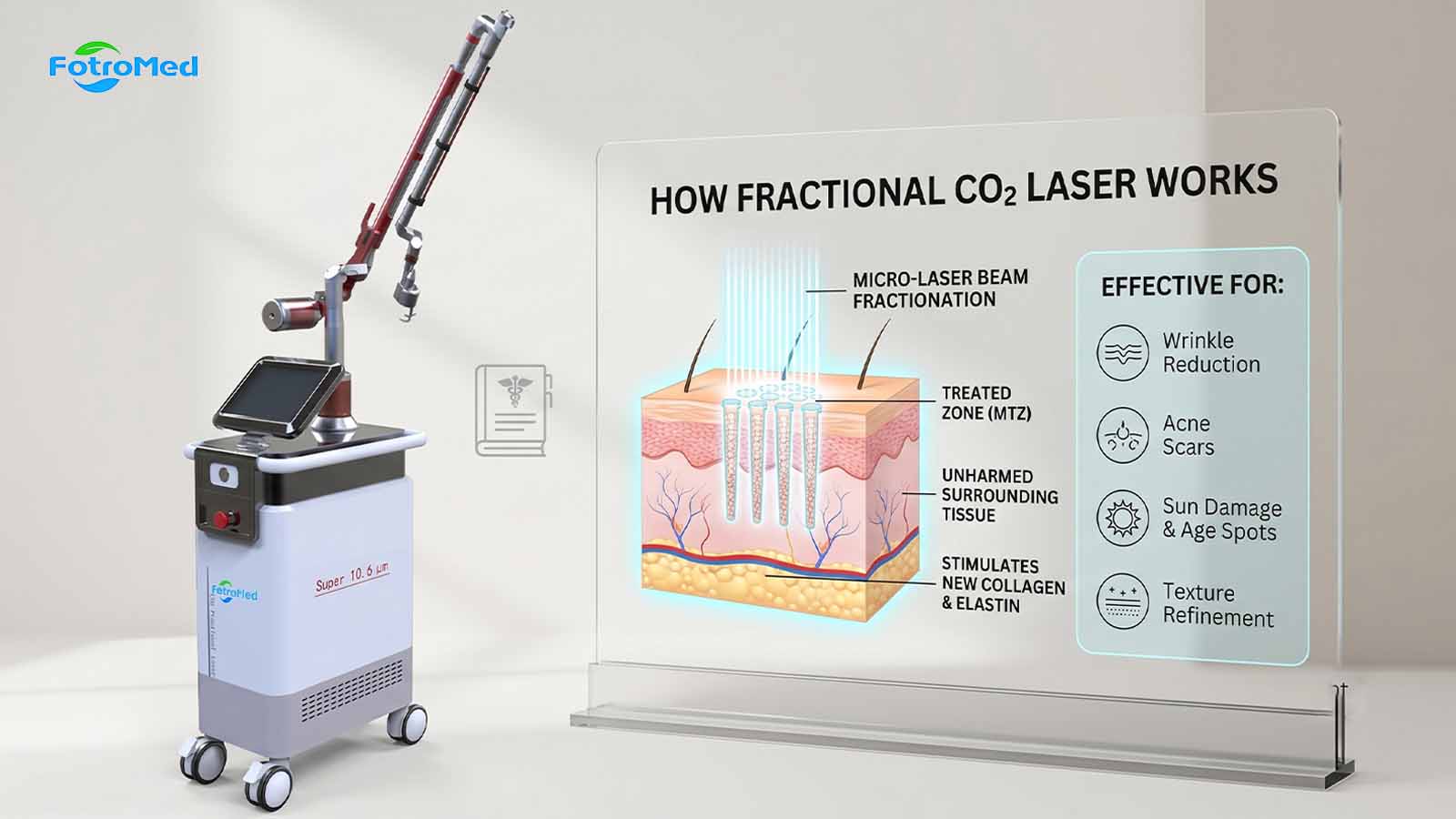
A fractional CO2 laser is a medical-aesthetic device that emits a 10,600 nm (10.6 ừm) far-infrared beam, then splits that beam into a grid of microscopic columns delivered to the skin in a controlled pattern. Each column ablates and heats a tiny vertical channel of tissue — a microthermal treatment zone, or MTZ — while the surrounding skin is left intact.
That fractionated geometry is the entire point. A traditional, fully ablative CO2 laser removes a continuous sheet of epidermis and dermis, producing dramatic results but also weeks of crusting, prolonged erythema, and a real risk of scarring or pigmentary change. A fractional CO2 laser delivers comparable depth in narrow columns and uses the untouched tissue between them as a reservoir of viable cells that re-epithelialize the treated zones from the sides. The healing window collapses from weeks to days, while collagen remodeling continues for months.
The underlying concept — fractional photothermolysis — was introduced by Manstein and colleagues at the Wellman Center for Photomedicine in 2004 Và adapted to CO2 wavelengths by 2007. It is the single most cited innovation in modern laser dermatology.
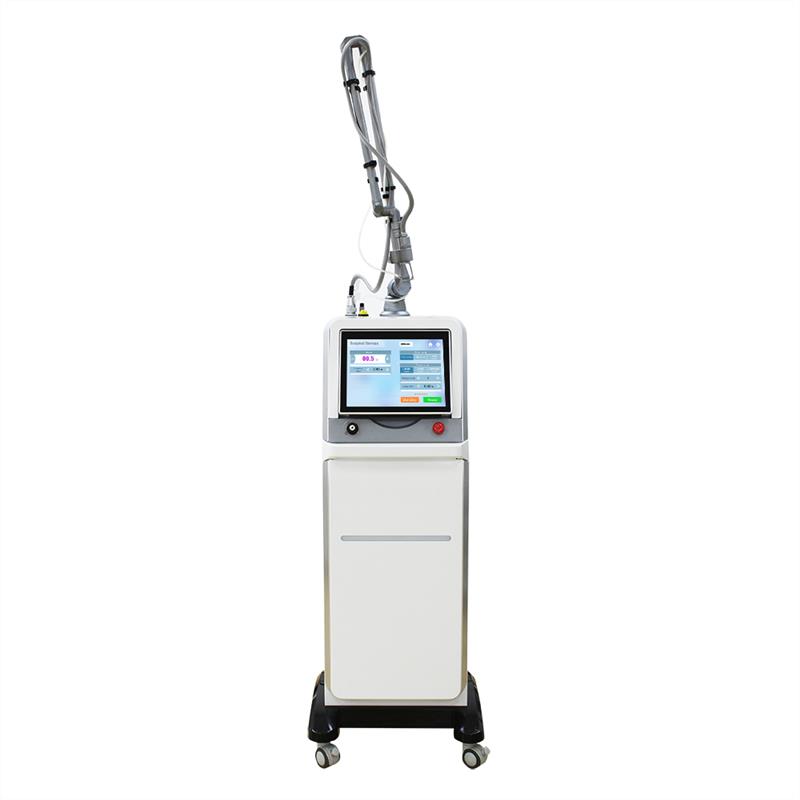
Dành cho người mua B2B, the practical takeaway is that “fractional CO2” is not one device but a family of systems with very different optics, quyền lực, scanner technology, and operating ranges. Fotromed từ Máy Laser CO2 phân đoạn phạm vi, for context, spans clinic-grade units in this market segment.
CO2 Laser vs Fractional CO2 Laser: Sự khác biệt là gì?
This is the highest-volume disambiguation question in the category, and the answer matters because the two technologies carry very different downtime, risk profiles, và các trường hợp sử dụng.
| Thuộc tính | Traditional CO2 Laser (fully ablative) | Laser CO2 phân đoạn |
|---|---|---|
| Beam delivery | Continuous sheet across the treated area | Grid of microscopic columns (MTZs) covering 5–30% of the surface area per pass |
| Epidermal removal | Complete, in the treated zone | Partial, fractionated |
| Healing reservoir | None — the entire treated zone re-epithelialises from wound edges | Untreated tissue between MTZs accelerates re-epithelialisation |
| Typical downtime | 2–4 weeks of crusting, weeping, ban đỏ | 5–14 days; the lighter end with conservative settings |
| Risk of scarring / dyspigmentation | Cao hơn | Substantially lower, but not zero |
| Tốt nhất cho | Severe rhytides, deep acne scarring where maximum resurfacing is acceptable | Photoaging, mild–moderate scarring, dyschromia, maintenance resurfacing |
| Patient tolerance | Often requires deeper anaesthesia / sedation | Usually topical anaesthesia |
Most CO2 platforms sold today are fractional-capable, and many can also operate in continuous-wave (CW) or pulsed modes for surgical excision (mụn cóc, Thẻ da, benign lesions). When buyers compare “Laser CO2” against “Laser CO2 phân số” in vendor specifications, they are usually comparing modes of the same machine, not two distinct devices.
How a Fractional CO2 Laser Works on Skin
các 10.6 µm wavelength and water absorption
các 10,600 nm wavelength is not chosen by tradition; it is chosen because it sits at a strong absorption peak of water in tissue. Skin is roughly 60–70% water, Vì thế 10.6 µm energy is absorbed within a very shallow depth — on the order of tens of micrometres — converting almost entirely to heat. That extreme superficial absorption is what makes CO2 lasers efficient ablators: they vaporise tissue before the heat has time to conduct laterally.
This wavelength behaviour is what differentiates CO2 from other “phân số” thiết bị. Erbium:YAG at 2,940 nm has an even higher water absorption coefficient and ablates more cleanly with less residual thermal damage. Non-ablative fractional lasers at 1,540–1,927 nm penetrate deeper but do not vaporise tissue. The choice of wavelength dictates the entire downtime and remodeling profile.
Microthermal treatment zones (MTZs)
Inside each MTZ, the laser does two things in sequence: it ablates a narrow column of tissue and creates a surrounding cuff of coagulated, thermally damaged dermis. The ablative column is what removes pigmented lesions and surface irregularities. The coagulative cuff is what triggers the longer-term wound-healing cascade that produces collagen remodeling.
The geometry of the MTZ pattern is controlled by three parameters every clinical-grade interface should expose:
- Density (dot pitch) — distance between adjacent columns, typically 0.1–2.0 mm. Tighter densities increase coverage and aggressiveness but extend downtime.
- Độ rộng xung / pulse energy — controls how deep each column reaches and how much residual heat is deposited.
- Scan pattern shape and mode — square, vòng tròn, lục giác, or custom raster; sequential vs randomised dot placement (random patterns reduce bulk heat accumulation in a region).
Cắt bỏ + đông máu: triggering collagen remodeling
Recent literature has revised the long-standing assumption that higher fluence always produces better outcomes. Reviews of fractional CO2 skin-rejuvenation parameters indicate that lower fluences with comparable density can induce similar molecular wound-healing markers with fewer side effects — useful guidance for operators tempted to push energy settings for “stronger” kết quả.
Engineering note. The ratio of ablation zone to coagulation cuff is largely set by pulse width. Short pulses (sub-millisecond) favour clean ablation with minimal thermal damage — good for surface texture work. Longer pulses (2–10 ms) widen the coagulative cuff — useful when collagen contraction is the goal (deeper rhytides, tái tạo vết sẹo). A machine that exposes a 0.1–10 ms pulse-width range gives the operator far more clinical flexibility than a fixed-pulse system.
What Is a Fractional CO2 Laser Used For?
Acne scars and surgical scars
Fractional CO2 is one of the best-evidenced laser modalities for atrophic acne scarring. MỘT systematic review by Ong and Bashir found consistent improvement in scar appearance across the published literature, with most studies reporting 25–75% improvement over a course of 2–4 treatments. The mechanism — controlled dermal injury followed by collagen reorganisation — also applies to hypertrophic surgical scars and burn-scar contractures, though parameters and pre-treatment counseling differ.
Photoaging, nếp nhăn, và nếp nhăn
Periorbital and perioral rhytides are the classic indications. The fractional approach produces less dramatic single-session results than a fully ablative pass, but a course of 1–3 treatments typically delivers visible, durable smoothing with manageable downtime, which has made the procedure the default in dermatology and plastic-surgery practices over the past fifteen years.
Dyschromia and uneven texture
Solar lentigines, tăng sắc tố sau viêm, and general textural irregularity respond well in lighter-skinned patients (Fitzpatrick I–III). Darker phototypes require a different risk-benefit assessment, covered in the next section. For diffuse pigmentation, alternatives such as a 1927NM thulium laser hoặc Máy IPL may be more appropriate or used as a combination platform.
Other indications: soft-tissue surgical excision
CO2 platforms with a focused surgical handpiece are widely used for excision of benign cutaneous lesions — warts, Thẻ da, Keratoses, nốt ruồi (when appropriate and after diagnosis), and other small soft-tissue procedures. This is a well-established surgical application of the 10.6 µm wavelength, predating the fractional modality by decades.
A note on indications outside the dermatology mainstream: some CO2 systems are marketed with intravaginal or vulvovaginal handpieces for “Trẻ hóa âm đạo,” urinary incontinence, or genitourinary syndrome of menopause. The US FDA has not cleared any energy-based device for these indications, and in July 2018 issued a giao tiếp an toàn warning of reports of vaginal burns, sẹo, and chronic pain following such procedures. Buyers evaluating a multi-handpiece platform should treat any clearance claim in this area with caution and request the specific 510(k) summary for the indication in question.
Which Skin Types Are Suitable for Fractional CO2 Laser?
| Fitzpatrick skin type | Sự phù hợp | Key consideration |
|---|---|---|
| I–II (very fair) | Cao | Lower PIH risk; standard parameters generally tolerated |
| III (light-medium) | High with reasonable parameters | Pre/post pigmentation prophylaxis often used |
| IV (trung bình) | Acceptable with conservative settings | Lower densities, longer treatment intervals; consider test patches |
| V–VI (dark) | Use with caution or consider non-ablative alternatives | Significantly higher post-inflammatory hyperpigmentation (PIH) rủi ro; some experts advise against ablative fractional CO2 in V–VI and prefer non-ablative fractional devices |
Standard contraindications include active herpes simplex infection in the treatment area (HSV prophylaxis is commonly prescribed for facial treatments), active inflammatory acne with pustules in the field, sử dụng isotretinoin gần đây (the long-standing 6-month wait has been questioned in recent literature, but most practitioners still observe it), xu hướng sẹo lồi, mang thai, and any active skin infection.
Phiên, Sự hồi phục, and Results: Những gì mong đợi
How long is a session?
A full-face fractional CO2 session typically takes 20–45 minutes of laser time, plus 30–60 minutes for topical anaesthetic to take effect beforehand. Smaller treatment areas (perioral, Periorbital) take 10–15 minutes. Multi-area body treatments — stretch marks, large scars — can run longer.
How many sessions are recommended?
For photoaging and mild scarring, 1–3 deeper sessions spaced 6–8 weeks apart often produce the target result. For atrophic acne scars and more advanced photoaging, 3–5 buổi with progressive intensity is a common protocol. Conservative practitioners increasingly favour multiple lighter passes over a single aggressive treatment because cumulative results are similar and side-effect risk is lower.
Recovery timeline
| Ngày | What patients typically experience |
|---|---|
| Ngày 0 (sự đối đãi) | Sunburn-like sensation, swelling begins within hours |
| Day 1–3 | Peak erythema and swelling; mild oozing; itching as healing begins |
| Day 4–7 | Crusting and peeling; new skin underneath; itching peaks |
| Day 7–14 | Pink, da nhạy cảm; makeup usually tolerated from day 7–10 |
| Weeks 2–6 | Erythema fades; texture continues to improve |
| Months 3–6 | Collagen remodeling delivers ongoing improvement |
Sun protection (SPF 50+, strict UV avoidance) is essential for at least three months post-treatment to minimise PIH risk.
What Are the Disadvantages and Risks of Fractional CO2 Laser?
No ablative device is risk-free, and a responsible B2B operator should be able to describe both established risks and rare complications to prospective patients.
The most common, expected side effects are erythema, oedema, đóng vảy, and transient pruritus during the healing window — these are part of the mechanism, not complications. Clinically significant risks documented across the literature include:
- Post-inflammatory hyperpigmentation (PIH) — most common in Fitzpatrick IV–VI; typically transient but can persist for months
- Post-inflammatory hypopigmentation — less common but harder to reverse
- Prolonged erythema lasting beyond 4–6 weeks
- Acneiform eruption or milia during healing
- vi khuẩn, nổi tiếng (HSV reactivation), or candidal infection of the treated area
- Sẹo, including hypertrophic scarring, particularly on neck and chest where dermis is thinner — Fife, Fitzpatrick, and Zachary documented four cases in a 2009 paper
- Demarcation lines at treatment-area borders if blending is poor
Risk magnitude scales with treatment aggressiveness, anatomical site, operator experience, and patient skin type. Conservative parameters, test patches in higher-risk patients, and HSV prophylaxis are standard risk-reduction measures.
What Makes the Best Fractional CO2 Laser Machine?
For a clinic or distributor evaluating a purchase, the difference between a mediocre and an excellent fractional CO2 laser sits in five engineering decisions. Brand names, country of origin, and marketing language are weaker signals than the underlying components.
RF metal tube vs glass tube — the single biggest reliability factor
The CO2 laser source is either an RF-excited metal tube hoặc a thủy tinh (DC-excited) laser tube. The performance and longevity differences are not marginal.
| Đặc điểm kỹ thuật | RF metal tube | Glass laser tube |
|---|---|---|
| Working life | ~20,000 hours | ~2,000 hours |
| Peak power stability | Cao, consistent across the service life | Thấp hơn; degrades faster |
| Minimum spot size | ~0.07 mm achievable | ~0.25 mm typical floor |
| Độ tin cậy | Ổn định, sealed unit | More fragile; sensitive to handling |
| Chi phí thay thế / thời gian ngừng hoạt động | Higher unit cost, but rare | Lower unit cost, but more frequent |
For a clinic running daily treatments, an RF tube system pays for itself in uptime and consistency. For an occasional-use practice the math is closer, but the smaller spot size achievable with an RF source matters clinically — finer dot patterns deliver gentler treatments with the same total energy.
Scanner technology, density range, and pulse width
The scanner is what turns a single laser column into a clinically useful grid pattern. Galvanometer (galvo) scanners with closed-loop driver control deliver more accurate dot placement than older rotating-prism or mirror-on-stepper-motor systems. Tìm kiếm:
- Pulse-width range — wider is better. A 0.1–10 ms range gives the operator both clean ablation (sub-millisecond) and deeper coagulation (multi-millisecond) on the same platform.
- Dot pitch range — 0.1–2.0 mm is typical for a flexible system.
- Scan modes — sequential, random, and middle-out patterns each have clinical use cases. Random patterns minimise bulk heating in any one region; sequential is faster but warmer.
- Pattern shapes — squares and circles are universal; hexagonal and triangular fills, plus operator-customisable shapes, allow better matching to anatomical contours.
Kích thước điểm, focal depth, và tay khoan
Multiple fixed-focus or interchangeable scan tips let an operator change ablation depth without changing energy settings. A typical four-tip family ranges from an ultra-ablative tip with ~0.2 mm focal diameter (deepest penetration, deep scar work) ĐẾN non-ablative tips with ~0.8–1.2 mm focal diameter (light resurfacing, khu vực nhạy cảm).
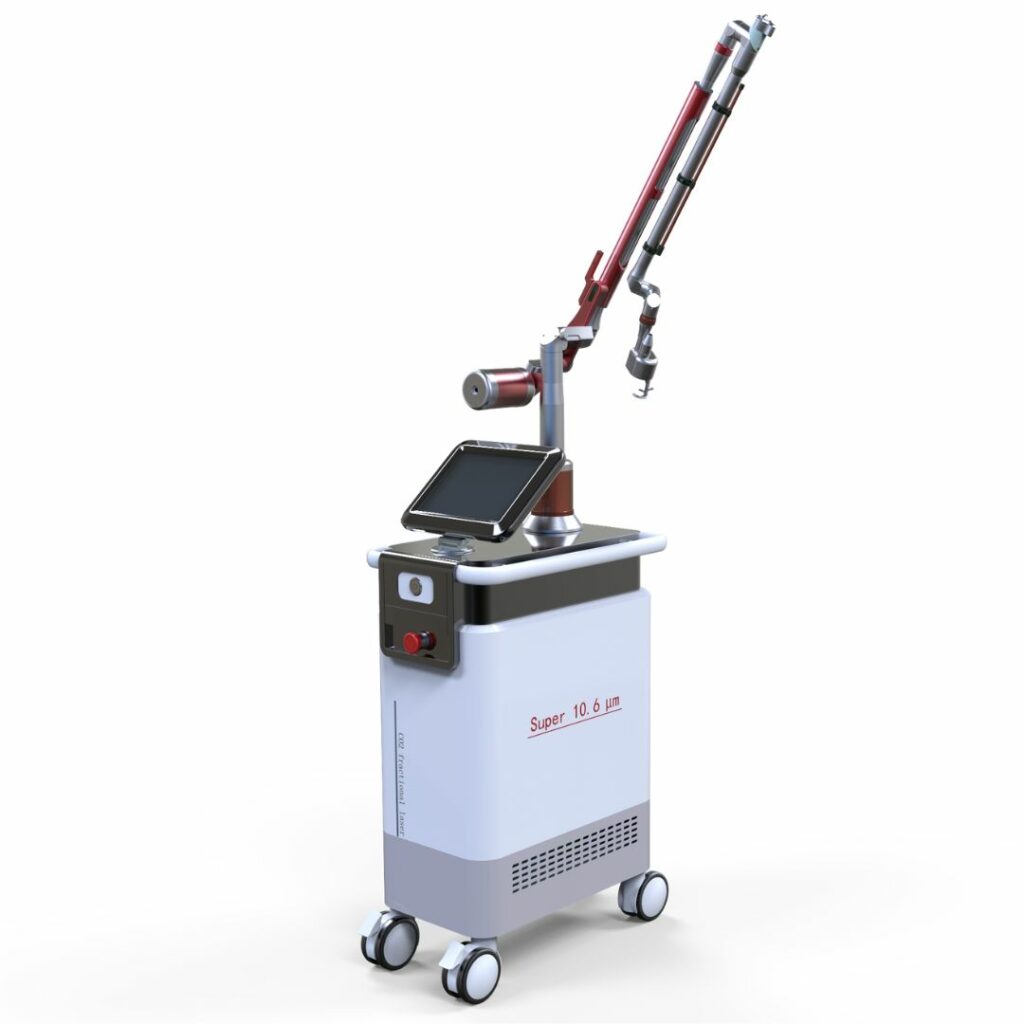
Case example — CeloLaser CO2 Fractional (fotromed). The CeloLaser platform illustrates a contemporary RF-tube design: Một 40 W USA-manufactured Coherent RF metal emitter at 10,600 nm ±0.3%, a Korean-imported 7-joint articulated arm with <0.5% optical-path deviation, a German Galvo scanning module, and four interchangeable scan tips spanning ultra-ablative through ultra-non-ablative focal-point ranges. The interface exposes 5 pattern shapes (square, vòng tròn, lục giác, triangle, customised), 3 chế độ quét, and a 0.1–10 ms pulse-width range — the kind of parameter envelope that supports both dermatology and aesthetic-surgery workflows without resorting to two separate machines. Full specifications are available on the Máy Laser CO2 phân đoạn category page.
Buyer’s checklist — what to ask a manufacturer before signing.
- RF metal tube or glass tube? What is the rated working life and the replacement cost?
- Pulse-width range and dot-pitch range — full numerical specs, not marketing language.
- Which scan tips ship standard and which are accessories? Focal diameters for each?
- What is the regulatory status in your target market — FDA 510(k), Đánh dấu CE, or local equivalent — and for which indications?
- Service network and parts availability in your region. What is the typical lead time for an emitter replacement?
- Training included? Treatment-parameter library or starting protocols provided?
- Continuous-use duty cycle — how many hours per day, and how many sessions before mandatory cool-down?
Build quality and articulated-arm optics
The articulated arm that delivers the beam from the emitter to the handpiece is a frequently overlooked component. A poorly built arm introduces optical-path drift, energy loss at the joints, and progressive misalignment that degrades treatment consistency. Korean and German precision-optics suppliers dominate this segment for a reason. Specifications worth asking for: optical-path deviation under 0.5%, multi-joint articulation (7 joints is the practical standard), and stated stable energy output over a working session.
Giải phóng mặt bằng FDA, Đánh dấu CE, and Safety Standards
Regulatory status is the single area where vendor marketing and reality most often diverge. Three distinctions matter.
| Status | What it means | What it does không mean |
|---|---|---|
| FDA 510(k) đã xóa | The US FDA has reviewed the device and determined it is substantially equivalent to a legally marketed predicate device for specific named indications. | That the device is “FDA chấp thuận” (a separate, higher PMA pathway). MỘT 510(k) clearance is per device, per indication. |
| Đánh dấu CE (EU) | Conformity with EU Medical Device Regulation (MDR 2017/745). Allows commercial sale in the European Economic Area. | Equivalence to FDA clearance. The pathways and evidence bars differ; CE is not US clearance. |
| Neither | The device has not gone through either pathway. | That it cannot be sold legally — depends on each jurisdiction’s local rules. Buyers should not interpret silence on regulatory status as equivalent to clearance. |
Several well-established fractional CO2 platforms hold FDA 510(k) clearances for dermatologic indications — examples include Lumenis UltraPulse, Solta Medical’s Fraxel Re:đôi, Candela CO2RE, and Alma’s Pixel CO2 family. Other systems are CE-marked but not FDA-cleared, and some markets are served by devices with neither US nor EU clearance. None of this is inherently disqualifying for a B2B buyer — many CE-marked devices are clinically excellent — but the correct labeling matters.
For the device-safety side, fractional CO2 lasers fall under IEC 60601-2-22, the international particular standard for the safety of surgical, mỹ phẩm, therapeutic, and diagnostic laser equipment. Compliance documentation should be available for any clinical-grade unit; eye-protection requirements (operator and patient), laser-safe-room signage, and key-switch interlocks are standard expectations.
The FDA’s July 2018 giao tiếp an toàn explicitly cautioned against marketing energy-based devices for vaginal rejuvenation, urinary incontinence, or menopause-related conditions. Any 510(k) claim for gynecological indications should be verified against the FDA 510(k) database before purchase.
How to Buy a Fractional CO2 Laser Machine: A B2B Sourcing Walk-Through
Hầu hết “how to buy” articles for fractional CO2 lasers stop at “ask the supplier for warranty and training.” That advice isn’t wrong, but it skips the parts of the procurement process where money actually leaks out: shadow costs hidden in the quotation, deployment failures at the clinic, and component-quality gaps that only show up after twelve months of use. The six steps below are written from the manufacturer side of the table — what an informed B2B buyer asks, sees, and verifies before signing.
Bước chân 1: Define your case mix and buyer profile before you shop
Two buyer profiles approach the same SERP and need very different machines. Clinics and medspas typically buy a single unit they will run 4–10 hours a week, primarily for facial resurfacing and scar work; the procurement focus is training, bảo hành, and parts availability. Distributors and OEM partners buy a platform they will resell or rebrand across a region; the focus shifts to minimum order quantity, exclusive-territory terms, OEM/ODM capability, và các điều khoản thanh toán (30/70 T/T against B/L is the common baseline). Settle this before requesting quotations — a quote sized for clinic procurement and a quote sized for regional distribution are different documents.
Bước chân 2: Build a shortlist using filters that actually matter
Public “top 10” lists read like SEO listicles. For a real shortlist, apply three filters in this order:
- Source type — manufacturer, authorised distributor, or trading-company reseller. The price gap between a manufacturer and a trader on the same machine is typically 25–40%. If a seller can’t name the factory that made the unit, they are a trader, not a manufacturer.
- Reference installations — request two clinic references in your region or a comparable market. A manufacturer with a real installed base produces them. One without will deflect.
- After-sales footprint in your country - “we ship worldwide” is not the same as “we have a service partner in Riyadh / São Paulo / Jakarta.” Ask for the local contact before signing, not after.
Bước chân 3: Audit the components, not just the brochure
This is where the manufacturer’s perspective diverges most from generic buying advice. A fractional CO2 laser is a system of sourced sub-assemblies — laser emitter, scanner, articulated arm, cooling unit — and the brochure rarely tells you who built each one. Ask the supplier for the original component manufacturer for each major sub-assembly, then request the corresponding factory certificate, batch number, or serial-traceable test report.
Reputable industrial component sources are well-known inside the industry:
- CO2 RF emitters on clinical-grade systems come from a small number of specialist manufacturers (US-based Coherent is the most widely used; a handful of peers serve the same segment). A supplier should be able to name the emitter brand and supply the original component certificate without hesitation.
- High-precision galvanometer scanners come predominantly from a short list of German and US optics vendors.
- Articulated arms with documented sub-0.5% optical-path deviation are most often Korean or German precision-optics products.
When a supplier names verifiable upstream brands for each sub-assembly, supplies the serial-numbered factory QC test report for the actual unit you are buying, and offers a live video factory tour or live demo of the assembled machine before shipment, you are dealing with an assembler that understands and stands behind its supply chain. When the answer is “we make everything in-house” with no upstream traceability, treat that as a yellow flag — vertical integration is fine, but refusal to name component sources is not.
Buyer tip. A factory QC test report should include the emitter serial number, the measured power output at full rating, the wavelength accuracy verification, and the date of test — all referenced to the unit’s chassis serial number. A generic “QC pass” stamp with no measured values is not a test report.
Bước chân 4: Read the quotation — what’s missing is what costs you later
A clinic-grade fractional CO2 laser quote should explicitly list the following lines. If any line is absent, ask why before signing.
| Quotation line | Xác nhận điều gì |
|---|---|
| Machine configuration | Emitter wattage, included handpieces and scan tips, pattern-shape library, supported scan modes |
| Shipping incoterm | EXW / FOB / CIF / DDP — these shift 5–15% of total landed cost between buyer and seller |
| Spare parts package | Recommended first-year spares: focusing tips, indicator-light components, articulated-arm wear parts |
| Installation and commissioning | On-site or remote? Who covers the engineer’s travel and visa cost? |
| Đào tạo người vận hành | Hours included, online vs on-site, language(S), completion certificate provided? |
| Bảo hành | Khoảng thời gian Và the warranty start-date definition — date of shipment vs date of commissioning is a 3–6 month gap |
| Service response time | Stated lead time for an emitter replacement and a scanner repair, in your region, in writing |
| Payment terms | T/T schedule, L/C accepted, milestone definitions, refund conditions if commissioning fails |
The quote that wins on headline price often loses on warranty start date and parts lead time. The five-year TCO delta is frequently larger than the unit-price delta.
Bước chân 5: Negotiate the deployment package, not just the box
Three deployment items are routinely under-negotiated and cost real money later:
- Voltage and power-supply compatibility — a 110V-only machine arriving in a 220V market is unusable until a transformer is sourced. Professional units should be wide-range (110–240V AC); confirm in writing, not just on the brochure.
- Training certification — in many jurisdictions the toán tử, not the device, requires certification. Ask whether the supplier provides a training-completion certificate the clinic can keep on file for regulatory inspection.
- Customs and HS code support — the supplier should supply the appropriate HS code, country of origin certificate, and any documentation required for medical-device import in your jurisdiction. Customs delays of 2–6 weeks are routine when this is missing.
Bước chân 6: Red flags that should end a deal
The pattern is consistent across the industry. The following are flags worth walking away from:
- A supplier conflates “FDA 510(k) đã xóa,” “FDA đã đăng ký,” Và “được đánh dấu CE” as if they were equivalent. They are not, and the conflation is rarely accidental.
- Brochure claims for indications the FDA has explicitly warned against (Trẻ hóa âm đạo, urinary incontinence) without an indication-specific 510(k) summary.
- Refusal to share a serial-numbered factory QC report for the actual unit being shipped.
- A warranty that excludes the laser emitter — the single most expensive component to replace.
- Prices that drop dramatically (>30%) after the first quote. Honest cost structures don’t carry that much margin to give back.
Câu hỏi thường gặp
How much does a fractional CO2 laser machine cost?
Fractional CO2 laser machines range from approximately USD 4,000 to over USD 150,000, depending on manufacturer, cấu hình, và tình trạng quản lý. Premium branded systems (Lumen, Solta, Candela, Alma) run USD 60,000–150,000+. Mid-tier FDA- or CE-cleared platforms sit at USD 15,000–40,000. Manufacturer-direct platforms including Fotromed’s CeloLaser range start at USD 4,000–8,000. Confirm total cost of ownership alongside headline price.
What is the lifespan of a fractional CO2 laser?
A well-built fractional CO2 laser typically delivers a 10–20 year working life, with the laser tube as the limiting component. RF metal emitters are rated around 20,000 working hours — roughly 7–10 years of typical clinic utilisation. Glass tubes last around 2,000 giờ and require more frequent replacement. Articulated-arm joints and reflection tips are the next most common service items.
Does fractional CO2 laser actually work?
Yes — within realistic expectations. The technology has been peer-reviewed since 2004 and is well-supported for atrophic acne scars, periorbital and perioral rhytides, Chuẩn bị trước, and surgical scar revision, with most studies reporting 25–75% improvement over 2–4 sessions. It does not tighten skin to surgical-lift extent, eliminate deep wrinkles in a single session, or correct volume loss.
Can fractional CO2 laser be used on dark skin?
Đúng, but with significantly greater caution. Fitzpatrick IV–VI patients face materially higher post-inflammatory hyperpigmentation risk. Many practitioners prefer non-ablative fractional or longer-wavelength alternatives for these skin types, or use conservative parameters with pre- and post-treatment pigmentation prophylaxis. Test patches are essential. For broad pigmentation on darker skin, 1927NM thulium laser devices are often a safer first-line choice.
What are alternatives to fractional CO2 laser for sun damage?
Several validated alternatives exist depending on the dominant pathology. Máy IPL target diffuse vascular and pigmentary irregularities với thời gian chết tối thiểu. Non-ablative fractional lasers at 1,540–1,927 nm treat photoaging without epidermal ablation. Máy RF microneedle hệ thống stimulate collagen remodeling without targeting pigment. Choice depends on skin type, acceptable downtime, và mục tiêu điều trị.
How does fractional CO2 compare to Erbium and 1927 nm fractional lasers?
CO2 at 10,600 nm produces a wider zone of residual thermal damage than Er:YAG at 2,940 nm, favouring collagen contraction but slower healing. Er:YAG ablates more cleanly with less residual heat — faster recovery, less aggressive remodeling. 1,927 nm thulium fractional lasers are non-ablative, target water absorption superficially, and excel for melasma and surface pigmentation. Each wavelength has a clinical niche.
What’s different about machines designed for dermatology vs aesthetic surgery clinics?
The core 10.6 µm laser source is identical; the parameter envelope and accessory set differ. Dermatology systems emphasise fractional resurfacing protocols and finer scan tips, with focal points down to 0.2 mm. Aesthetic-surgery systems extend duty cycle and add a focused surgical handpiece for cutting and coagulation. Multi-handpiece platforms serve both workflows from one chassis — worth the premium only when both workflows actually run.
How often should the machine be serviced?
Annual preventive maintenance is the baseline — optical-path inspection, scanner calibration, and emitter performance check. Vật tư tiêu hao (articulated-arm joint covers, indicator-light components, focusing tips) are replaced as needed. Daily operator checks should include energy output verification and visual inspection of the articulated arm and handpiece. Manufacturers should specify exact service intervals in the user manual.
Sourcing a Fractional CO2 Laser Machine for Your Clinic
A fractional CO2 laser is a 7–10 year investment, and the engineering decisions made before purchase determine the next decade of treatment quality and service margin. Match the system to your actual case mix, ask the questions in the buyer’s checklist above, and verify regulatory claims against the relevant database for your market.
Fotromed’s Fractional CO2 Laser Machine range, including the CeloLaser CO2 Fractional platform discussed above, is manufactured and sold direct to clinics, thuốc điều trị, and distributors across more than 30 các nước. For technical specifications, tùy chọn cấu hình, and quotation, contact our team via the category page.
About This Guide
This article was written by Kelcy on behalf of fotromed, a Chinese manufacturer of medical-aesthetic devices serving distributors and clinics internationally. The guide draws on (Một) the foundational peer-reviewed literature on fractional photothermolysis and ablative fractional CO2 resurfacing, (b) published regulatory communications from the US FDA, (c) the international IEC 60601-2-22 laser-equipment safety standard, Và (d) engineering parameters from current clinical-grade fractional CO2 systems including Fotromed’s own platforms. We have separated peer-reviewed findings from vendor claims throughout the text and cited sources inline. Clinical claims about specific patient outcomes should be confirmed against the cited literature; configuration claims about Fotromed devices reflect the specifications on file as of the publication date.
Tài liệu tham khảo & Sources
- Manstein D, Herron GS, Sink RK, Tanner H, Anderson RR. Fractional photothermolysis: a new concept for cutaneous remodeling using microscopic patterns of thermal injury. Lasers Surg Med. 2004;34(5):426–438.
- Hantash BM, Bedi VP, Kapadia B, et al. In vivo histological evaluation of a novel ablative fractional resurfacing device. Lasers Surg Med. 2007;39(2):96–107.
- Tierney EP, Eisen RF, Hanke CW. Fractionated CO2 laser skin rejuvenation. Dermatologic Therapy. 2011;24(1):41–53.
- Ong MWS, Bashir SJ. Fractional laser resurfacing for acne scars: a review. Br J Dermatol. 2012;166(6):1160–1169.
- US Food and Drug Administration. Statement from FDA Commissioner Scott Gottlieb, M.D., on efforts to safeguard women’s health from deceptive health claims and significant risks related to devices marketed for use in medical procedures for ‘vaginal rejuvenation’. Safety Communication, July 30, 2018.
- Fife DJ, Fitzpatrick RE, Zachary CB. Complications of fractional CO2 laser resurfacing: four cases. Lasers Surg Med. 2009;41(3):179–184.
- International Electrotechnical Commission. IEC 60601-2-22: Medical electrical equipment — Part 2-22: Particular requirements for basic safety and essential performance of surgical, mỹ phẩm, therapeutic and diagnostic laser equipment.