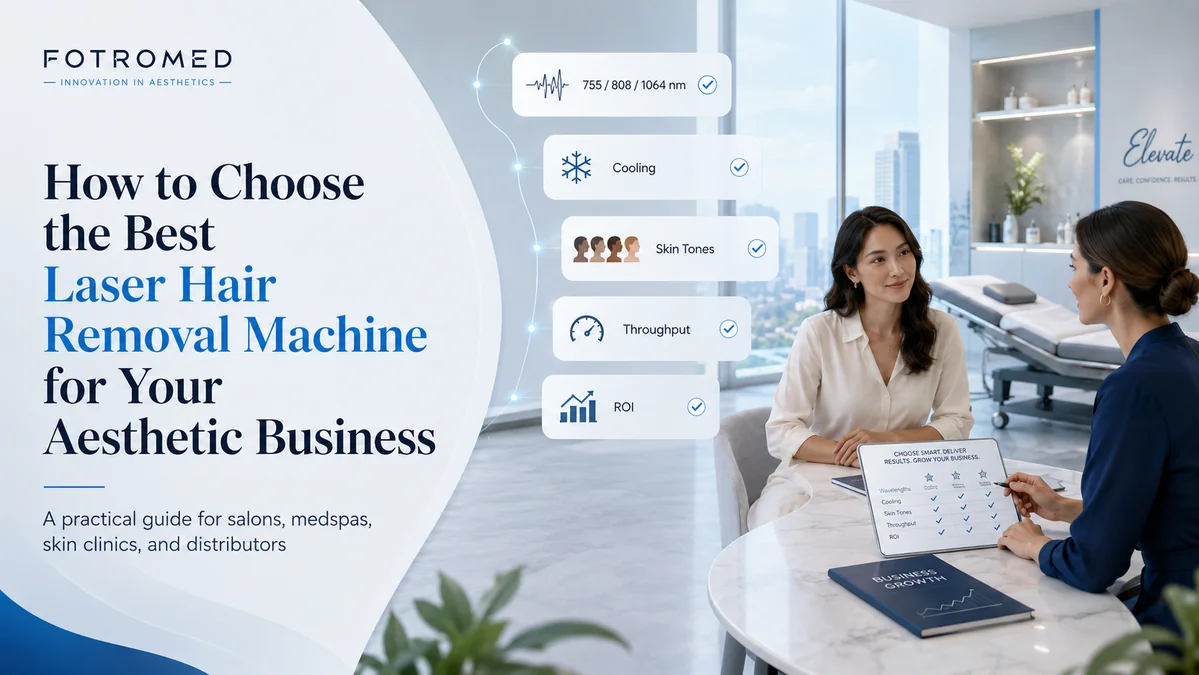
Buying hair removal equipment for a salon, medspa, skin clinic, or distribution line is a different job from a consumer picking an at-home device. The best laser hair removal machine for a business is one that runs commercially for years and produces stable service revenue — and the cost of choosing wrong shows up as downtime, retraining, and lost clients. At-home units, consumer IPL, and professional platforms sit in different categories and should not be judged against the same yardstick.
Which type of laser hair removal machine fits your work, which parameters actually move your daily numbers, what different operating models should prioritise, and what to verify before you wire a deposit — here is how it breaks down.
What makes a laser hair removal machine “best” for a business?
The best laser hair removal machine for a business is not automatically the most expensive one, nor the one with the highest advertised power. What matters is fit: your client base, treatment volume, operator skill level, budget, after-sales service, and long-term business model.
For most aesthetic businesses, a multi-wavelength diode laser hair removal machine is the category to compare first. It balances treatment flexibility, throughput, comfort workflow, and purchase cost. Clinical-leaning skin clinics should also compare Alexandrite (755 nm) and Nd:YAG (1064 nm) platforms. Budget-driven salons can treat IPL/SHR as an entry point — but it is intense pulsed light, not a laser, and shouldn’t be marketed as if it were the same platform.
| Buyer situation | Category to compare first | Why it fits |
|---|---|---|
| Most salons, medspas, and beauty centres | Multi-wavelength diode laser hair removal machine | Broad application range, commercial pricing, clear service positioning |
| Rooms with high daily booking volume | High-power diode with strong cooling | Built for long, continuous, high-frequency use |
| A wide range of client skin tones | Diode with a 1064 nm option, or an Nd:YAG platform | Better wavelength strategy for darker skin tones |
| High-end skin clinics or physician-led practices | Alexandrite + Nd:YAG platform | Supports clinical positioning and a wider treatment menu |
| Budget-led salons or multi-purpose rooms | IPL/SHR hair removal system | Lower entry cost — but it is light-based, not a true laser platform |
The procurement principle: choose the machine your team can run consistently and that suits your real client base, not the one that looks strongest in the brochure.
A quick shortlist: 5 professional hair-removal machine categories
Beyond the theory, a purchase decision needs a shortlist you can actually compare. More useful than a brand ranking is comparing machine types by business fit.
1. Multi-wavelength diode laser hair removal machine
A multi-wavelength diode laser is the all-rounder for most aesthetic businesses. Depending on configuration, systems combine wavelengths such as 694, 755, 808, 940, or 1064 nm. The value is room to adjust across different hair types, skin tones, and treatment areas.
This is usually the first category salons, medspas, and distributors should compare, because its commercial story is the cleanest: one main platform that covers many client situations, and easier to position as professional than an at-home unit or basic IPL.
Take Fotromed’s own LaseSmooth Pro as a concrete example of the category: a Three-wavelength diode platform (755, 808 and 1064 nm) covering fine-to-coarse hair and light-to-dark skin tones from one handpiece, with sapphire contact cooling and a 2-year / up-to-20-million-shot warranty. It maps directly onto the “one main platform for daily service” buying logic.
Fits: businesses that want a single primary professional hair removal machine to cover day-to-day service.
2. High-power diode with strong cooling
Once booking volume rises, the buying logic changes. A small salon may care most about purchase cost and training difficulty; a high-throughput room cares whether the machine stays stable across many back-to-back treatments.
The cooling system is critical here. The StatPearls chapter on laser hair removal notes that professional laser and IPL practice involves built-in cooling systems plus post-treatment cooling. For a commercial machine, cooling also drives treatment-room throughput — weak cooling slows the workflow.
Fits: medspas, salons, and chains running multiple hair-removal appointments a day.
💡 Operations tip: Don’t judge on a short demo clip. Ask the supplier how the machine performs after long, continuous use. Treatment-room stability is a business problem, not just a technical one.
3. Diode with a 1064 nm option, or an Nd:YAG platform
If your business serves a wide range of skin tones, wavelength strategy matters. The professional literature commonly covers diode, Alexandrite, and Nd:YAG, and different wavelengths change how energy interacts with melanin and the hair follicle.
1064 nm Nd:YAG is often chosen for darker skin tones because it penetrates deeper and is absorbed less strongly by epidermal melanin than shorter wavelengths. The StatPearls guidance on laser use by Fitzpatrick skin type points the same way: longer wavelengths and reliable contact or cryogen cooling reduce the risk of epidermal thermal injury in darker skin. That does not make any treatment automatically safe. Machine configuration, parameter settings, cooling, training, and client assessment all carry equal weight.
Fits: skin clinics, medspas, and multi-ethnic markets with a wide skin-tone range and a high share of Fitzpatrick IV–VI clients. If this is your focus, how to choose an Nd:YAG laser machine covers service life, cooling, and spare parts in more depth.
4. Alexandrite + Nd:YAG platform
Alexandrite lasers are tied to the 755 nm wavelength and are often discussed for fast treatment on lighter skin; Nd:YAG covers a wider skin-tone range. A dual Alexandrite + Nd:YAG platform appeals to high-end clinics because it supports stronger clinical positioning and a more specialised treatment menu.
The trade-off is cost. Purchase, maintenance, service, and training costs typically all rise. For the right clinic this is a strong choice; for a salon that only needs simple daily operation, it may be unnecessary.
Fits: dermatology-led clinics, high-end skin-management practices, and businesses that want the device itself to support a premium position.
5. IPL/SHR hair removal system
IPL and SHR show up often in “best hair removal machine” searches, but they are not laser systems. A laser uses a focused single wavelength; IPL uses broad-spectrum intense pulsed light. Clinical references describe IPL as polychromatic, non-coherent light — a reminder that IPL and laser are not the same technology.
IPL/SHR still has value for some businesses, because entry pricing is usually lower and it may support several aesthetic functions. Positioning has to be honest: it can be a practical budget option, but shouldn’t be packaged as identical to a professional diode or Nd:YAG laser.
Fits: budget-led salons, multi-purpose rooms, or distributors who need an entry-level light-based option.
How you use the machine day to day decides which class to buy
The same machine can perform very differently inside different operating rhythms. What really decides which class of machine to buy is how you use it every day — how much volume, how many operators, what your clients look like. Here it is mapped to a few common operating situations.
Small salons need simple operation and reliable daily use
A small salon usually doesn’t need the most complex clinical platform on the market. It needs a professional hair removal machine that staff can learn, explain, and run reliably without slowing the rest of the menu.
For this buyer, usability shows up in small details. The screen flow has to be simple and the presets easy enough that a new hire understands them at a glance — training cost depends directly on this. Cooling stability during back-to-back treatment of common areas (underarms, lower legs, bikini line) decides whether one operator can fill a full day without falling behind. Handpiece weight and grip look minor but drive operator fatigue and treatment consistency. Two things get overlooked and bite repeatedly: whether the supplier delivers clear, repeatable training, and whether handpiece consumables (windows, tips) stay in stock — one parts shortage disrupts the schedule.
For this buyer, a professional diode laser hair removal machine is usually more practical than a complex high-end platform.
Growing medspas need to cover more client situations
A medspa often folds hair removal into a wider menu with skin management, body contouring, and anti-ageing. The machine has to do more than remove hair — it should support a broader client base and a better experience.
This is where a multi-wavelength diode system earns its place. It helps a business build treatment packages around different body areas, skin tones, and appointment lengths. When buying, don’t read only the spec sheet — watch the whole flow: staff prep, treatment, cooling, cleaning, and switching to the next client.
📐 Fotromed manufacturer observation: Buyers compare power up front, but after a few months the recurring questions are about cooling stability, handpiece weight, screen logic, and after-sales response. Those details drive daily repeat use and long-term ownership far more than peak wattage.
Skin clinics value control, stability, and clinical trust
Skin clinics tend to weight treatment control, record-keeping, staff training, and managing client expectations more heavily. A clinic may also face more complex skin-tone cases, or combine hair removal with other skin procedures.
In this setting, “best” means more than high hair-reduction efficiency. It’s whether the machine gives the operator enough parameter control, cooling performance, wavelength flexibility, and supplier documentation to build a more professional treatment protocol. Clinics should compare diode, Alexandrite, and Nd:YAG options more carefully than a small salon, and confirm before purchase that the supplier can provide training materials, user manuals, after-sales support, and the documents required for the target market.
High-traffic rooms: look at uptime, not feature count
If the business plans multiple hair-removal appointments a day, uptime beats feature count. A machine that looks feature-rich but overheats, pauses, or relies on hard-to-source consumables hits your schedule and staff confidence directly.
What this buyer should really track are the questions that tie back to scheduling: how long the machine runs under normal commercial load, which handpiece parts are consumables, and how long those consumables take to resupply — because when a consumable runs out, the room stops. Equally, clarify the after-sales response process when a machine fails, and whether new operators can be retrained after delivery. The answers decide not the spec, but how many days a year the machine actually stays in service. That is why total cost of ownership is worth more attention here than the single purchase price.
Distributors need a machine that’s easy to sell, train, and support
A distributor’s problem is different. They aren’t buying for one treatment room; they’re choosing a product line. That line has to be easy for a sales team to explain and easy for local buyers to understand and trust.
So distributors look at slightly different things from an end clinic. The technology story has to be clear — diode, triple-wavelength diode, Nd:YAG, or IPL/SHR summarised in a sentence, so sales can open the conversation. The line should ideally offer configurations across price points, so it can meet both high- and low-end buyers. Spare-parts and after-sales supply has to be stable, because a shortage damages the distributor’s own reputation. Marketing material has to avoid over-stated clinical results, or the compliance risk lands on the local seller. And training has to be standardised and repeatable across many local clients rather than rebuilt each time. For a distributor, a machine that is clearly positioned and easy to sell usually carries more commercial value than a complex platform that is hard to explain.
Professional laser hair removal machine vs. at-home device
A professional laser hair removal machine is bought for repeated commercial use, and the purchase logic is nothing like a consumer choosing an at-home device. It needs stronger cooling, more operator control, after-sales support, training, and a supplier relationship. An at-home unit is a personal-care tool and usually can’t meet a salon’s or clinic’s demands for speed, durability, and professional workflow.
| Comparison point | Professional machine | At-home device |
|---|---|---|
| Buyer | Salon, medspa, clinic, distributor | Individual consumer |
| Use pattern | Repeated commercial treatment | Personal home use |
| Control | More parameters and operator settings | Simplified settings |
| Support needs | Training, after-sales, spares, documents | Consumer warranty and basic instructions |
| Business value | A revenue-generating platform | A personal-care tool |
For a commercial buyer, the real search isn’t just “best laser hair removal machine” — it’s “best professional laser hair removal machine for my business model”.
How do diode, Alexandrite, Nd:YAG, and IPL compare?
Different hair-removal technologies aren’t interchangeable. They all rely on selective photothermolysis — light absorbed by melanin in the hair follicle turns to heat and disables the follicle — but they deliver that energy differently, and they suit different budgets, client bases, and business models.
Diode laser hair removal machine
Diode laser machines are common in professional aesthetic businesses because they balance cost, performance, and operability. The most common commercial application is permanent hair reduction. Many systems use the 808 nm diode wavelength, with multi-wavelength versions adding 755, 940, or 1064 nm depending on the model.
If your business wants one primary commercial hair-removal platform, diode is usually the category to compare first.
Alexandrite laser hair removal machine
Alexandrite systems are tied to the 755 nm wavelength. They’re often discussed for fast treatment on lighter skin and are a common technology type in the professional laser hair removal literature.
For high-end clinics, Alexandrite has value. For a small salon, it warrants caution if the business model can’t support the higher purchase and service cost.
Nd:YAG laser hair removal machine
Nd:YAG systems use the longer 1064 nm wavelength. Because it penetrates deeper and is absorbed less by epidermal melanin, it’s often discussed for hair removal on darker skin tones. A clinical study of Fitzpatrick IV–VI patients found that low-fluence 1064 nm Nd:YAG with contact cooling was safe and effective for hair removal on darker skin, with no adverse events or paradoxical hypertrichosis reported.
If your market spans a wide skin-tone range, this class deserves a careful look. But wavelength isn’t the whole story — sound technique and appropriate patient and device selection are key to reducing laser complications, and correct training, client assessment, cooling, and conservative parameters all matter.
IPL/SHR hair removal system
IPL and SHR appeal on lower cost and their ability to support several aesthetic functions. If the buyer understands the positioning, Máquinas de IPL can be a sound commercial choice.
The trade-off is precision and service positioning. IPL is broad-spectrum intense pulsed light, not coherent laser. If your marketing and pricing centre on professional laser hair removal, diode or Nd:YAG systems are usually the cleaner fit.
Four technologies, three decision steps
Put diode, Alexandrite, Nd:YAG, and IPL/SHR side by side and the decision isn’t complex. First, decide whether you want a true laser hair removal position or a budget light-based one — that step alone separates diode/Nd:YAG from IPL/SHR. Second, let your client skin-tone range decide whether you need 1064 nm capability; the wider the range and the more Fitzpatrick IV–VI clients, the stronger the case for Nd:YAG or a 1064 nm-capable diode. Third, use budget and clinical positioning to decide whether a dual Alexandrite + Nd:YAG platform is worth it. Most aesthetic businesses land on a multi-wavelength diode; only clinical, premium-positioned practices need to move up to a dual platform.
⚠️ Buyer pitfall: aiming for laser, ending up with IPL. IPL is broad-spectrum intense pulsed light, not coherent laser, and the two differ in service positioning, pricing power, and skin-tone suitability. Some devices blur the line with wording like “laser” or “SHR laser”. If your marketing and fees are built around professional laser hair removal, confirm the light source on the quotation — laser or IPL/SHR — rather than trusting the product name. For a full breakdown, read the difference between laser and IPL hair removal for a clinic.
Machine specs that matter more than the brochure
Brochures push peak power, glossy screens, and dramatic before-and-afters. A professional buyer should look deeper: whether the machine supports your real service menu, staff skill level, and daily appointment rhythm.
| Spec dimension | What to check | Why it matters |
|---|---|---|
| Wavelength options | 755, 808, 940, 1064 nm or specific platform options | Drives the treatment strategy across hair and skin types |
| Cooling system | Contact, sapphire, water, air, semiconductor, or combined cooling | Drives comfort workflow and long treatments |
| Spot size and rep rate | Coverage area and firing speed (Hz) | Drives appointment time and room throughput |
| Handpiece design | Weight, grip, window size, replaceable parts | Drives operator fatigue and maintenance |
| Presets and control | Skin tone, area, hair type, pulse width and fluence | Drives training difficulty and operator consistency |
| Service structure | Warranty, spares, remote support, training | Drives downtime and long-term cost |
Wavelength coverage and skin-tone strategy
More wavelengths don’t automatically make a better machine. Extra options only pay off when the team can use them, the supplier can train on them, and the market actually needs them.
If most of your clients have lighter skin and speed matters more, one configuration may be enough. If your market skin-tone range is wider, a multi-wavelength diode system or an Nd:YAG-capable system tends to be more practical. To weigh the wavelength trade-offs from a buyer’s angle, see how to choose between 755 nm, 808 nm, and 1064 nm.
Cooling and treatment-room throughput
Cooling isn’t only a comfort feature. It affects room throughput, operator confidence, and client experience. Clinical references mention cooling when describing laser hair removal, because it helps manage skin reaction and discomfort.
For a commercial purchase, ask about continuous cooling, handpiece temperature stability, and performance across long treatments. A machine that looks good in a five-minute video may not hold up across a full day’s bookings.
Power, speed, and usable settings
Power matters, but advertised power isn’t the whole picture. Ask how the power is delivered, how cooling supports the parameters, and whether the operator can adjust settings in a genuinely controllable way.
If settings are too complex, staff may never use the machine’s capability. If there are too few, the business may lack the flexibility to handle different clients.
⚠️ Procurement mistake: Don’t buy on “highest power” alone. A machine with stable cooling, clear controls, and reliable after-sales is usually a better long-term business asset than one with impressive numbers and weak service.
How much does a professional laser hair removal machine cost?
Professional laser hair removal machine prices vary widely, because buyers aren’t comparing one product — they’re comparing different technologies, configurations, cooling systems, software control, handpieces, supplier service, shipping terms, and market documentation.
Não leia apenas o primeiro orçamento. Compare o custo total de propriedade.
| Fator de custo | O que afeta o preço | O que perguntar |
|---|---|---|
| Tipo de tecnologia | Diodo, Alexandrite, Nd:YAG, IPL/SHR | Qual tecnologia se adapta ao meu posicionamento de serviço? |
| Configuração do comprimento de onda | Comprimento de onda único, duplo, triplo ou múltiplo | Preciso atender mais clientes? |
| Cooling system | Resfriamento básico ou resfriamento contínuo mais forte | A máquina pode suportar tratamentos longos? |
| Manípulo e consumíveis | Peças substituíveis, janelas, ponteiras, peças de reposição | O que pode precisar de substituição dentro de 12 a 24 meses? |
| Training | Treinamento básico do operador, manual ou estruturado | A nova equipe pode aprender de forma confiável? |
| Garantia e suporte | Suporte remoto, fornecimento de peças de reposição, velocidade de resposta | Quão rápido o fornecedor pode ajudar quando houver uma falha? |
| Envio e importação | Frete, embalagem, impostos, requisitos do destino | Qual é o custo total de aquisição, e não apenas o preço da máquina? |
Um preço de compra baixo é atraente para uma nova clínica. Mas se a máquina causar tempo de inatividade, peças difíceis de encontrar ou equipe mal treinada, o custo real a longo prazo pode ser maior.
💡 Exemplo ilustrativo de TCO (apenas para fins de explicação, não é um orçamento): Suponha que uma plataforma profissional de diodo de múltiplos comprimentos de onda chegue custando aproximadamente US$15,000–30,000, com consumíveis do primeiro ano (janelas do aplicador, ponteiras) e manutenção básica adicionando cerca de US$1,500–3,000. Se um único tratamento custar US$80–150 e a sala realizar de 60 a 100 tratamentos por mês, a receita bruta mensal será de cerca de US$4,800–15,000. Com utilização estável e sem tempo de inatividade prolongado, o custo total de aquisição é frequentemente recuperado em cerca de 3 a 9 meses. O retorno real depende fortemente do preço da sessão, volume de agendamentos, retenção de funcionários e resposta pós-venda — estes números apenas mostram como calcular o custo total de propriedade e o retorno, não constituindo um compromisso de preço ou receita.
📐 Visão do fabricante Fotromed: A mesma máquina comprada por meio de camadas de distribuição de marcas e comprada diretamente da fábrica possui estruturas de preço muito diferentes. Como fabricante original, com capacidade OEM/ODM, Fotromed envia diretamente da fábrica — o que você economiza é a margem de lucro de remarcação e de distribuição multinível, e não a qualidade de construção ou o serviço. Suas plataformas de depilação possuem certificação de sistema de qualidade ISO 13485 e marcação CE para o mercado da UE, com garantia de 2 anos (ou até 20 milhões de disparos), além de treinamento de operadores e suporte pós-venda. Uma regra de compras se aplica independentemente do fornecedor: peça ao fornecedor para mostrar os documentos de certificação para o seu mercado-alvo — marcação CE, ISO 13485 e qualquer liberação FDA 510(k) aplicável — antes de comprar. Esse é tanto o nível mínimo de conformidade quanto a maneira de saber se um preço baixo reduziu a margem de lucro ou a qualidade.
Erros comuns ao comprar uma máquina de depilação a laser
Os erros mais dispendiosos acontecem antes do sinal, e não depois — geralmente porque o comprador comparou as coisas erradas.
| Erro | Por que é arriscado | Melhor abordagem |
|---|---|---|
| Escolher apenas pelo menor preço | Pode aumentar o tempo de inatividade e os riscos de treinamento e pós-venda | Compare preço, suporte, peças de reposição e garantia juntos |
| Tratar IPL e laser como se fossem a mesma coisa | O posicionamento do serviço fica pouco claro | Decida primeiro se você precisa de laser verdadeiro ou de depilação a luz mais econômica |
| Ignorar o perfil local de tons de pele | Pode limitar a variedade de clientes que você pode atender | Escolha a estratégia de comprimento de onda para o seu mercado real |
| Comprar recursos que a equipe não vai usar | Aumenta os custos sem melhorar o fluxo de trabalho | Adeque a lógica de controle à habilidade do operador |
| Ignorar as necessidades de suporte do distribuidor | A equipe de vendas tem dificuldade para explicar a máquina | Escolha uma narrativa de produto que seja fácil de treinar e vender |
| Ignorar o desempenho de resfriamento | Desacelera a velocidade dos atendimentos e prejudica a experiência | Teste a estabilidade do resfriamento, não apenas a potência |
Recomendação final
Para a maioria dos salões, medspas, centros de estética e distribuidores, a melhor máquina de depilação a laser para comparar primeiro é uma máquina profissional de depilação a laser de diodo de múltiplos comprimentos de onda. Ela equilibra a praticidade do negócio, a cobertura de clientes, o custo operacional e a flexibilidade de suprimento.
Para clínicas dermatológicas e estabelecimentos de alto padrão liderados por dermatologistas, as plataformas Alexandrite e Nd:YAG também merecem comparação. Para empresas focadas em orçamento reduzido, o IPL/SHR pode servir como porta de entrada — desde que fique claro que não pertence à mesma classe de tecnologia de uma plataforma a laser verdadeira.
A melhor compra não é o dispositivo com a especificação mais impressionante. É aquele que se adapta aos seus clientes reais, ao volume real de agendamentos, à habilidade da equipe e às expectativas pós-venda. Se você está comparando opções profissionais, a Fotromed’s série de máquinas de depilação a laser é um bom ponto de partida para plataformas de diodo, IPL/SHR e afins.
FAQ
Qual é a melhor máquina de depilação a laser para um negócio de estética?
Para a maioria dos negócios de estética, a máquina de depilação a laser de diodo de múltiplos comprimentos de onda é a categoria a ser comparada primeiro. Ela equilibra flexibilidade de tratamento, preço comercial, opções de resfriamento e suporte do fornecedor. Clínicas de alto padrão também podem comparar plataformas de Alexandrite (755 nm) e Nd:YAG (1064 nm) para uma variedade maior de tons de pele e menu clínico.
What laser hair removal machine do professionals use?
Os profissionais usam sistemas de diodo, Alexandrite, Nd:YAG ou IPL/SHR dependendo do modelo de negócio. O laser de diodo é comum em salões e medspas; Alexandrite e Nd:YAG aparecem mais em ambientes clínicos. O IPL/SHR é uma depilação baseada em luz de amplo espectro, não um laser verdadeiro, por isso se adapta a orçamentos reduzidos ou salas multifuncionais.
O diodo ou o IPL é melhor para um salão?
Se um salão quer se posicionar como um serviço profissional de depilação a laser, o diodo é geralmente a melhor opção. Se o orçamento for menor e o objetivo for uma sala multifuncional, a IPL pode funcionar. A principal diferença é a tecnologia: o diodo usa energia laser focada em um único comprimento de onda; a IPL usa luz intensa pulsada de amplo espectro.
Qual máquina de depilação a laser é a melhor para peles escuras?
Sistemas com capacidade Nd:YAG de 1064 nm, ou plataformas de diodo que incluem uma opção de 1064 nm, são comumente escolhidos para tons de pele mais escuros porque o comprimento de onda mais longo penetra mais profundamente e é menos absorvido pela melanina epidérmica. A máquina sozinha não é suficiente — parâmetros corretos, resfriamento, avaliação do cliente e treinamento do operador, tudo isso importa.
How much does a professional laser hair removal machine cost?
O preço depende do tipo de tecnologia, configuração do comprimento de onda, sistema de resfriamento, peça de mão, treinamento, garantia, frete e suporte pós-venda. Não compare apenas o primeiro orçamento — compare o custo total de propriedade ao longo de 12–24 meses de custos reais com consumíveis, manutenção e tempo de inatividade, e não apenas o preço de tabela.
Uma única máquina pode atender a salões, medspas e clínicas de estética?
Sim, se a configuração, o treinamento e o plano de assistência forem adequados ao ambiente. Um sistema de diodo com múltiplos comprimentos de onda atende a muitos salões e medspas. Clínicas de estética podem precisar de maior controle de parâmetros, suporte documental mais robusto ou opções de Nd:YAG \/ Alexandrita para uma gama mais ampla de tons de pele e menu clínico.
Os distribuidores precisam de um padrão de seleção diferente?
Sim. Os distribuidores devem escolher máquinas que sejam fáceis de vender, treinar, prestar manutenção e explicar. Eles devem avaliar o posicionamento do produto, o fornecimento de peças de reposição, o material de marketing, a repetibilidade do treinamento e a velocidade de resposta do fornecedor — e não apenas as especificações da máquina na ficha técnica.
Um dispositivo doméstico de depilação a laser é adequado para uso comercial?
Geralmente não. Dispositivos domésticos são desenvolvidos para uso pessoal, enquanto máquinas profissionais são projetadas para tratamentos comerciais repetidos. Um salão ou clínica precisa de controle do operador, resfriamento mais potente, treinamento, pós-venda e um relacionamento com o fornecedor para dar suporte a serviços pagos.
Sobre este guia
Este guia foi escrito para compradores B2B de equipamentos estéticos — proprietários de salões, operadores de medspas, equipes de clínicas de estética e distribuidores. Ele combina intenção de busca comercial, perguntas frequentes de aquisição, experiência de compra do ponto de vista do fabricante e referências de autoridade sobre tecnologia e segurança na depilação a laser. Não fornece conselhos individuais de tratamento e não substitui os requisitos locais de treinamento profissional.
Referências e Fontes
- Depilação a Laser — StatPearls — NCBI Bookshelf \/ StatPearls Publishing: oferece suporte para tecnologias comuns de depilação a laser, a distinção da IPL, exemplos de comprimentos de onda, contexto de resfriamento e a necessidade de treinamento do operador.
- Recomendações de Laser para Tipos de Pele de Fitzpatrick — StatPearls — NCBI Bookshelf \/ StatPearls Publishing: oferece suporte ao uso de comprimentos de onda mais longos e resfriamento por contato\/criogênio para reduzir lesões térmicas epidérmicas em peles mais escuras.
- Terapia por Luz Intensa Pulsada (IPL) — StatPearls — NCBI Bookshelf \/ StatPearls Publishing: oferece suporte à IPL como luz não coerente de amplo espectro, distinta do laser, e à migração para Nd:YAG de 1064 nm para peles mais escuras.
- Complicações do Laser — StatPearls — NCBI Bookshelf \/ StatPearls Publishing: oferece suporte ao fato de que as complicações do laser podem ser reduzidas por meio de técnica adequada e seleção correta do paciente e do dispositivo.
- Eficácia e Segurança do Laser Nd:YAG de 1064 nm para Depilação nos Tipos de Pele IV–VI de Fitzpatrick — Lasers in Medical Science (PubMed, PMID 40892306): apoia a segurança e a eficácia da depilação com laser Nd:YAG de 1064 nm e baixa fluência em tons de pele mais escuros.
- Lasers Médicos — U.S. FDA: usado para declarações gerais de segurança e cautela regulatória sobre dispositivos médicos a laser; não é usado para alegar aprovação de nenhum modelo específico.