L'acquisizione di un Ultrasuono Focalizzato ad Alta Intensità (HIFU) dispositivo rappresenta un investimento di capitale significativo per le cliniche estetiche, con il 2025 market exhibiting a wide spectrum of pricing. The investigation delineates a price range from approximately $1,600 for basic, portable units to upwards of $75,000 for premium systems with extensive regulatory approvals. Key determinants of cost include the sophistication of the underlying technology (such as 4D, 7D, or MPT innovations), the presence or absence of U.S. Amministrazione degli alimenti e dei farmaci (FDA) sdoganamento, reputazione del marchio, and country of origin. Additional cost drivers are the specifications of consumables, particularly treatment cartridges, and the extensiveness of post-sale support, including warranty and training. By deconstructing these variables, this guide provides clinic owners with the necessary intellectual tools to conduct a nuanced evaluation, moving beyond the initial purchase price to a more holistic understanding of the total cost of ownership and potential return on investment.
The Evolution of Technology and Its Impact on Price
One of the most immediate variables you will encounter when exploring the HIFU market is a confusing lexicon of “generations” O “dimensions”—terms like 4D, 7D, 12D, and even 22D HIFU. It is essential to recognize that these are primarily marketing terms created by manufacturers, not standardized scientific classifications (BambooLaser, 2025). Tuttavia, they do correspond to tangible technological advancements that directly influence a HIFU machine’s capabilities, treatment efficiency, Comfort del paziente, E, consequently, its price.
From Single Lines to Multi-Line Arrays: 3D and 4D HIFU
Early HIFU systems were relatively basic, delivering a single line of thermal coagulation points with each press of the trigger. IL “3D” E “4D” designations emerged as machines evolved to deliver a matrix, or multiple lines of dots, simultaneously. A 4D HIFU machine, Per esempio, might lay down up to 12 lines in a single shot.
This was a significant leap forward. What does this mean in a practical sense for a clinic? It translates directly to speed. A full-face treatment that might have taken 90 minutes with an older, single-line device could now potentially be completed in 45-60 minuti. For a busy clinic, time is money. Faster treatments allow for more bookings per day, directly increasing revenue potential. Tuttavia, this increased efficiency comes at a cost. The complex engineering required to create a stable, uniform multi-line array makes these machines more expensive than their predecessors. The HIFU machine price for a reliable 4D system from a reputable manufacturer can range from approximately $2,000 A $5,000.
The Dawn of Precision and Comfort: 7D HIFU and MMFU
The next major step in the technology’s evolution is often marketed as “7D HIFU.” This term typically signifies the introduction of Micro and Macro Focused Ultrasound (MMFU). The key innovation here is a smaller, more precise focal point. While older 4D systems had a relatively larger thermal zone, 7D systems create a much finer point of coagulation.
Why does this matter? A smaller focal point means the energy is more densely concentrated, which can lead to more effective collagen stimulation. More importantly for the patient experience, it significantly reduces discomfort. The surrounding tissue receives less collateral heat, making the treatment more tolerable. Many 7D systems also feature specialized, smaller handpieces and cartridges designed for the delicate and curved contours of the face, such as around the eyes and mouth, allowing for more precise and comprehensive treatments. These enhancements—greater efficacy, improved patient comfort, and enhanced treatment precision—make 7D systems a popular choice for clinics wanting to offer a premium experience. The improved technology and versatility are reflected in the HIFU machine price, which for 7D models typically falls in the $1,700 A $4,900 allineare, depending on the manufacturer and included features (Mico Aes, n.d.-b).
The Pinnacle of Speed and Innovation: 12D, 22D, and MPT
The latest advancements are marketed under even more impressive names like “12D,” “22D,” or systems featuring Micro-Pulsed Technology (MPT). These represent the current state-of-the-art among many non-FDA-cleared devices.
- 12D/22D: These designations often refer to the ability to fire even more lines per shot (fino a 22), further reducing treatment time. A full-face session could be completed in as little as 20-30 minuti (BambooLaser, 2025). These systems may also incorporate brushless motors for faster, quieter, and more reliable operation.
- MPT (Micro-Pulsed Technology): This is a more significant innovation. Instead of just a “dot” mode, MPT introduces a “line” mode, where the transducer rapidly emits a continuous line of coagulation points. This not only speeds up treatment but also allows for a different type of thermal effect, which some practitioners believe is superior for body contouring and skin tightening.
Some of these top-tier machines also integrate other modalities, like Radiofrequency (RF), into the same platform. The combination of HIFU and RF can provide synergistic effects, with HIFU targeting deep foundational layers and RF providing more superficial skin tightening and texture improvement. These multi-platform systems offer incredible versatility but also sit at the highest end of the price spectrum for this category of devices, with the HIFU machine price often ranging from $2,400 oltre $5,000.
| Caratteristica | 4D hifu | 7D hifu (MMFU) | 12D/MPT HIFU | Impact on HIFU Machine Price |
|---|---|---|---|---|
| Focal Point | Più grande, less precise | Più piccolo, highly precise | Smallest, distribuzione uniforme dell'energia | Più piccolo, more precise focal points require advanced engineering, aumentando il prezzo. |
| Lines per Shot | Fino a 12 linee | Typically single-line (but very fast) | Fino a 22 linee; includes dot and line modes | More lines per shot and multiple modes increase hardware complexity and software sophistication, driving up cost. |
| Velocità del trattamento | Moderare (45-60 Min/Face) | Veloce (30-45 Min/Face) | Ultra-Fast (20-30 Min/Face) | Faster treatment times allow for higher client throughput, justifying a higher initial investment. |
| Comfort del paziente | Moderare, some discomfort | Alto, minimo disagio | Highest, very low pain | Enhanced comfort is a premium feature that adds to the device’s value and price. |
| Caratteristiche speciali | Basic multi-line treatment | Specialized cartridges for contours | MPT line mode, potential RF integration | Advanced features like MPT and integrated RF significantly increase the overall HIFU machine price. |
| Typical Price Range | $2,000 – $5,000 | $1,700 – $4,900 | $2,400 – $5,000+ | The price range reflects the increasing technological sophistication and clinical advantages of each generation. |
Nota: Prices are estimates for 2025 based on non-FDA-cleared professional devices from various international manufacturers and can vary widely.
The Decisive Role of FDA Clearance and Regulatory Standing
Of all the factors that influence the HIFU machine price, none is more significant or creates a wider price chasm than regulatory approval, specifically clearance from the U.S. Amministrazione degli alimenti e dei farmaci (FDA). This is a topic that requires careful and nuanced consideration, as it touches upon issues of legality, sicurezza, efficacia, and marketing.
Understanding the FDA’s Role
The FDA’s Center for Devices and Radiological Health (CDRH) is responsible for regulating firms that manufacture and sell medical devices in the United States. This includes ultrasound equipment used for aesthetic purposes (FDA, 2024B). The FDA classifies medical devices into three categories based on risk: Classe I (low risk), Classe II (moderate risk), and Class III (high risk). Most aesthetic energy-based devices, including HIFU systems, fall into Class II.
For a Class II device to be legally marketed in the U.S. for a specific medical purpose (Piace “sollevamento” the brow, collo, and submental area), it must go through a rigorous review process. The most common pathway is the Premarket Notification 510(k). To obtain 510(k) sdoganamento, a manufacturer must demonstrate to the FDA that their device is “sostanzialmente equivalenti” in terms of safety and effectiveness to a legally marketed predicate device (FDA, 2024UN). This process is anything but simple. It involves extensive bench testing, performance data, and often, costly clinical trials to prove the device’s claims. The entire process can take years and cost millions of dollars in research, development, and administrative fees.
The Price of Legitimacy: FDA-Cleared vs. Non-Cleared Devices
This is where the market splits dramatically.
- FDA-Cleared HIFU Systems: The most well-known example is Ultherapy. These devices have undergone the 510(k) process and have been cleared by the FDA for specific indications (per esempio., lifting delle sopracciglia non invasivo, neck lift, and improvement of lines and wrinkles on the décolletage). Because of the enormous investment required to achieve this status, the HIFU machine price for an FDA-cleared system is in an entirely different league. These machines can cost anywhere from$50,000 oltre $75,000. This price reflects not just the hardware, but the millions of dollars invested in clinical data that prove its safety and effectiveness for specific, legally-marketable claims. When a clinic purchases an FDA-cleared device, it is buying the legal right to advertise and perform those specific cleared treatments.
- Non-Cleared Devices: The vast majority of HIFU machines on the market, especially those from overseas manufacturers, do not have FDA clearance. These are the 4D, 7D, MPT, and other devices available from retailers likeFotomed. Their price is dramatically lower, in genere vanno da$1,600 A $7,000 (Mico Aes, n.d.-b; iBeautyMachine, n.d.). Perché la differenza? These manufacturers have not undertaken the costly FDA submission process. Legally, these devices cannot be marketed in the U.S. per “treating,” “sollevamento,” O “diagnosing” a medical condition. They are often sold for “aesthetic” O “cosmetic” purposes for “improving appearance,” which occupies a regulatory gray area.
What Does This Mean for Your Clinic?
Choosing between an FDA-cleared and a non-cleared device is a profound business decision with significant implications.
Investing in an FDA-Cleared System (per esempio., Ulterapia):
- Professionisti: You can legally market and advertise specific, proven treatments (per esempio., “The FDA-cleared non-invasive lift”). This provides immense marketing power and patient trust. It also offers a higher degree of protection from liability, as the device has been vetted for safety and efficacy by a federal agency.
- Contro: The staggering upfront HIFU machine price is a major barrier to entry for many smaller clinics. The cost per treatment is also higher due to proprietary, expensive consumables.
Investing in a Non-Cleared System:
- Professionisti: The low initial HIFU machine price makes the technology accessible. The potential for a much faster return on investment is very high. Consumables are generally far less expensive, lowering the cost per treatment.
- Contro: You are in a legally precarious position. You cannot make medical claims. Your marketing language must be very careful (per esempio., “improves the appearance of skin laxity” vs. “lifts sagging skin”). Your liability risk is higher, making robust insurance and impeccable patient consent forms absolutely critical. The quality, affidabilità, and support can vary dramatically between manufacturers.
Alla fine, the decision hinges on your clinic’s business model, risk tolerance, and target clientele. A high-end medical dermatology practice in a major metropolitan area might see an FDA-cleared system as a necessary investment, while a smaller medspa in a different market might find a high-quality non-cleared device to be a more pragmatic and profitable choice.
Reputazione del marchio, Manufacturing Origin, and Build Quality
Beyond the headline features and regulatory status, the identity of the company behind the machine plays a crucial role in determining the HIFU machine price. This factor encompasses the manufacturer’s reputation, the country of origin, and the tangible quality of the device’s components. It is a consideration of trust, affidabilità, and the long-term performance of your investment.
The Spectrum of Manufacturers
The market for aesthetic devices is global, and HIFU machines are produced by a wide array of companies. At one end of the spectrum, you have established, often publicly traded, medical device corporations based in the U.S. or Europe. These companies, like Merz Aesthetics (the parent company of Ultherapy), have decades of history, extensive research and development departments, and a global reputation to protect. Their brand name is synonymous with rigorous testing, clinical validation, and robust post-market surveillance. The premium price of their machines is, in part, a payment for this legacy of trust and accountability.
At the other end of the spectrum are thousands of smaller manufacturers, predominantly based in South Korea and China. South Korea has become a powerhouse in the aesthetic technology space, known for producing innovative and high-quality devices. Many of the advancements like MMFU and MPT originated there. Chinese manufacturers offer an even wider range of options, from highly sophisticated systems to very basic, low-cost models. While some of these companies produce excellent, reliable equipment, the market is also flooded with lower-quality imitations. Discerning the difference requires careful due diligence.
How Reputation and Origin Affect Price
- Ricerca & Development Investment: Established Western and top-tier South Korean brands invest heavily in R&D. They employ teams of engineers and scientists to refine the technology, improve energy delivery, and enhance safety protocols. This investment is recouped through a higher HIFU machine price.
- Component Quality: The price of a machine is directly related to the quality of its internal components. A reputable manufacturer might use a medical-grade power supply from a trusted source (per esempio., Meanwell), high-quality transducers that deliver consistent energy, and durable motors and casings (Mico Aes, n.d.-a). A lower-priced machine may cut corners with cheaper components, leading to inconsistent energy output (a safety risk), more frequent breakdowns, and a shorter overall lifespan. A machine that is constantly out of service is not generating revenue.
- Quality Control and Certification: Companies with strong reputations adhere to stringent international manufacturing standards, such as ISO 13485, which is a quality management system specifically for medical devices (FDA, 2024UN). Achieving and maintaining this certification is costly and adds to the product’s final price. It serves as an assurance that the device is manufactured in a controlled and consistent manner.
When you are evaluating a machine from a less-known international manufacturer, you are taking on more of the burden of due diligence. You must ask critical questions: What kind of power supply does it use? Who manufactures the transducers? Can the company provide evidence of quality certifications like CE (for Europe) o iso? A slightly higher HIFU machine price from a transparent and reputable international supplier is often a wise investment compared to the cheapest option from an unknown factory.
The Economics of Consumables and Cartridges
The initial purchase price of a HIFU machine is only the beginning of the financial story. A significant, ongoing operational cost is associated with the consumables—specifically, the treatment cartridges. Failing to thoroughly analyze the economics of these cartridges before purchase is one of the biggest mistakes a clinic can make. The cost, lifespan, and variety of cartridges are fundamental to calculating your cost per treatment, setting your pricing, and ultimately determining the profitability of your HIFU services.
Deconstructing the HIFU Cartridge
A HIFU cartridge, also called a transducer, is the part of the handpiece that comes into contact with the patient’s skin (via ultrasound gel). It is a highly engineered component that contains the piezoelectric element responsible for generating and focusing the ultrasound waves to a specific depth. Each cartridge is designed for a single depth. A typical set for facial treatments includes:
- 1.5mm: For the superficial dermis, targeting fine lines and improving skin texture.
- 3.0mm: For the deep dermis, stimulating collagen for skin tightening.
- 4.5mm: For the SMAS layer, providing a foundational lift.
Body treatments require deeper cartridges, come 6,0 mm, 8.0mm, 10.0mm, 13.0mm, and even 16.0mm, to target subcutaneous adipose tissue. Some systems also offer specialized vaginal rejuvenation cartridges (per esempio., 3.0mm and 4.5mm) for tightening the vaginal canal.
The Critical Metric: Costo per scatto
Every cartridge has a finite lifespan, measured in “colpi” O “lines.” A single shot delivers the focused ultrasound energy. A cartridge for a non-cleared device might be rated for 10,000, 20,000, o anche 30,000 colpi (Mico Aes, n.d.-a). Once the shot count is depleted, the cartridge must be replaced.
Understanding the cost per shot is therefore essential. The formula is simple:
Cost Per Shot = Cartridge Price / Total Shots in Cartridge
Let’s consider a hypothetical scenario. A full-face and neck treatment might require a total of 800 shots distributed across three different cartridges (per esempio., 300 shots at 4.5mm, 300 shots at 3.0mm, E 200 shots at 1.5mm).
- Scenario A: Lower-Cost Cartridge
- Prezzo della cartuccia: $150
- Total Shots: 20,000
- Costo per scatto: $150 / 20,000 = $0.0075
- Cost for 800-shot treatment: 800 * $0.0075 =$6.00
- Scenario B: Higher-Cost Cartridge (per esempio., for an FDA-cleared device)
- Prezzo della cartuccia: $400
- Total Shots: 2,400 (often much lower for proprietary systems)
- Costo per scatto: $400 / 2,400 = ~$0.167
- Cost for 800-shot treatment: 800 * $0.167 =$133.60
This dramatic difference in the cost of consumables directly impacts your profit margin on every single treatment. A lower HIFU machine price upfront can be quickly negated by expensive, low-shot-count cartridges. Al contrario, a machine with affordable, high-shot-count cartridges significantly lowers your operational costs and can accelerate your return on investment.
Quando si confrontano le macchine, you must create a spreadsheet. List the initial HIFU machine price. Poi, for each machine, list the price of every cartridge you will need and its corresponding shot count. Calculate the cost per shot for each depth. This granular analysis is the only way to truly compare the long-term financial implications of different systems.
| Tipo di cartuccia | Common Depths (mm) | Typical Shot Count (Non-Cleared Devices) | Prezzo medio (Dollaro statunitense) | Est. Cost per Shot (Dollaro statunitense) | Primary Use Case |
|---|---|---|---|---|---|
| Trattamento viso standard | 1.5, 3.0, 4.5 | 10,000 – 20,000 | $120 – $350 | $0.006 – $0.035 | Face/Neck Lifting, Riduzione delle rughe |
| 7D/MMFU | 1.5, 2.0, 3.0, 4.5 | 20,000 – 30,000 | $120 – $400 | $0.004 – $0.020 | Precision Facial Contouring |
| Rimodellamento del corpo | 6.0, 8.0, 13.0, 16.0 | 10,000 – 20,000 | $120 – $350 | $0.006 – $0.035 | Subcutaneous Fat Reduction |
| Liposonix-style | 8.0, 13.0 | ~525 (but each shot covers a larger area) | $120 – $350 | ~$0.23 – $0.67 | Focused Body Fat Reduction |
| Vaginale | 3.0, 4.5 | ~10,000 | $100 – $300 | $0.01 – $0.03 | Vaginal Canal Tightening |
Fonte: Data compiled from Mico Aes (n.d.-a) and iBeautyMachine (n.d.). Prices and shot counts are estimates for 2025 and vary by manufacturer.
The Hidden Value of Warranty, Formazione, and After-Sales Support
In the quest for a favorable HIFU machine price, it can be tempting to focus solely on the physical hardware and its upfront cost. This is a narrow and often costly perspective. IL “soft” assets that accompany the device—the warranty, the quality of training, and the responsiveness of technical support—are not mere add-ons; they are integral components of your investment. Their quality, or lack thereof, can be the difference between a profitable new service line and a frustrating, expensive piece of equipment gathering dust.
The Warranty as a Safety Net
A warranty is your primary protection against manufacturing defects and premature failure. A standard warranty for a professional aesthetic device is typically one year for the main machine and three to six months for handpieces and other accessories.
- Cosa cercare: A comprehensive warranty should clearly state what is covered, the process for making a claim, and who is responsible for shipping costs for repairs. Does the company offer a loaner machine if yours needs to be sent for service? Any downtime is lost revenue, so a supplier’s policy on minimizing it is a critical detail.
- The Price of Poor Warranty: A machine with a limited or non-existent warranty might have a lower initial HIFU machine price, but you are assuming all the risk. A single major component failure, such as a power supply or motherboard, could result in a repair bill of hundreds or even thousands of dollars, wiping out any initial savings. A reputable supplier, like one offering a wide array ofaesthetic technology solutions, will stand behind their products with a clear and fair warranty policy.
Formazione: From Technician to Practitioner
HIFU is a technique-dependent modality. Achieving safe, consistent, and effective results requires more than just turning the machine on. The operator must have a solid understanding of facial anatomy, selezione del paziente, treatment parameters, and proper application techniques. High-quality training is non-negotiable.
- Levels of Training: Training can range from a simple user manual and a few pre-recorded videos to live, one-on-one virtual or in-person sessions with an experienced clinical educator. The latter is vastly superior. Live training allows your staff to ask questions, practice the technique under supervision, and gain confidence.
- The Impact on Price and Value: A low-cost provider may offer minimal training, leaving you to figure things out on your own. This is a recipe for suboptimal results and potential adverse events. A higher-priced package from a premium supplier often includes comprehensive training as part of the cost. Think of this not as an expense, but as an investment in your staff’s expertise and your clinic’s reputation. The ability to market your services as being performed by “certificato” O “factory-trained” technicians is a powerful differentiator.
Supporto post-vendita: Your Lifeline
What happens when you encounter an error code you don’t recognize, or you have a clinical question about treating a specific patient? This is where after-sales support becomes your lifeline.
- Availability and Expertise: A reputable supplier will have a dedicated technical and clinical support team accessible via phone, e-mail, or video chat. You need to know that a knowledgeable person will be available to help you troubleshoot problems quickly. When evaluating suppliers, ask about their support hours. Are they in a compatible time zone? What is their typical response time?
- The Cost of No Support: An attractively low HIFU machine price from a distant, unresponsive seller can become a nightmare. If the machine malfunctions and you cannot get timely support, your investment is rendered useless. Ongoing clinical support is also invaluable. As you gain more experience, you will encounter more complex cases. Having an expert to consult with can help you refine your protocols and expand your treatment capabilities.
When you evaluate the total HIFU machine price, you must assign a monetary value to these support structures. A machine that costs $1,000 more but comes with a robust warranty, live professional training, and accessible, expert support is almost certainly a better long-term investment than the cheapest option available.
Device Versatility and Treatment Applications
A HIFU machine is not always just a HIFU machine. Many modern platforms are designed as multifunctional systems, combining HIFU with other popular and profitable aesthetic technologies. While these all-in-one devices command a higher initial HIFU machine price, their ability to perform a wider range of treatments can significantly enhance a clinic’s revenue potential and provide a more compelling return on investment.
The Rise of the Multifunction Platform
The trend in the aesthetic device market is toward integration. Instead of purchasing four or five separate machines, each requiring its own space and capital outlay, a clinic can invest in a single platform that offers multiple modalities. Common combinations include:
- HIFU + Vmax: This combines standard multi-line HIFU for larger areas with a “Vmax” or dot-peen style HIFU handpiece. The Vmax handpiece delivers shots in a rubbing or circular motion and is excellent for treating smaller, more delicate, or highly contoured areas that are difficult to treat with a standard cartridge.
- HIFU + Hifu vaginale: This adds a specialized handpiece and cartridges designed for non-invasive vaginal rejuvenation. This is a growing and highly profitable niche market, and having this capability can open up an entirely new client base.
- HIFU + Liposonix: Liposonix is a specific brand name, but the technology (high-intensity focused ultrasound for fat reduction) is integrated into many platforms. This adds dedicated body contouring capabilities for permanently destroying fat cells in areas like the abdomen, fianchi, e cosce.
- HIFU + Microaghi RF: This is a powerhouse combination. HIFU provides deep foundational lifting, while Radiofrequency (RF) Microneedling addresses more superficial concerns like skin texture, dimensione dei pori, cicatrici da acne, and laxity in the upper dermis. Offering these two treatments in combination can produce truly remarkable results that neither could achieve alone.
Analyzing the Business Case for Versatility
A 5-in-1 machine that includes 4D HIFU, Vmax, Hifu vaginale, Liposonix, and RF Microneedling might have a HIFU machine price of $3,000 A $3,500 (Mico Aes, n.d.-b). A standalone 7D HIFU machine might cost $1,700. At first glance, the multifunction platform seems much more expensive. Tuttavia, consider the alternative. Purchasing separate, high-quality devices for RF Microneedling, Ringiovanimento vaginale, and body contouring could easily cost an additional $5,000 A $10,000 o più.
The versatile platform offers several distinct advantages:
- Lower Total Capital Outlay: The combined device is almost always cheaper than buying individual machines.
- Expanded Service Menu: You can immediately offer a wide variety of treatments, appealing to a broader range of client concerns and budgets. You can market HIFU facelifts, Scultura del corpo, serraggio vaginale, and advanced skin resurfacing, all from one device.
- Treatment Stacking and Packages: Multifunction platforms are perfect for creating high-value combination treatment packages. Per esempio, UN “Total Body Makeover” package could include HIFU for the face and neck, Liposonix for the abdomen, and RF Microneedling for stretch marks. These packages command premium pricing and deliver superior results.
- Efficienza spaziale: For clinics with limited treatment room space, a single machine that does the work of four is a significant operational advantage.
When evaluating the HIFU machine price, you must think like a business strategist. Do you want to be a specialist offering only one type of treatment, or do you want to be a versatile problem-solver for your clients? If your goal is the latter, investing more in a multifunctional platform can be a far more astute financial decision, leading to more revenue streams and a faster path to profitability.
Form Factor—Portable vs. Stationary Systems
The physical design of a HIFU machine, specifically whether it is a portable, desktop unit or a larger, vertical, cart-based system, is another factor that contributes to its overall cost and suitability for a given clinical environment. While perhaps not as dramatic a price driver as FDA clearance or technology generation, the form factor has practical implications for workflow, perceived value, E, to some extent, the HIFU machine price.
Portable/Desktop Models
Portable HIFU machines are compact, self-contained units designed to sit on a countertop or a small utility cart.
- Vantaggi:
- Space Saving: Their small footprint is a major benefit for clinics with limited space, smaller treatment rooms, or home-based practices.
- Portabilità: Come suggerisce il nome, they are relatively easy to move between treatment rooms. For practitioners who may offer services at multiple locations, a portable device is a necessity.
- Lower Price: Generalmente, portable models tend to have a slightly lower HIFU machine price than their larger counterparts with similar technological specifications. This can make them an attractive entry point for new or smaller businesses. A portable 7D HIFU machine, ad esempio, might be found in the $1,700 A $2,000 allineare (Mico Aes, n.d.-b).
- Svantaggi:
- Valore percepito: Some clients may subconsciously perceive a smaller, desktop machine as being less “powerful” O “professional” than a large, impressive-looking vertical unit. This is a matter of psychology, but it can influence client perception.
- Ergonomics: A desktop unit may not be at the ideal height for the practitioner, potentially leading to ergonomic strain during a long day of treatments unless it is placed on a cart of the appropriate height.
- Cooling and Power: In some very low-cost models, the smaller chassis may offer less robust cooling systems, which could potentially impact performance during back-to-back treatments. Tuttavia, high-quality portable devices are engineered to manage heat effectively.
Vertical/Stationary Models
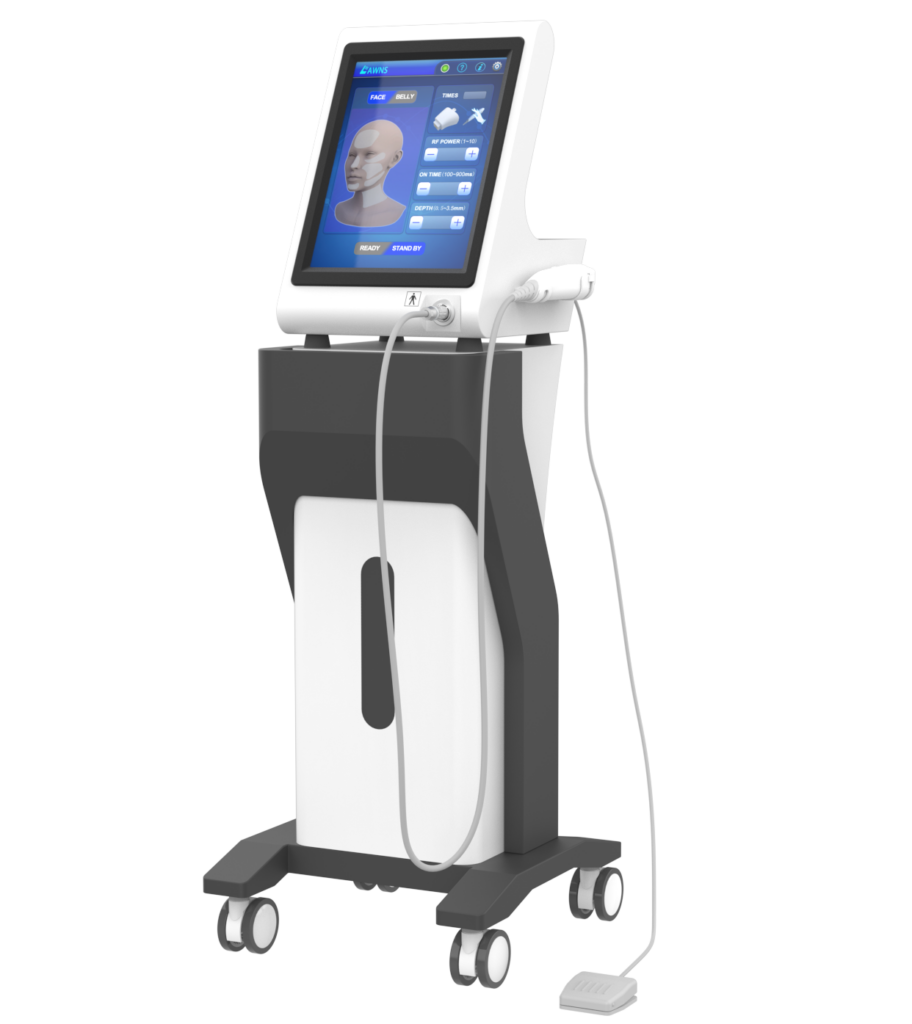
Stationary models are larger, vertically oriented machines, often integrated into a dedicated rolling cart with built-in storage for cartridges and accessories.
- Vantaggi:
- Professional Appearance: These larger units often have a more substantial and “medico” appearance, which can enhance a clinic’s professional image and a client’s confidence in the treatment.
- Ergonomics and Workflow: They are typically designed to be at an optimal working height for a standing or seated practitioner. Integrated storage keeps accessories organized and within easy reach, streamlining the treatment process.
- Potentially More Robust Internals: The larger chassis provides more room for components, including larger power supplies and more extensive cooling systems (fans, heat sinks), which can contribute to long-term durability and consistent performance.
- Svantaggi:
- Higher Price: The additional materials, larger casing, and integrated cart mean that stationary models almost always have a higher HIFU machine price than a portable version with the same core technology. The price difference might be several hundred to over a thousand dollars.
- Larger Footprint: They require more floor space, which can be a consideration in smaller clinics.
- Less Flexibility: While they are on wheels, they are heavier and more cumbersome to move between locations.
The choice between a portable and stationary model is primarily a practical one. It depends on your clinic’s physical space, il tuo flusso di lavoro, whether you need to transport the device, e il tuo budget. It is important not to equate size with quality. A high-quality portable machine from a reputable manufacturer will outperform a poorly made stationary unit every time. Tuttavia, when comparing two machines with identical technology and from the same trusted brand, you can expect to pay a premium for the larger, stationary form factor.
Calculating Your Return on Investment (ROI)
Purchasing a HIFU machine is not an expense; it is an investment. Like any good investment, you should project its potential returns before you commit capital. A careful ROI calculation will transform the abstract HIFU machine price into a concrete business plan, giving you clarity on the financial viability of offering this service in your specific market.
The fundamental ROI question is: “How long will it take for the machine to pay for itself and start generating profit?”
Let’s walk through a sample calculation. This is a mental exercise you should perform for every machine you consider.
Fare un passo 1: Determine Your Total Initial Investment This is more than just the HIFU machine price.
- HIFU Machine Cost: $4,500 (Let’s assume a quality, multi-function 7D/MPT machine)
- Spedizione & Tasse (se applicabile): $300
- Additional Training/Certification (if not included): $0
- Initial Marketing Materials: $200
- Total Initial Investment: $5,000
Fare un passo 2: Calculate Your Cost Per Treatment This is your primary variable cost.
- Average Shots per Full Face/Neck Treatment: 800 colpi
- Cartridge Cost: $200 per 20,000 colpi
- Cost per Shot: $200 / 20,000 = $0.01
- Cost of Consumables per Treatment: 800 colpi * $0.01 = $8.00
- Other Disposables (gel, guanti, ecc.): ~$2.00
- Practitioner’s Time (per esempio., $50/ora, 1-hour treatment): $50.00 (This can be allocated differently depending on your accounting, but it’s important to consider).
- Total Cost Per Treatment: $8 + $2 + $50 = $60.00
Fare un passo 3: Set Your Treatment Price This requires market research. What are other reputable clinics in your area charging for similar non-surgical lifting treatments? Price is a signal of quality, so don’t undercharge. Let’s assume a competitive but profitable price.
- Price per Full Face/Neck Treatment: $750
Fare un passo 4: Project Your Monthly Revenue and Profit This requires an honest assessment of your marketing capabilities and client base.
- Gross Revenue per Treatment: $750
- Profit per Treatment: $750 (Reddito) – $60 (Costo) = $690
- Projected Treatments per Week: 3 (a conservative starting point)
- Treatments per Month: 3 * 4 = 12
- Total Monthly Profit: 12 trattamenti * $690/treatment = $8,280
Fare un passo 5: Calculate the Break-Even Point
- Time to Break Even = Total Initial Investment / Total Monthly Profit
- Time to Break Even = $5,000 / $8,280 =~0.6 months, or about 3 settimane.
In this hypothetical scenario, the machine pays for itself in less than a month and then becomes a pure profit center.
| Articolo | Example Calculation |
|---|---|
| UN. Investimento iniziale | |
| Prezzo della macchina HIFU | $4,500 |
| Shipping/Taxes | $300 |
| Investimento totale (UN) | $4,800 |
| B. Cost Per Treatment | |
| Costo dei materiali di consumo (per esempio., 800 colpi) | $8.00 |
| Other Disposables (gel, ecc.) | $2.00 |
| Total Variable Cost (B) | $10.00 |
| C. Reddito & Profit Per Treatment | |
| Your Treatment Price | $750 |
| Profit Per Treatment (C = Price – B) | $740 |
| D. Analisi del pareggio | |
| Treatments Needed to Break Even (UN / C) | 6.5 trattamenti |
| Projected Treatments per Month | 10 |
| Months to Break Even | < 1 month |
This exercise demonstrates the power of a low consumable cost. Even with a significant initial investment, a profitable service with healthy margins can recoup its cost very quickly. Run these numbers for a high-cost, FDA-cleared device with its expensive cartridges, and you will see a much longer break-even timeline, illustrating the different business models at play.
Domande frequenti (FAQ)
What is a realistic HIFU machine price for a new small clinic in 2025?
For a new or small clinic, a realistic budget for a high-quality, professional, non-FDA-cleared HIFU machine would be between $2,000 E $5,000. Within this range, you can acquire a technologically current device (such as a 7D or even a portable MPT system) from a reputable international manufacturer. This price point should include multiple cartridges for face and body, a good warranty, and some level of training. Going below this range significantly increases the risk of poor build quality, lack of support, and inconsistent results.
Do I really need an FDA-cleared machine to operate safely?
You do not necessarily need an FDA-cleared machine to operate safely, but you do need to be exceptionally diligent. Safety is a function of device quality, operator training, and proper protocols. A well-made machine from a reputable manufacturer, even if not FDA-cleared, can deliver energy safely and effectively. The key is that the operator must be thoroughly trained in facial anatomy and the correct treatment technique. Tuttavia, FDA clearance provides an external validation of safety and efficacy, which can simplify liability and marketing. Senza di esso, the burden of ensuring safety falls more heavily on the clinic owner and practitioner.
How much do replacement HIFU cartridges cost?
The cost of replacement cartridges varies dramatically. For most non-FDA-cleared machines from Asian manufacturers, replacement cartridges typically cost between $120 E $400 ogni (Mico Aes, n.d.-a). These cartridges usually offer a high shot count, often between 10,000 E 30,000 colpi. For FDA-cleared systems like Ultherapy, cartridges are proprietary, significantly more expensive, and have a lower shot count, which translates to a much higher cost per treatment.
Is a more expensive HIFU machine always better?
Non necessariamente. A higher HIFU machine price often correlates with factors like FDA clearance, reputazione del marchio, o funzionalità avanzate. UN $75,000 FDA-cleared machine is “Meglio” in terms of its legal marketing status and the clinical data backing it. Tuttavia, UN $5,000 12D MPT machine might offer faster treatment times and more technological features. IL “Meglio” machine depends on your clinic’s specific goals, budget, and risk tolerance. The focus should be on value—the combination of quality, caratteristiche, supporto, and price—rather than price alone.
How many treatments can I get from one cartridge?
This depends on the cartridge’s total shot count and the number of shots you use per treatment. Per esempio, a common 20,000-shot cartridge could provide 40 full-face treatments if you use 500 shots per treatment (20,000 / 500 = 40). If a full-face and neck treatment requires 800 colpi, the same cartridge would yield 25 trattamenti (20,000 / 800 = 25). It is crucial to determine your treatment protocols and average shot counts to accurately forecast how long your cartridges will last.
Can I use third-party cartridges with my HIFU machine?
This is generally not recommended. HIFU machines are calibrated to work with their specific, manufacturer-supplied cartridges. Using a third-party or counterfeit cartridge can lead to incorrect energy delivery, which is both a safety risk for the patient and a potential cause of damage to the handpiece or the machine itself. Doing so would almost certainly void your device’s warranty. Always purchase replacement cartridges directly from your original supplier or an authorized distributor.