If your clinic turns away Fitzpatrick IV–VI clients — or treats them on the wrong wavelength — you are trading away one of the fastest-growing segments in aesthetic hair removal and taking on a real complication risk while you do it. Dark-skinned clients have historically been under-served because the lasers most clinics bought first (755nm alexandrite, some IPL systems) were built for lighter skin. Get the wavelength wrong on melanin-rich skin and the outcome is not a slow result; it is burns, cloquant, and post-inflammatory hyperpigmentation that turn into refunds and reviews.
This guide explains why the 1064nm Nd:YAG wavelength is the accepted choice for darker skin, what the clinical evidence actually shows for skin types IV–VI, and — the part most buying guides skip — what to verify in a machine before you sign a purchase order. The clinical figures below are drawn from peer-reviewed studies indexed on PubMed and from DermNet’s dermatology references; every number is anchored to its source.
1064nm for Dark Skin at a Glance
| Paramètre | Valeur |
|---|---|
| Longueur d'onde | 1064 nm (proche infrarouge) |
| Laser medium | sd:Yag (neodymium-doped yttrium aluminium garnet) |
| Typical dermal penetration | ~2–5 mm to the follicle target |
| Best-suited skin types | Fitzpatrick IV–VI (also usable across I–VI) |
| Epidermal melanin absorption | Low relative to 755nm/808nm |
| Typical hair-removal settings | Fluence ~10–50 J/cm²; pulse duration ~10–30 ms; contact cooling |
| NOUS. regulatory pathway | FDA 510(k) cleared for hair reduction |
These are category-level facts, not a claim about any one device. The reasons 1064nm is preferred for melanin-rich skin — the mechanism, the depth, the safety margin — are set out and sourced in the sections below.
Why Laser Hair Removal Is Riskier on Dark Skin
All laser hair removal works by selective photothermolysis: light is absorbed by melanin in the hair, converti en chaleur, and that heat destroys the follicle. The problem on darker skin is that the melanin in the epidermis and the melanin in the hair follicle have nearly identical absorption spectra, so a wavelength that is strongly absorbed by hair pigment is also strongly absorbed by the pigment sitting in the skin’s surface layers.
On Fitzpatrick I–III skin there is little competing epidermal melanin, so this rarely matters. On IV–VI skin, the epidermis is a dense chromophore of its own. A shorter wavelength — 755nm alexandrite is the classic example — deposits too much of its energy in the surface, producing the burns, cloquant, and pigmentary changes that make laser hair removal « not recommended » for dark skin when the wrong device is used.
The fix is not a stronger laser. It is a wavelength that the epidermis largely ignores.
⚠️ Buyer Pitfall — « Il’s a laser, it works on everyone. » A single-wavelength 755nm or short-pulse system marketed as « Tous les types de peau » is one of the most common mismatches we see in distributor returns. On IV–VI skin it is a complication waiting to happen. The wavelength, not the brand, determines whether melanin-rich skin can be treated safely.
Pourquoi 1064 nm Nd:YAG Is Preferred for Fitzpatrick IV–VI
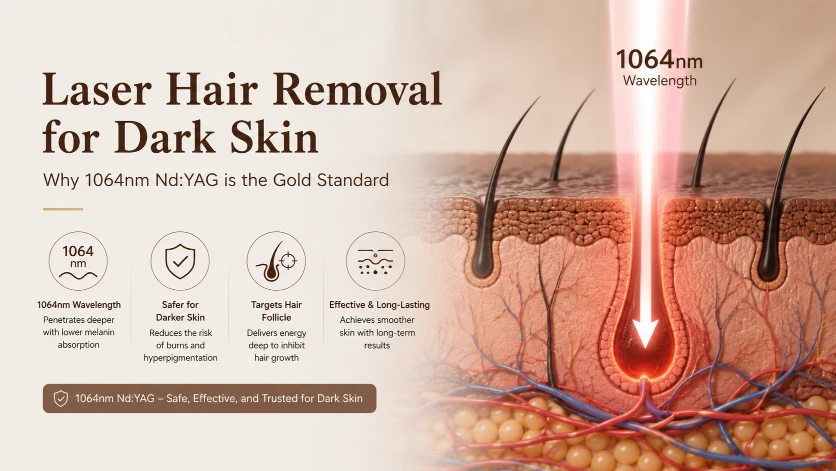
The 1064nm wavelength sits at the far end of melanin’s absorption curve. According to DermNet’s dermatology reference, the long-pulsed Nd:YAG laser is the safest option for hair removal in skin of colour precisely because its 1064nm wavelength is at the end of melanin’s absorption spectrum — it delivers enough thermal injury to dark, coarse hair while sparing the epidermis.
Two physical properties do the work:
Low epidermal absorption. Because 1064nm is weakly absorbed by surface melanin, the beam passes through the pigmented epidermis rather than depositing its energy there. Less surface energy means a wider safety margin against burns and hyperpigmentation on IV–VI skin.
Pénétration plus profonde. The near-infrared wavelength reaches the follicle target roughly 2–5 mm into the dermis. Peer-reviewed work notes that only wavelengths in the ~630–1100nm range can irradiate the full length of an anagen follicle at that depth — data drawn from PubMed-indexed research on 1064nm hair reduction in darker skin (Mittal et al., 2008).
📐 Engineering Note — pulse width is not a spec to skimp on. The pulse duration should be matched to the hair’s thermal relaxation time so heat builds in the follicle faster than it can leak into surrounding tissue. Plus long, adjustable pulse widths let the energy be delivered slowly enough for the epidermis to shed heat between the surface and the deeper dermis — one of the two factors that make long-pulsed 1064nm safe on dark skin. A machine that offers only one or two fixed pulse settings gives your operators far less room to treat IV–VI skin conservatively.
For a fuller breakdown of how 1064nm compares to 755nm and 808nm across skin types, see our companion guide on laser hair removal wavelengths.
What the Clinical Studies Show for Skin Types IV–VI
The evidence base for 1064nm on darker skin is substantial and consistent. Three studies are worth putting in front of a clinical buyer:
| Étude (types de peau) | Protocole | Résultat |
|---|---|---|
| Mittal et al., 2008 — Indian patients (IV–V) | 1064nm, 10mm spot, 30–50 J/cm², 15–30 ms, 6 sessions at 4–6 wk intervals, contact cooling | 56% of patients reached a « clair » grade; success improved with each successive session |
| Alster, Bryan & Williams, 2001 — pigmented skin (IV-VI) | 1064nm, 50 MS, 40–50 J/cm², 3 monthly sessions | 70–90% hair reduction at 12 mois, with selective follicular injury and no epidermal disruption on histology |
| Ahmed et al., 2025 — Sudanese women (IV-VI) | Low-fluence 1064nm Nd:Yag | Supported safe and effective hair reduction at conservative fluences on very dark skin |
Two operator-relevant patterns come out of this literature. D'abord, results are session-dependent, not single-shot. In the Indian study, « achievers » rose from 5% after three sessions to 56% after six — because a laser can only affect follicles in the active anagen phase, and only 50–65% of hair is in anagen at any time (Mittal et al., 2008). Any device sold on a « permanent removal in one session » promise is misrepresenting the biology.
Deuxième, hair type predicts response. Coarse terminal hair responds best; fine intermediate hair is far more likely to be a treatment failure — nearly 50% failure among intermediate-hair patients versus none in the terminal-hair group in the Indian cohort. This is the counselling point your clinic clients need to set client expectations, and it holds regardless of which manufacturer’s machine performs the treatment.
💡 Pro Tip — patch test before the first full session on IV–VI skin. Run a test spot at the intended settings and review it at 24–48 hours before committing to a full treatment. It costs a few minutes and is the single most reliable guard against a pigmentary complication on a new client. Reputable protocols build this in; make sure your operator training does too.
sd:YAG vs Diode: What to Actually Look For in a Machine
Here is the trade-off that vendor marketing usually hides, and the honest answer to « what is the main disadvantage of Nd:Yag? »
Because 1064nm is weakly absorbed by melanin, it is less efficient per pulse than shorter wavelengths — the same property that makes it safe on dark skin makes it work harder to heat the hair. In practice that means Nd:YAG treatment causes more discomfort during treatment and is less effective on fine and light hair than 755nm or 808nm systems. The shorter-wavelength diode (808nm) is often regarded as more effective on hair pigment for exactly this reason.
So the framing « buy an Nd:YAG machine ou a diode machine » is a false choice for a clinic that serves a mixed client base. The question is not the laser medium printed on the box — it is whether the platform gives you a genuine, independently controllable 1064nm output alongside the shorter wavelengths that handle lighter skin and finer hair efficiently.
UN three-wavelength diode platform (755nm + 808nm + 1064nm) resolves the trade-off: 808nm for the bread-and-butter I–III work, 755nm for finer hair on lighter skin, and 1064nm as the safety wavelength for IV–VI clients — one machine covering the full Fitzpatrick range. What matters for procurement is that the 1064nm is not a token spec.
Before you sign a purchase order, verify each of these — and the reason each matters:
| Que vérifier | Pourquoi ça compte |
|---|---|
| 1064nm is independently selectable at adequate fluence | A blended output that can’t isolate 1064nm doesn’t give you the epidermal safety margin on IV–VI skin |
| Plage de largeur d'impulsion, not one or two fixed settings | Conservative treatment of dark skin depends on matching pulse duration to hair type (see Engineering Note) |
| Contact cooling integrated in the handpiece | Both landmark studies used contact cooling to protect the epidermis; it is not optional on IV–VI skin |
| Supplier provides IV–VI parameter guidance | A supplier who can’t hand you starting fluence/pulse tables for darker skin hasn’t validated the device for that use |
| Regulatory status stated precisely | See the pitfall below — the exact wording tells you whether the claim is real |
⚠️ Buyer Pitfall — « Approuvé par la FDA » is a red flag, not a green one. Hair-removal lasers in the U.S. reach market through the 510(k) autorisation pathway, not the pre-market approval (PMA) pathway used for higher-risk devices. A supplier who advertises a hair-removal laser as « Approuvé par la FDA » is either careless with regulatory language or hoping you won’t check. The correct term is FDA. ou 510(k) effacé. Ask for the clearance and verify it — this small wording test filters out a surprising number of unserious suppliers.
For the record on the category: the U.S. FDA has cleared both long-pulsed diode and Nd:YAG laser systems for hair-reduction indications, and DermNet notes the long-pulse (millisecond) 1064nm system is more effective and safer for hair removal than the Q-switched (nanosecond) sd:YAG used for pigment and tattoo work — the two are not interchangeable.
Photomed’s own device in this class, the FDA-cleared LaseSmooth Pro, is built for exactly this mixed-clientele use case; if you serve IV–VI clients, ask us for the darker-skin parameter guidance referenced above.
Questions fréquemment posées
Is Nd:YAG laser good for dark skin?
Oui. The long-pulsed 1064nm Nd:YAG is widely regarded as the safest laser for Fitzpatrick IV–VI skin because its wavelength sits at the end of melanin’s absorption spectrum, sparing the epidermis while heating deeper follicles. Clinical studies report 56% to 70–90% hair reduction across multiple sessions on darker skin (Mittal 2008; Alster 2001).
What is a 1064nm laser used for?
In aesthetics, 1064nm Sd:YAG is used for hair reduction on darker and coarse-hair clients, and — in a different Q-switched mode — for pigment and tattoo removal. The long-pulse (millisecond) mode is for hair; the Q-switched (nanosecond) mode is for pigment. The two modes are not interchangeable settings.
Why is laser hair removal not recommended for dark skin?
It is only ill-advised when the wrong wavelength est utilisé. Shorter wavelengths (par exemple. 755nm) are heavily absorbed by epidermal melanin on IV–VI skin, risking burns and hyperpigmentation. A correctly operated 1064nm Nd:YAG with cooling avoids this, which is why it is the recommended wavelength for darker skin.
What is the main disadvantage of the Nd:Laser yag?
Its low melanin absorption — the same property that makes it safe on dark skin — makes it less efficient per pulse. In practice it is more uncomfortable during treatment and less effective on fine or light-coloured hair than 755nm/808nm systems, and it typically needs adequate fluence and multiple sessions to match their results.
What type of laser is best for dark skin?
The long-pulsed 1064nm Nd:YAG wavelength. For a clinic with a mixed client base, a three-wavelength platform (755/808/1064nm) is the practical answer, using 1064nm specifically for Fitzpatrick IV–VI clients while shorter wavelengths handle lighter skin and finer hair.
Does laser hair removal cause dark spots on dark skin?
Post-inflammatory hyperpigmentation is the main pigmentary risk, and it stems from excess epidermal heating — most often from a too-short wavelength or too-aggressive settings on IV–VI skin. Using 1064nm at conservative fluences with contact cooling and a prior patch test substantially lowers that risk; landmark IV–VI studies reported only transient, non-scarring effects.
Ready to serve darker-skin clients safely?
If your clinic or distribution catalogue needs a wavelength that covers Fitzpatrick IV–VI without compromising efficiency on lighter skin, contact Fotromed for the three-wavelength parameter guidance and a quotation for the LaseSmooth Pro.
À propos de ce guide
Cet article est écrit pour les propriétaires de cliniques, medspa operators, and distributors evaluating laser hair-removal equipment for darker-skinned clients. Clinical claims are sourced to peer-reviewed studies indexed on PubMed and to DermNet’s dermatology references, cited inline at the point of use. Regulatory terminology follows current U.S. FDA usage (510(k) autorisation for hair-removal lasers, distinct from pre-market approval). It is B2B procurement guidance, not patient medical advice or a treatment protocol; treatment parameters must be set by trained clinical operators.
Références & Sources
- Evaluation of Long-pulsed 1064 nm Sd:YAG Laser-assisted Hair Removal vs Multiple Treatment Sessions and Different Hair Types in Indian Patients — Mittal et al., Journal de chirurgie cutanée et esthétique (indexed on PubMed / PMC)
- Long-pulsed Nd:YAG Laser-Assisted Hair Removal in Pigmented Skin: A Clinical and Histological Evaluation — Alster, Bryan & Williams, Archives of Dermatology (PubMed)
- Efficacy and Safety of 1064 nm Sd:YAG Laser for Hair Removal in Sudanese Women (Fitzpatrick IV–VI) — PubMed
- Laser therapy in skin of colour — DermNet
- sd:YAG laser treatment — DermNet
- An ideal laser for hair reduction in ethnic skin — OA Text clinical review
Articles connexes
- Explication des longueurs d'onde de l'épilation au laser: 755nm contre 808 nm contre 1064 nm
-
Haut 10 Fabricants et fournisseurs de machines laser à diode en 2026
-
Haut 7 Les cliniques d’appareils d’épilation au laser devraient envisager (2026)
-
Épilation laser ou IPL: Quelle est la différence pour une clinique?
-
Explication des longueurs d'onde de l'épilation au laser: 755nm contre 808 nm contre 1064 nm