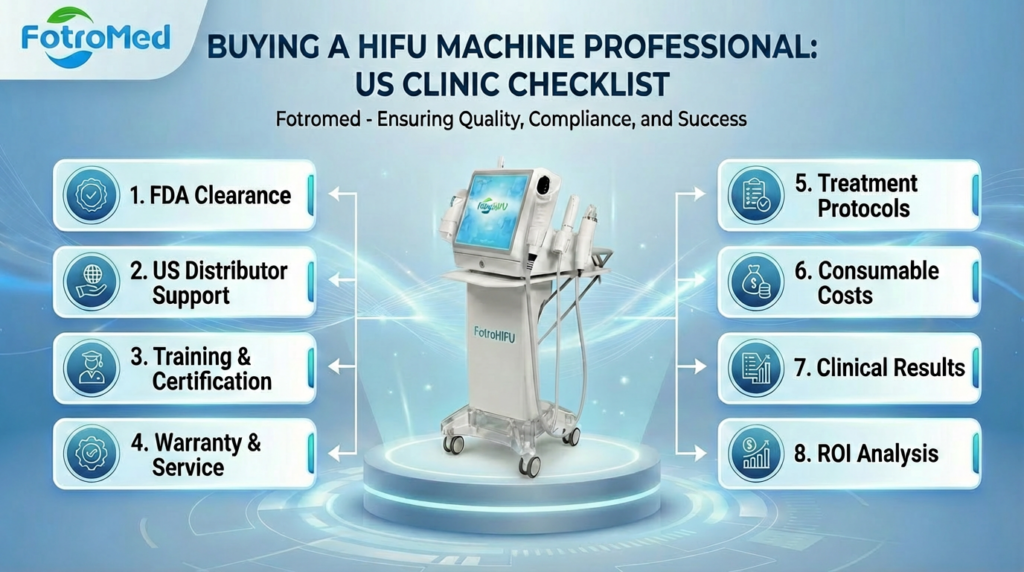
Investing in a HIFU machine professional for a U.S. clinic is a significant financial decision subject to strict regulatory oversight. This purchasing guide helps prospective buyers navigate the complexities of sourcing a professional HIFU machine, covering the FDA approval process, vetting international manufacturers, and understanding the true cost of ownership. Our goal is to provide a clear framework for selecting a safe, effective, and compliant medical-grade HIFU device, helping you confidently acquire the best HIFU machine professional for your practice while mitigating risks and ensuring patient safety.
Decoding FDA Regulations and Device Classification
The journey toward integrating a new aesthetic modality into a clinical practice is often animated by the promise of technological advancement and enhanced patient outcomes. Yet, the acquisition of a device like a HIFU machine professional is not merely a commercial transaction; it is an entry into a rigorously structured regulatory environment. For any practitioner in the United States, the first and most foundational point of inquiry must be the U.S. Food and Drug Administration (FDA). The FDA’s mandate is to protect public health by ensuring the safety and efficacy of a vast range of products, including the very devices that define modern aesthetic medicine (). To neglect this dimension is to build a clinical service on an unstable and legally precarious foundation.
Understanding Device Classification: Class I, II, and III
The FDA employs a risk-based classification system to categorize all medical devices. Think of it as a tiered system where the level of regulatory control is directly proportional to the potential risk the device poses to the patient.
| Device Class | Risk Level | Regulatory Control | Examples | Typical Pathway for a HIFU Machine Professional |
|---|---|---|---|---|
| Class I | Low | General Controls | Elastic bandages, manual toothbrushes | Not Applicable |
| Class II | Moderate | General Controls and Special Controls | Powered wheelchairs, infusion pumps, most aesthetic energy devices | Premarket Notification (510(k)) |
| Class III | High | General Controls and Premarket Approval (PMA) | Implantable pacemakers, heart valves | Not Applicable (for most aesthetic uses) |
Most aesthetic energy devices, including the majority of legally marketed HIFU systems, are categorized as Class II medical devices. The risk is considered moderate; while not as high as a life-sustaining implant, the potential for misuse or malfunction to cause harm (such as burns or nerve injury) is significant. This classification means the device is subject not only to “General Controls” (which include provisions on adulteration, misbranding, device registration, and good manufacturing practices) but also to “Special Controls.” For Class II devices, the most common form of special control is the requirement for Premarket Notification, more commonly known as a 510(k) submission.
The 510(k) Pathway: The Gatekeeper for Most Aesthetic Devices
Imagine you are a manufacturer. You cannot simply start selling your new HIFU machine professional in the U.S. You must first submit a 510(k) dossier to the FDA. In this dossier, you will provide extensive data—engineering specifications, performance testing, safety data, and sometimes clinical data—that compares your device to an existing, legally marketed predicate HIFU device. The FDA’s role is to review this data and determine if your device is indeed substantially equivalent. If they agree, they issue a clearance letter, allowing you to legally market the device in the U.S. for the specific “indications for use” that were cleared.
For you, the prospective buyer, the 510(k) clearance is your first and most important piece of evidence that the device has undergone FDA review for its intended purpose. A manufacturer or supplier claiming their device is “FDA registered” or “FDA certified” is using misleading language. An establishment (the company) must register with the FDA, but the device itself must be cleared (via 510(k)) or approved (via PMA). A legitimate manufacturer will be transparent about their 510(k) number. For example, some companies proudly announce their FDA 510(k) clearance and provide the specific submission number (K202257, for instance) for verification (jontelaser.com).
Your due diligence here is non-negotiable. You must independently verify this claim. The FDA maintains a public database for 510(k) clearances. You can search this database using the manufacturer’s name, device name, or the 510(k) number itself. When you find the clearance summary, pay close attention to two things: the name of the applicant (does it match the manufacturer?) and, crucially, the “indications for use.” If a HIFU machine professional was cleared for a non-specific dermatological procedure, but the company is marketing it for a “non-surgical facelift,” that is a red flag. The marketing claims must align with the cleared indications.
Verifying Manufacturer and Supplier Credentials
Once you have confirmed that a specific model of a HIFU machine professional has legitimate FDA 510(k) clearance, the investigation shifts from the device to the people selling it. In a globalized market, the company you purchase from may be the original manufacturer, a designated distributor, or an independent reseller. Each link in this supply chain carries its own set of risks and responsibilities. Your task is to trace the chain back to its source and verify the credentials of each entity involved. This process is akin to verifying the provenance of a valuable piece of art; it establishes authenticity and value.
The global supply chain for medical devices is complex. A device might be designed in one country, use components from several others, be assembled in another, and then imported into the United States for sale (). Simply finding a website that looks professional is insufficient. You must dig deeper to protect your clinic, your patients, and your investment.
The FDA Establishment Registration Database
Just as the device itself must be cleared or approved, any establishment involved in the production and distribution of medical devices intended for sale in the U.S. is required to register annually with the FDA. This includes foreign manufacturers, exporters, and U.S. importers. This registration is a fundamental requirement for legal importation and commercial distribution ().
Like the 510(k) database, the FDA maintains a public Establishment Registration & Device Listing database. Before engaging with a supplier, you should search for their company name in this database. What should you look for?
- Active Registration: Is their registration current for the year 2025? An expired registration is a major red flag.
- Establishment Operations: The listing will specify the company’s role—are they a Manufacturer, a Foreign Exporter, a Repackager/Relabeler, or a U.S. Importer? This helps you understand their position in the supply chain. If a company claims to be the manufacturer but is only listed as an importer, you need to ask more questions.
- Listed Devices: The database also shows which devices the establishment has listed. Does the HIFU machine professional you are considering appear on their list of actively marketed devices?
| Vetting Aspect | What to Check | Where to Check | Red Flags |
|---|---|---|---|
| Device Status | 510(k) Clearance Number | FDA 510(k) Premarket Notification Database | No 510(k) number provided; Mismatch in company name or indications for use. |
| Manufacturer/Supplier | Active Establishment Registration | FDA Establishment Registration & Device Listing Database | Expired or non-existent registration; Company’s role doesn’t match their claims. |
| Compliance History | Import Alerts | FDA Import Alert Database | The manufacturer or device is listed on an alert, especially for GMP violations (e.g., Alert 89-04). |
| Documentation | Certificate to Foreign Government (CFG) | Request from the manufacturer/exporter | Unwillingness or inability to provide a copy of a CFG for the device. |
Digging Deeper: Import Alerts and Certificates
Beyond registration, the FDA maintains an “Import Alert” list. This is essentially a “watch list” for firms and products that have a history of violating FDA regulations. Before finalizing a purchase, it is wise to search this database for the name of the foreign manufacturer. If they are on an import alert, their products are subject to “Detention Without Physical Examination” (DWPE), meaning your shipment could be stopped at the border and refused entry. This could leave you with a significant financial loss and no device.
A key document to request from a foreign manufacturer is a Certificate to Foreign Government (CFG). Issued by the FDA, a CFG certifies that their medical device, such as a HIFU machine professional, is legally marketed in the U.S.
Asking a manufacturer for a CFG is a powerful vetting tool. A confident, compliant manufacturer will readily provide it, while any hesitation could signal underlying regulatory issues. This check, combined with verifying device clearance, establishment registration, and import alerts, creates a robust shield against the risks of sourcing high-value medical devices from overseas.
Assessing Technical Specifications Beyond the Hype
In the world of aesthetic devices, marketing language often employs a vocabulary of power, precision, and revolution. While compelling, these claims must be translated into the concrete language of physics and engineering. When you evaluate a HIFU machine professional, you must move beyond the glossy brochures and focus on the technical specifications that directly impact clinical efficacy and patient safety. Your role transitions from that of a consumer to that of a discerning scientist, scrutinizing the engine under the hood rather than just the polished exterior.
The fundamental principle of HIFU is the creation of precise, controlled thermal injury at specific depths beneath the skin, without harming the overlying epidermis. This is achieved by focusing ultrasound waves to a tiny point, much like a magnifying glass focuses sunlight. At this focal point, the rapid absorption of acoustic energy causes the temperature to rise above 65°C in a fraction of a second, creating a “thermal coagulation point” or TCP. The body’s natural wound-healing response to these thousands of tiny TCPs results in the production of new collagen and elastin, leading to tissue tightening and lifting over several months. The quality of the treatment is therefore entirely dependent on the quality and precision of these TCPs.
The Transducer: The Heart of the HIFU Machine
The single most important component of any HIFU machine professional is the transducer, which is housed within the handpiece cartridges. The transducer is what converts electrical energy into mechanical ultrasound waves and then focuses them. Think of it as the equivalent of a high-end lens on a professional camera. A poor-quality lens will produce a blurry, distorted image regardless of how sophisticated the camera body is. Similarly, a low-quality transducer will create inconsistent, poorly-formed TCPs, leading to suboptimal results and an increased risk of side effects.
What defines a high-quality transducer?
- Consistency of Energy Output: Each pulse from the device should deliver a consistent amount of energy. Fluctuations in energy can lead to some TCPs being too weak (ineffective) and others being too strong (risking burns or fat atrophy). A reputable manufacturer will have stringent quality control measures to ensure energy consistency across all pulses and throughout the lifespan of the cartridge. Ask for data on energy stability and shot-to-shot variance.
- Focal Point Precision: The transducer must focus the energy at the exact intended depth (e.g., 1.5mm, 3.0mm, 4.5mm). An imprecise focal point means the thermal injury could occur too superficially, risking a skin burn, or too deep, potentially affecting unintended structures like bone or major nerves. This precision is a hallmark of a well-engineered HIFU machine professional.
- Durability and Lifespan: HIFU cartridges are consumables with a finite number of “shots.” The materials and construction of the transducer determine its durability. A cheaply made transducer may degrade over its lifespan, with the quality of the focal point diminishing as the shot count increases. This is why it is often unwise to purchase “refilled” or third-party cartridges; you have no guarantee of the transducer’s quality or remaining effective life.
Key Performance Metrics to Scrutinize
When comparing different models of a HIFU machine professional, create a checklist of key performance metrics.
- Frequency (MHz): Most aesthetic HIFU systems operate between 4 and 10 MHz. Higher frequencies have a shorter wavelength and are absorbed more superficially, making them suitable for treating the upper dermis (e.g., with a 1.5mm or 2.0mm cartridge). Lower frequencies penetrate deeper and are used for the deep dermis and the SMAS layer (e.g., with 3.0mm and 4.5mm cartridges). A versatile system will offer a range of cartridges at different frequencies and depths.
- Power/Energy (Joules): The energy level determines the size and temperature of the TCP. The software interface should allow for precise control of the energy settings. However, higher power is not always better. The goal is to deliver just enough energy to create a therapeutic TCP without causing excessive damage. The ability to titrate energy based on the patient’s skin thickness and sensitivity is a feature of a superior device.
- Cartridge Options: A comprehensive system will offer a variety of cartridges for different treatment areas and depths. Standard cartridges include 4.5mm for the SMAS, 3.0mm for the deep dermis, and 1.5mm for the superficial dermis. Some advanced systems, such as certain Microneedle RF Machine platforms that also incorporate HIFU, may offer specialized cartridges for smaller areas like around the eyes and mouth, or even body cartridges for contouring. The availability of a wide range of high-quality cartridges expands the clinical versatility of the device.
- Software and User Interface: The software is the brain of the HIFU machine professional. It should be intuitive, stable, and provide clear feedback to the operator. Look for features like a real-time display of the shot count, clear energy and spacing parameters, and safety interlocks. A clunky, unresponsive, or confusing interface can increase the risk of user error.
Your evaluation of a device should involve a direct conversation with the manufacturer’s technical or clinical team. Pose specific questions about transducer technology, energy stability testing, and quality control processes. A company that is proud of its engineering will be able to answer these questions in detail. A company that deflects with vague marketing terms is hiding a lack of substance.
The Importance of Clinical Training and Post-Sale Support
The acquisition of a sophisticated medical device like a HIFU machine professional is not the culmination of a process, but the beginning of one. The device itself is a tool, and its potential can only be realized through the skill, knowledge, and confidence of the practitioner who wields it. An empathetic understanding of the practitioner’s journey reveals that the transition from owning a device to mastering it is fraught with challenges. Therefore, the quality of the clinical training and the reliability of the post-sale support offered by the supplier are not ancillary benefits; they are integral components of the product’s total value proposition. To invest in a machine without securing robust educational and technical support is to purchase a high-performance race car without learning how to drive it.
The safe and effective application of high-intensity focused ultrasound requires a deep understanding of facial anatomy, the principles of tissue interaction with ultrasound, and nuanced treatment techniques. It is a procedure that carries significant potential for adverse events, including burns, scarring, and nerve palsy, if performed incorrectly. Consequently, the training provided must go far beyond a simple demonstration of how to turn the machine on and press a button.
What Constitutes High-Quality Clinical Training?
When vetting a supplier for a HIFU machine professional, the training program should be scrutinized as rigorously as the device’s 510(k) clearance. A superior training program will exhibit several key characteristics:
- Qualified Instructors: Who is conducting the training? The trainer should be an experienced clinical professional—a nurse, physician, or senior esthetician—with extensive hands-on experience performing HIFU treatments. They should be able to answer complex questions about anatomy, patient selection, and managing complications, not just recite a pre-written script.
- Comprehensive Didactic Component: The training must begin with a thorough theoretical foundation. This should include the physics of focused ultrasound, the mechanism of action in tissue, detailed facial anatomy (with a focus on the SMAS, facial nerves, and vasculature), patient assessment and selection criteria, contraindications, and protocols for managing patient discomfort and potential side effects.
- Extensive Hands-on Practice: The majority of the training day should be dedicated to supervised, hands-on practice. Trainees should have the opportunity to perform full treatments on multiple live models, under the direct supervision of the instructor. This allows them to develop a feel for the handpiece, learn how to properly couple it to the skin, and practice different treatment patterns for various facial areas. A supplier that offers only remote, video-based training or a brief two-hour demonstration is not providing a professional level of education.
- Ongoing Clinical Support: Learning does not end when the initial training day is over. A reputable supplier will provide a clear pathway for ongoing clinical support. This could be a dedicated clinical hotline, an email support system, or access to a network of experienced users. When you are three months post-training and encounter a challenging patient case or an unexpected skin reaction, who can you call for advice? The answer to that question is a critical part of your purchasing decision.
The Ecosystem of Post-Sale Support
Beyond the initial training, the long-term relationship with your supplier is defined by the ecosystem of support they provide. This ecosystem is what ensures your HIFU machine professional remains a productive asset for your clinic, rather than a source of frustration.
- Technical Support and Maintenance: What happens when the machine displays an error code or the handpiece fails? You need a clear and efficient process for troubleshooting and repair. Does the supplier offer remote diagnostic capabilities? Do they have U.S.-based technicians? What is the typical turnaround time for a repair? A machine that is out of service is a machine that is losing money. Investigate the supplier’s service infrastructure.
- Warranty and Service Contracts: As we will discuss further, the warranty terms are a direct reflection of the manufacturer’s confidence in their product. A comprehensive warranty that covers both parts and labor for at least one year is standard. Many suppliers also offer extended service contracts. While an additional expense, a service contract can provide peace of mind by capping your potential repair costs and ensuring priority service.
- Marketing and Business Development Support: The most forward-thinking suppliers understand that their success is tied to yours. Some may offer marketing support materials, such as before-and-after photos, patient education brochures, or digital marketing assets, to help you successfully launch the new service in your clinic.
When you are in discussions with a potential supplier, ask to speak with one of their existing customers. A confident company with a strong record of customer satisfaction will be happy to provide a reference. Ask that reference about their experience with the training, the reliability of the device, and the responsiveness of the clinical and technical support teams. This peer-to-peer insight is often more revealing than any marketing brochure.
Calculating the True Cost of Ownership and ROI
A judicious assessment of any major capital investment requires a perspective that extends beyond the initial purchase price listed on an invoice. The acquisition of a HIFU machine professional is a paradigmatic case. The figure quoted by the sales representative is merely the entry point to a series of associated costs that will accrue over the lifetime of the device. A comprehensive financial analysis, one that calculates the “true cost of ownership” (TCO), is essential for accurately forecasting profitability and making a sound business decision. This requires a shift in mindset from that of a simple buyer to that of a strategic financial planner, meticulously accounting for every variable that will impact the bottom line.
The true cost of ownership is a financial estimate intended to help buyers and owners determine the direct and indirect costs of a product. Neglecting this calculation can lead to a situation where a seemingly affordable device becomes a financial drain due to unexpectedly high operational expenses.
Deconstructing the Total Cost of Ownership
Let’s break down the components that constitute the TCO for a professional HIFU machine.
- Initial Purchase Price: This is the most obvious cost, the price of the device itself. It can range significantly, from tens of thousands to well over one hundred thousand dollars, depending on the brand, technology, and regulatory status. It is tempting to be swayed by a lower initial price, but this is often where the financial pitfalls begin. A less expensive, non-510(k)-cleared device carries immense regulatory and liability risks that can result in costs far exceeding any initial savings.
- Consumables (Cartridges): This is the most significant ongoing operational cost. HIFU cartridges have a limited number of “shots” and must be replaced once depleted. The cost per shot is a critical metric for calculating the profitability of each treatment. You must ask the supplier for the price of each replacement cartridge and its total shot count. Let’s perform a simple mental exercise:
- Suppose a full-face treatment requires 800 shots.
- A cartridge costs $1,500 and contains 10,000 shots.
- The cost per shot is $1,500 / 10,000 = $0.15 per shot.
- The consumable cost for one full-face treatment is 800 shots * $0.15/shot = $120. You must perform this calculation for every device you consider. A machine with a lower purchase price but significantly more expensive cartridges may be far less profitable in the long run. Also, inquire about the shelf life of the cartridges and if there are discounts for bulk purchases. The cost structure of consumables for a HIFU machine professional can be compared to other devices, like a Hydro Facial Machine, which relies on a steady supply of treatment serums.
- Warranty and Service Contracts: A standard one-year warranty is typically included in the purchase price. After this period, you are exposed to the full cost of any repairs. Many suppliers offer extended service contracts for an annual fee. This fee must be factored into your TCO. While it adds to your fixed costs, it functions as an insurance policy against potentially catastrophic repair bills, which could run into thousands of dollars for a major component like a power supply or the main control board.
- Training Costs: While initial training is often included, you may need to train additional staff members in the future. Will the supplier charge for this? Are there costs associated with travel and accommodation if the training is conducted off-site? These potential future costs should be clarified upfront.
- Shipping, Installation, and Insurance: Remember to account for shipping fees, especially for an imported device. You will also need to ensure your professional liability insurance policy covers the use of this specific HIFU device. An increase in your insurance premium is a direct cost of ownership.
Projecting Return on Investment (ROI)
Once you have a clear picture of the TCO, you can begin to project the potential return on investment. ROI is a performance measure used to evaluate the efficiency of an investment. The basic formula is: (Net Profit / Cost of Investment) * 100.
To project your ROI, you need to estimate your revenue. This involves:
- Market Research: What is the average price for a full-face HIFU treatment in your geographic area? Research your competitors. Let’s say the average price is $2,500.
- Revenue per Treatment: Your revenue per treatment is the price charged to the patient minus the consumable cost. In our earlier example, this would be $2,500 – $120 = $2,380.
- Break-Even Analysis: How many treatments do you need to perform to cover the initial cost of the machine? If the machine costs $85,000, your break-even point would be $85,000 / $2,380 per treatment ≈ 36 treatments.
This break-even analysis provides a tangible goal. Can you realistically perform 36 treatments in your first year? How many will you need to perform to cover all your first-year costs (machine + service contract + etc.) and begin generating a profit? This structured financial projection transforms the purchase from a hopeful gamble into a strategic business expansion. It allows you to confidently answer the question: “Does this investment make financial sense for my practice?”
Navigating the Importation Process Smoothly
For many clinic owners in the United States, the prospect of purchasing a high-value medical device from an overseas manufacturer can be daunting. The process appears opaque, laden with customs regulations, paperwork, and the potential for costly delays. However, a systematic understanding of the import process, coupled with the engagement of professional partners, can demystify the procedure and ensure your HIFU machine professional arrives at your clinic smoothly and without incident. The key is to approach importation not as a logistical hurdle, but as a predictable sequence of steps that require proactive preparation.
All products offered for entry into the U.S., whether for commercial or personal use, must be declared to U.S. Customs and Border Protection (CBP). When the product is one that is regulated by the FDA, such as a medical device, CBP refers the entry to the FDA for review (). The FDA’s import review process is designed to ensure that products entering the country meet the same standards of safety and efficacy as domestically produced goods. Your goal is to provide all the necessary information in a clear and accurate format so that this review can be completed efficiently.
Step 1: Engage a Licensed Customs Broker
While it is technically possible to handle the customs entry yourself, it is highly inadvisable for a high-value, regulated product like a HIFU machine professional. The most prudent first step is to hire a licensed customs broker. A customs broker is a professional who is licensed by CBP to act as an agent for importers in customs transactions. Their expertise is invaluable. They understand the complex tariff schedules, the specific data elements required for an FDA-regulated entry, and how to communicate effectively with both CBP and the FDA. They will handle the preparation and submission of all required entry documents, the payment of duties and fees, and troubleshooting any issues that may arise. The cost of hiring a broker is a small price to pay for the assurance that the importation will be handled correctly.
Step 2: Ensure Your Supplier Provides the Correct Information
The customs entry process is now almost entirely electronic, managed through a system called the Automated Commercial Environment (ACE). Your customs broker will file the entry in ACE, but the accuracy of that filing depends entirely on the information provided by you and your foreign supplier. Before the device is even shipped, you must confirm that the supplier is prepared to provide a commercial invoice that includes all the necessary details:
- Accurate Product Description: “HIFU Machine” is not sufficient. The description should be precise, including the model name and number (e.g., “Model X-5000 Professional HIFU System”).
- Declared Manufacturer: The invoice must clearly state the name and full address of the actual manufacturer of the device.
- Consignee Information: Your clinic’s full name, address, and contact information.
- Harmonized Tariff Schedule (HTS) Code: This is a standardized international code used to classify traded products. Your customs broker can help determine the correct HTS code for your device.
Step 3: The Critical Role of Affirmation of Compliance (AofC) Codes
For FDA-regulated products, the electronic entry filing allows for the inclusion of “Affirmation of Compliance” codes. These are three-letter codes that affirmatively state that the product meets specific FDA requirements. Providing the correct AofC codes is perhaps the single most effective way to expedite the FDA’s review of your shipment (fda.gov).
When your customs broker files the entry for your HIFU machine professional, they will need to transmit several key pieces of information, which can be entered as AofC codes. These include:
- Device Foreign Manufacturer Registration (DEV): The FDA registration number of the foreign manufacturer.
- Device Listing (LST): The listing number for the specific device.
- Premarket Notification 510(k) (PMN): The 510(k) number for the device (e.g., Kxxxxxx).
When this information is submitted correctly, the FDA’s automated screening system, known as PREDICT, can electronically verify the data against its internal databases. If the submitted manufacturer registration number, device listing, and 510(k) number all match the FDA’s records for the imported product, the shipment is likely to be electronically cleared for release in a matter of minutes. If the information is missing, incomplete, or inaccurate, the entry will be flagged for manual review by an FDA import compliance officer, which can delay the release of your shipment by days or even weeks.
Before authorizing shipment, create a checklist for your supplier. Confirm with them that they will provide the commercial invoice with all details and, most importantly, provide you with the correct FDA registration number, device listing number, and 510(k) clearance number so you can pass it to your customs broker. Proactive communication and preparation are the cornerstones of a successful importation.
Securing Your Investment: Warranties, Insurance, and Service Agreements
The final pillar in the robust framework for acquiring a HIFU machine professional is the mitigation of future risk. After navigating the complexities of regulation, supplier vetting, and importation, the focus must turn to protecting your asset and your practice for the long term. This involves a meticulous examination of the legal and financial safety nets that will support you in the event of device malfunction, adverse patient outcomes, or routine wear and tear. These instruments—warranties, insurance policies, and service agreements—are not mere formalities; they are the essential components of a comprehensive risk management strategy.
A warranty is, in essence, a promise made by the manufacturer. It is a statement of their confidence in the quality and durability of their product. A service agreement is a business contract that defines the terms of future maintenance. And an insurance policy is a mechanism for transferring risk from your practice to an underwriter. Each plays a distinct but complementary role.
Deconstructing the Device Warranty
When you receive the warranty document for the HIFU machine professional, do not simply file it away. Read it with the same critical attention you would apply to any legal contract.
- Duration: What is the length of the warranty period? A one-year warranty is a common minimum standard for professional medical equipment. A longer warranty (two or three years) can be a significant indicator of the manufacturer’s confidence in their device’s reliability.
- Scope of Coverage: What, precisely, is covered? A comprehensive warranty should cover both parts and labor for any defects in materials or workmanship. Pay close attention to the exclusions. Are the consumable cartridges covered? Usually not. Is damage due to operator error, power surges, or failure to follow maintenance protocols excluded? Almost certainly. Understanding these limitations is crucial.
- The Service Process: If a warranty claim is necessary, what is the procedure? Do you contact the U.S. distributor or the foreign manufacturer directly? Will a technician be dispatched to your clinic, or will you be required to ship the device (or a component) to a service center? If shipping is required, who bears the cost? What is the guaranteed or estimated turnaround time for the repair? A vague or convoluted warranty claim process is a red flag.
The Imperative of Professional Liability Insurance
Standard professional liability (malpractice) insurance may not automatically cover new, advanced procedures like HIFU. Before you perform your first treatment, you must contact your insurance provider and inform them that you are adding a HIFU machine professional to your services. You will need to provide them with details about the device, including the manufacturer, model, and evidence of its FDA 510(k) clearance. The insurer will conduct a risk assessment and may adjust your premium accordingly. Failure to inform your insurer and get explicit confirmation of coverage in writing could result in a claim being denied, leaving you personally and financially exposed in the event of a lawsuit. Do not assume you are covered. Verify it. This step is as critical as verifying the device’s FDA status. Some insurers may also require proof of certification or training for any practitioner who will be operating the device.
Evaluating Service Agreements
After the initial warranty period expires, you will face a choice: operate without a service contract and pay for repairs as they arise (the “time and materials” model), or purchase an extended service agreement.
- Cost-Benefit Analysis: A service agreement provides cost predictability. You pay a fixed annual fee, and in return, most or all repair costs are covered. To evaluate if this is worthwhile, ask the supplier for the average cost of common out-of-warranty repairs. What is the cost to replace the main power supply? The control screen? The handpiece cable? If a single major repair could cost a significant fraction of the annual service contract fee, the contract may be a wise investment.
- Benefits Beyond Repair: Service agreements often come with additional benefits, such as priority service, free software updates, and sometimes even included preventative maintenance visits. A preventative maintenance check can identify potential problems before they lead to a catastrophic failure, minimizing downtime.
Ultimately, securing your investment is about creating layers of protection. A strong manufacturer’s warranty is your first layer. A comprehensive and specific professional liability policy is your second. And a well-structured service agreement can be your third. Together, they form a safety net that allows you to operate your new HIFU machine professional with confidence and peace of mind.
Frequently Asked Questions (FAQ)
Is a device that is “CE marked” legal to use in the US?
No, this is a common and critical misunderstanding. The CE mark indicates conformity with health, safety, and environmental protection standards for products sold within the European Economic Area (EEA). It is not recognized by the FDA and has no legal standing in the United States. A medical device must have FDA 510(k) clearance or PMA to be legally marketed and used in the U.S., regardless of its status in Europe or any other region.
What is the difference between “FDA Registered” and “FDA Cleared”?
“FDA Registered” refers to the establishment or company. Any firm involved in the manufacturing or distribution of medical devices for the U.S. market must register its facility with the FDA. “FDA Cleared” refers to the device itself. It signifies that the FDA has reviewed a Premarket Notification 510(k) submission and determined the device to be substantially equivalent to a legally marketed predicate device. You should look for a device that is FDA cleared, from a company that is FDA registered.
Can I buy a cheaper HIFU machine professional directly from an online marketplace for my clinic?
This is extremely risky and strongly discouraged. Devices sold on large, unregulated online marketplaces often lack FDA 510(k) clearance, are not manufactured in FDA-registered facilities, and may be counterfeit or poorly made. Importing and using such a device in a professional setting is illegal, voids most liability insurance, and poses a serious safety risk to your patients. The FDA actively monitors and can seize such illegal imports.
How often do the HIFU cartridges need to be replaced?
Each cartridge is rated for a specific number of “shots” or pulses, typically ranging from 10,000 to 20,000. The machine’s software tracks the shot count, and the cartridge must be replaced once the limit is reached to ensure consistent and safe energy delivery. The frequency of replacement depends entirely on your patient volume.
What happens if I use a non-510(k) cleared HIFU device and a patient has a bad outcome?
The legal and financial ramifications would be severe. Your professional liability insurance would almost certainly deny the claim, as you were using an unapproved medical device. You could face legal action from the patient, as well as regulatory action from your state medical or cosmetology board and the FDA. The risk to your license, your business, and your personal assets is immense.