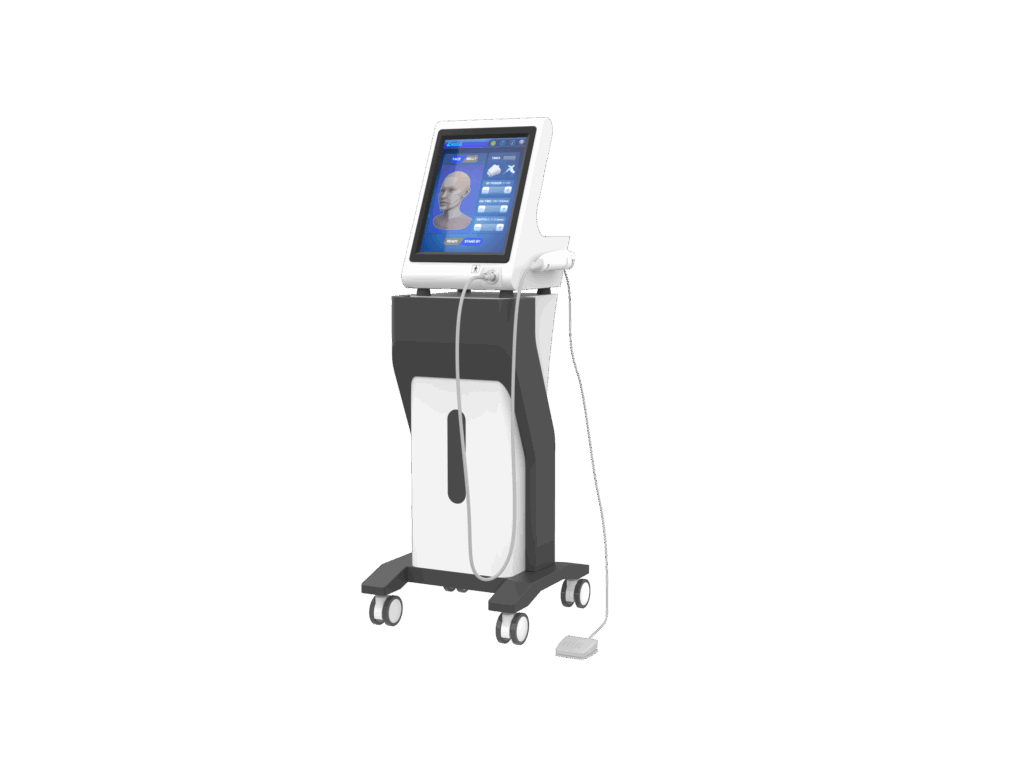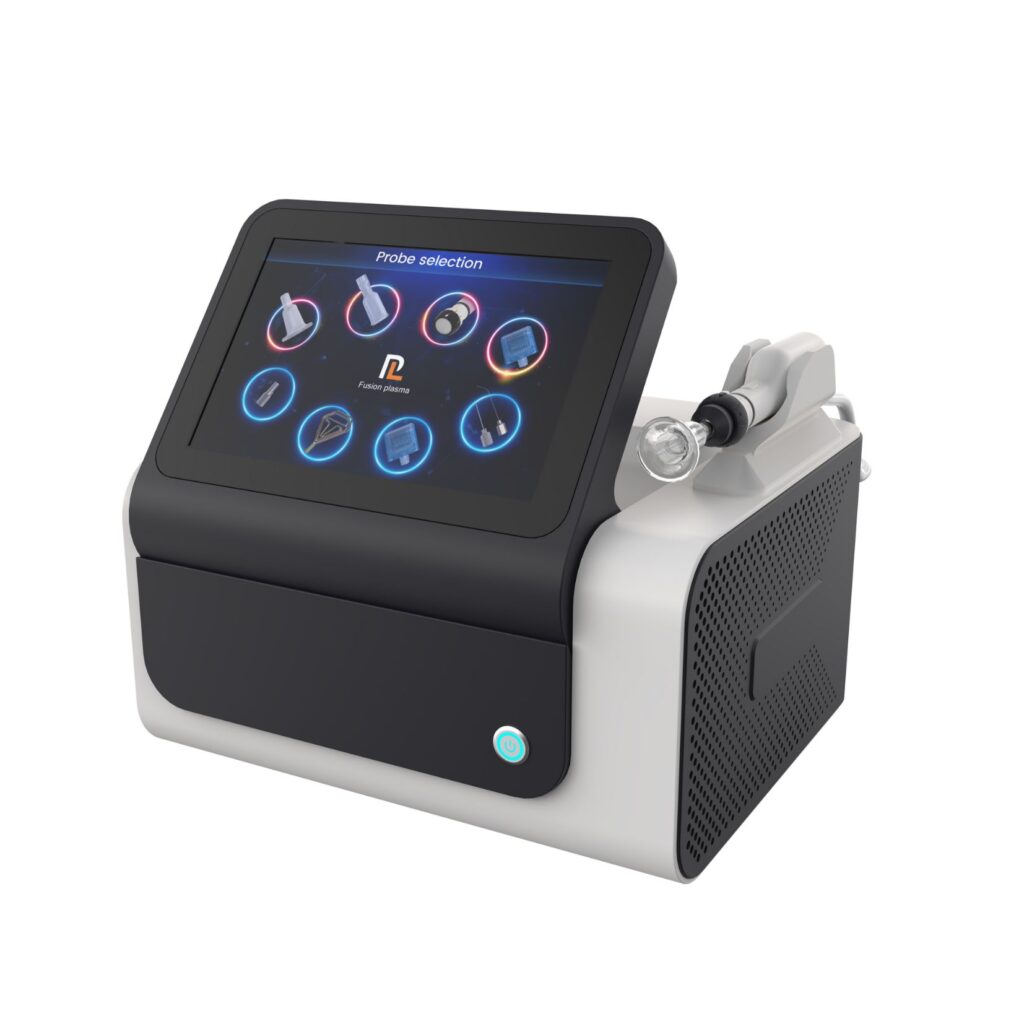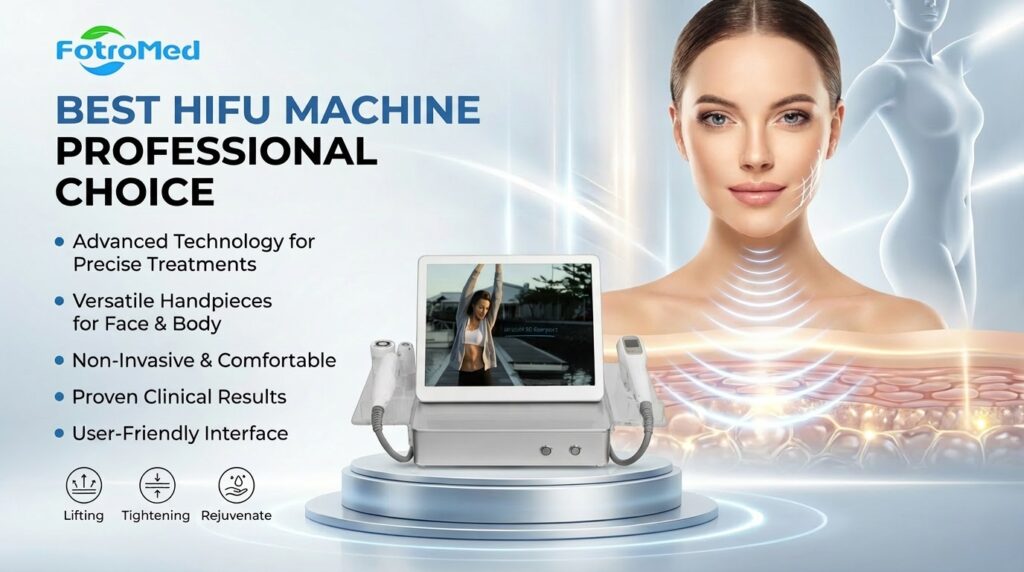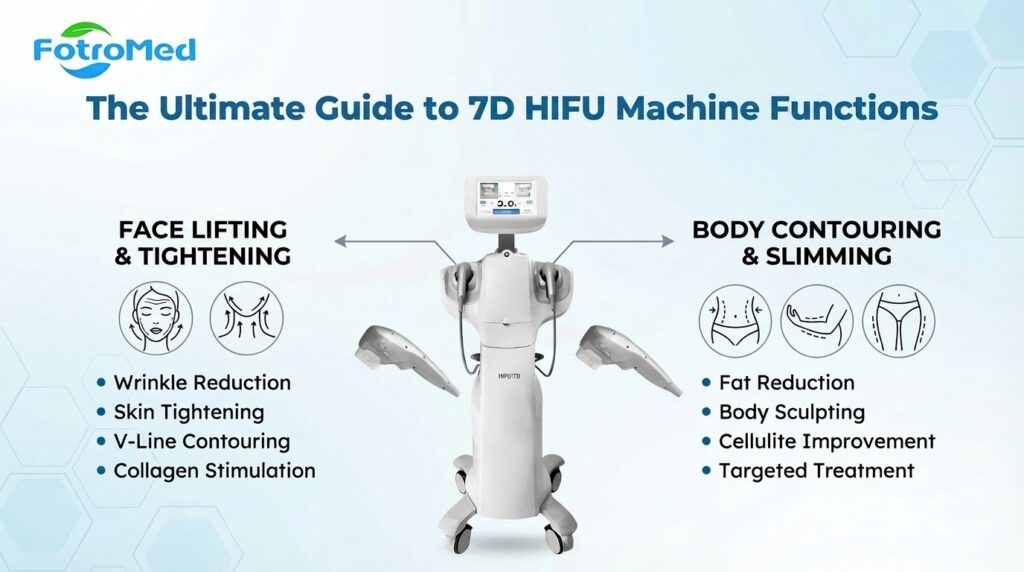
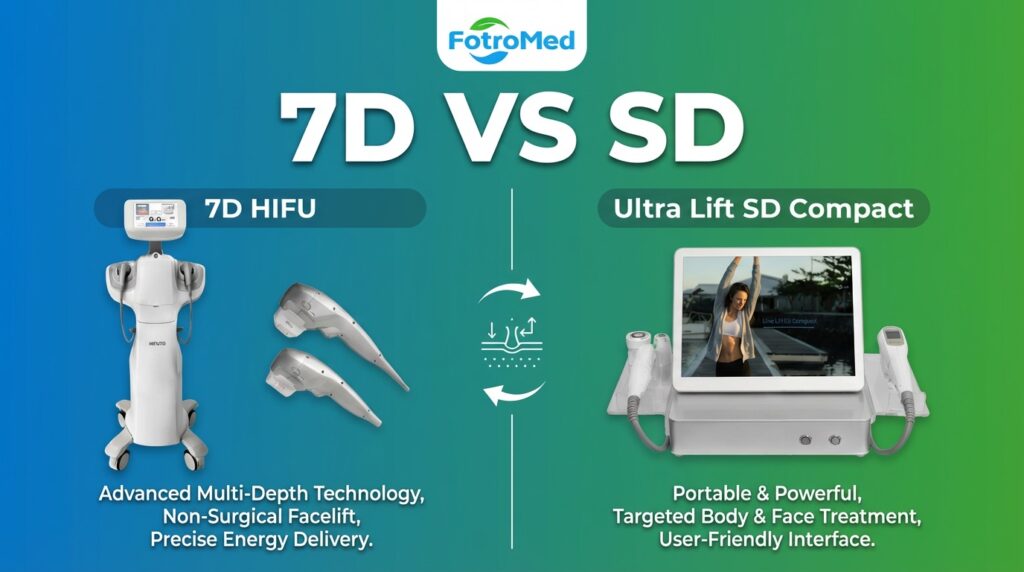
In the competitive landscape of aesthetic medicine, the search for the best professional HIFU devices often narrows down to two leading technologies in 2025: the widely known 7D MMFU systems and the emerging SD (Synergy Dotting) technology. For clinic owners and dermatologists, the choice involves balancing clinical efficacy, patient comfort, and Return on Investment (ROI). While 7D HIFU devices have set a high standard for SMAS lifting using Macro and Micro-focused ultrasound, the new Ultralift SD Compact by Fotromed introduces a game-changing evolution: the fusion of Micro-Focused Ultrasound (MFU) with Radio Frequency (RF). This article provides a critical technical comparison between these two giants, analyzing thermal diffusion, pain management, and profitability to help you decide which workstation is the superior asset for your practice.
The Evolution of HIFU Devices: From Linear to Synergy
To understand the difference between 7D and SD, we must first look at the trajectory of HIFU devices. The technology has evolved rapidly from the first generation of painful, single-depth treatments to today’s multi-layered approaches.
- 1st Gen (Legacy): Focused purely on deep SMAS lifting (4.5mm) with significant pain.
- 3D/4D Era: Introduced multi-row cartridges to speed up treatment time but kept the same energy delivery method.
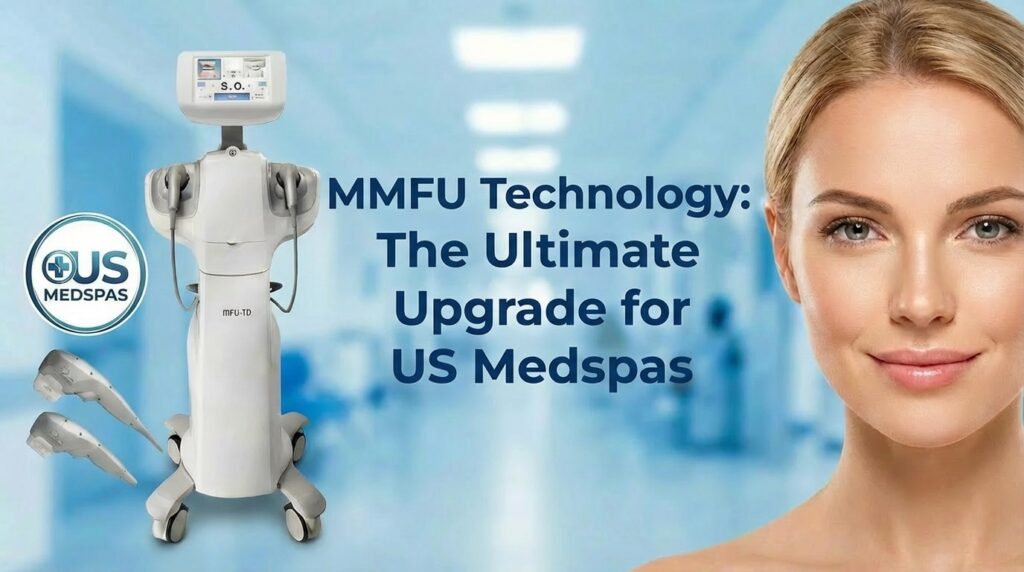
- 7D MMFU (The Current Standard): Utilized thinner cartridges and dual-engine technology (Micro for face, Macro for body) to improve precision.
- SD Era (The New Standard): The integration of MFU + RF, represented by the Ultralift SD Compact. This generation moves beyond simple “lifting” to comprehensive “volumizing and tightening.”
Technology Deep Dive: How Do They Work?
When evaluating HIFU devices, the mechanism of action is the most critical differentiator.
7D HIFU: Micro & Macro Focused Ultrasound
The 7D system is famous for its “MMFU” technology.
- Micro-Focused: Targets the 1.5mm, 3.0mm, and 4.5mm layers on the face. It creates small coagulation points to contract the SMAS.
- Macro-Focused: Targets deeper layers (6.0mm, 9.0mm, 13.0mm) for body contouring. The focal point is larger, designed to disrupt fat cells.
SD (Synergy Dotting): MFU + RF
The Ultralift SD Compact takes a different approach. It does not rely on ultrasound alone.
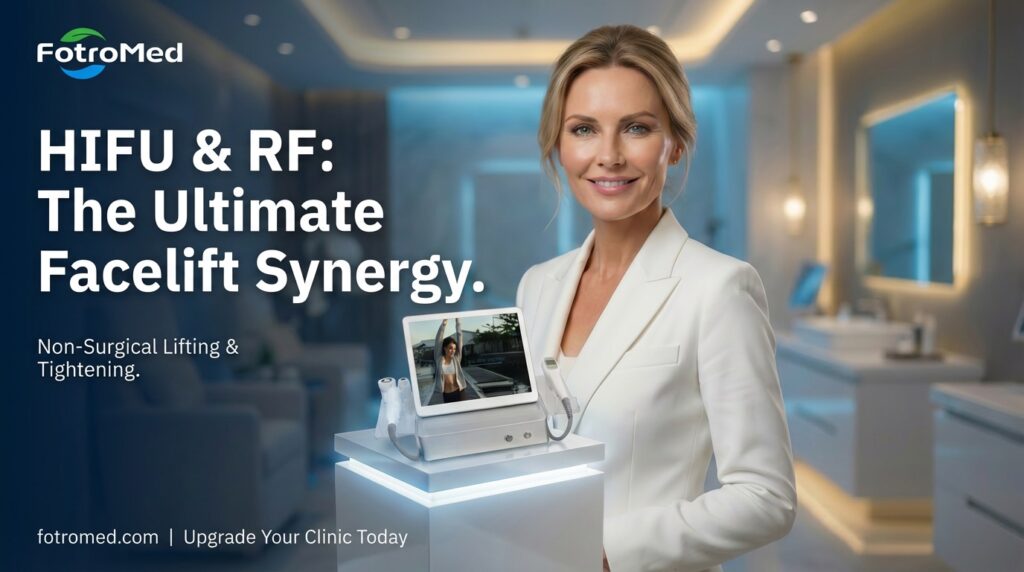
- The Synergy Effect: The device emits MFU energy to create the anchor point for lifting, while simultaneously releasing Radio Frequency (RF) energy.
- The Benefit: RF heats the surrounding tissue (volumetric heating). This pre-heating lowers the impedance of the skin, allowing the ultrasound energy to penetrate more effectively without requiring “spikes” of high intensity that cause pain.
[Visual Description: Technology Comparison Diagram]Imagine a cross-section of skin tissue.
- Left Side (7D HIFU): Shows sharp, isolated red dots at 4.5mm deep. The heat is concentrated only at the dot.
- Right Side (SD Technology): Shows the same red dots at 4.5mm, but they are surrounded by a warm orange “halo” of RF energy spreading laterally.
Head-to-Head Comparison: 7D vs. SD
For a clinic owner, specs on paper must translate to daily operations. Below is a structured comparison of these HIFU devices.
Operational & Clinical Comparison
| Feature | 7D HIFU Machine | Fotromed Ultralift SD Compact |
| Core Technology | MMFU (Ultrasound Only) | Synergy Dotting (MFU + RF) |
| Handpiece Type | Cartridge Block | Pen-Type (Precision) + Strip |
| Pain Level | Moderate (Sharp sensation) | Low (Warm sensation) |
| Treatment Areas | Face & Body (Broad areas) | Face, Eyes (Periorbital), Body |
| Skin Tone Safety | All Skin Types | All Skin Types (RF adds safety) |
| Downtime | Mild Redness | Immediate Glow (Due to RF) |
| Primary Indication | Heavy Lifting / Fat Reduction | Lifting + Texture Improvement |
While the 7D HIFU Machine remains a powerful tool for body contouring and deep lifting, the Ultralift SD offers a more refined, comfortable experience that is often preferred for facial rejuvenation.
The Pain Management Factor
“Does it hurt?” This is the first question every patient asks. In the world of HIFU devices, pain perception is the biggest barrier to patient retention.
Why 7D can be uncomfortable
7D machines rely on delivering high-peak acoustic energy to a tiny focal point to generate heat (65°C). This rapid spike stimulates nerves, causing the characteristic “zap” feeling.
Why SD is virtually painless
By integrating RF, the Ultralift SD maintains the target temperature (65°C) but reaches it more gradually through volumetric accumulation.
- The “Blurring” Effect: The RF energy stimulates sensory nerves with a warm sensation, which acts as a “gate control,” masking the sharp sensation of the ultrasound.
Financial Analysis: ROI and Consumables
For professional clinics, the “best” device is the one that generates the highest profit margin. Let’s analyze the economics of these HIFU devices.
Consumable Costs
- 7D HIFU: Typically uses cartridges with 10,000 to 20,000 shots.
- Ultralift SD: Fotromed engineers our SD cartridges for high durability. Because the SD technique treats a wider surface area per shot (due to RF spread), you often need fewer total shots to achieve the desired clinical endpoint compared to a standard linear HIFU.
The Profitability Curve
[Visual Description: ROI Data Curve]A line graph comparing “Months to Break-Even” for a standard US-brand device vs. Fotromed Ultralift SD.
- Y-Axis: Net Profit ($).
- X-Axis: Time (Months 1-12).
- Curve A (Competitor): Starts at -$60k. Crosses $0 (break-even) at Month 9.
- Curve B (Fotromed SD): Starts at a significantly lower investment point. Crosses $0 at Month 2. Slope is steeper due to lower consumable costs.
This high ROI is why many Portable HIFU Solutions like the Ultralift SD are becoming the preferred choice for smart B2B investors.
Versatility and “Pen-Type” Advantage
One distinct feature of the Ultralift SD Compact is the Pen-Type Probe.
Most HIFU devices, including standard 7D models, use a large, rectangular cartridge.
- The Limitation: It is difficult to maintain full contact on curved areas like the jawline, nasolabial folds, and especially around the eyes.
- The SD Solution: The Pen probe moves in a circular motion. This allows the practitioner to “paint” the energy onto the face, ensuring 100% contact and no energy loss. This technique is superior for fine-tuning and sculpting, making it an essential tool for advanced aesthetic injectors.
You can view our full range of HIFU Machine options to compare the form factors of cart-based vs. portable units.
Clinical Results: What to Expect
When comparing results, both technologies deliver. However, the quality of the result differs.
- 7D Results: Excellent for “de-bulking” heavy faces and tightening loose skin on the abdomen.
- SD Results: Superior for “refining.” Patients report not just lifting, but a significant improvement in skin texture, pore size reduction, and glow—benefits directly attributed to the Radio Frequency component
Conclusion: Which Device Should You Choose?
The battle of HIFU devices is no longer just about power; it is about precision and patient experience.
- Choose the 7D HIFU if: Your primary focus is body contouring and treating patients with heavy, thick tissue who require deep macro-focused energy.
- Choose the Ultralift SD Compact if: You want the best professional HIFU experience for facial rejuvenation. If your patients demand painless treatments, and if you want to treat delicate areas (eyes/mouth) with high precision, the MFU+RF technology is the clear winner.
At Fotromed, we manufacture both technologies to the highest international standards. We believe in empowering clinics with choices that fit their specific business model.
Ready to upgrade your clinic?
For detailed pricing, technical specs, and training options, please Contact Us today. Our team of specialists is ready to help you calculate your ROI.
FAQ
Can the Ultralift SD Compact replace my current Radio Frequency machine?
Yes. Because the Ultralift SD utilizes MFU+RF, it functions as a 2-in-1 device. You get the deep lifting of ultrasound and the superficial tightening of RF in a single session, saving you the cost of buying separate HIFU devices and RF machines.
Is the training for the Pen-Type probe difficult?
Not at all. While it requires a different technique than the “stamp” method of 7D cartridges, Fotromed provides comprehensive video training and protocols. The “rubbing” technique is actually more intuitive for many estheticians as it feels like a massage.
How does the price of the Ultralift SD compare to US brands?
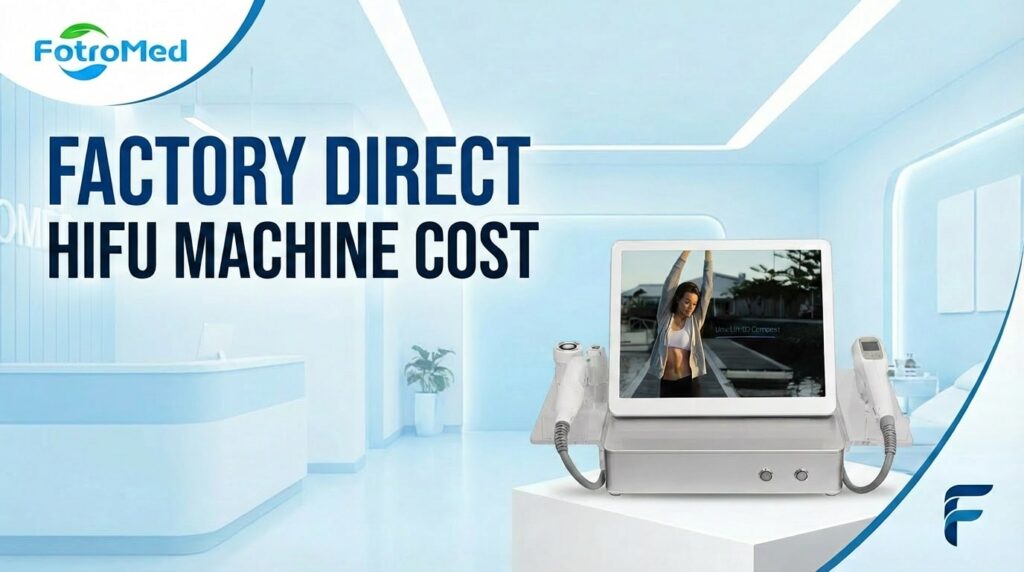
Fotromed offers a factory-direct pricing model. By cutting out the middlemen, we provide professional-grade HIFU devices at a fraction of the cost of legacy brands like Ultherapy or Thermage, ensuring a faster return on your investment.
Can I use the Ultralift SD on the body?
Yes. The device comes with specific body cartridges and protocols. The addition of RF is particularly beneficial for body treatments (like post-pregnancy tummies) where skin laxity is a bigger issue than fat volume.
What is the warranty and after-sales support?
We stand behind our quality. All Fotromed professional units come with a comprehensive warranty and access to our technical support team, ensuring your clinic experiences minimal downtime.