Kurzantwort
Kliniken, die sich für ein HIFU-System entscheiden, sollten Anbietern mit einer bewährten Produktlinie, strukturierter Bediener-Schulung und einem echten lokalen Servicekanal den Vorzug geben – der Preis allein ist ein schlechtes Filterkriterium. Händler, Importeure und Private-Label-Käufer sollten die Fertigungskontrolle, ein dokumentiertes Qualitätsmanagement wie ISO 13485, geltende CE-Dokumentationen auf Produktebene, OEM/ODM-Abgrenzungen, die Zuverlässigkeit bei Nachbestellungen sowie den Umgang mit Upgrades gegeneinander abwägen. Bevor Sie eine einzelne Maschine vergleichen, entscheiden Sie, was Sie tatsächlich kaufen – eine Behandlungsmarke, unter der Sie arbeiten möchten, oder eine Produktlinie, die Sie selbst aufbauen und vertreiben wollen.
Diese Unterscheidung ändert den Gegenstand der Verhandlungen. Ein Direkthersteller kann Branding, Verpackung, Schnittstellenlokalisierung, Gehäuseanpassungen und eine tiefere ODM-Entwicklung unterstützen, sofern dies technisch machbar ist. Jede Änderung sollte durch freigegebene Muster, Dokumentation und ein Änderungsmanagement gesteuert werden. Ein markengeführtes klinisches Unternehmen bietet in der Regel eine proprietäre Plattform, eine etablierte Produktpositionierung, professionelle Ausbildung und eine autorisierte Vertriebsstruktur. Sein Anpassungsspielraum ist geringer, während seine Marke, seine Schulungen und sein Kanal-Ökosystem stärker standardisiert sind. Bei beiden Modellen sollten lokale Servicezuständigkeiten, die Ersatzteilplanung und die Eskalation an den Hersteller vor dem Kauf vereinbart werden.
Dieser Leitfaden vergleicht 12 Hersteller und Anbieter von HIFU-Geräten, die 2026 aktiv sind, anhand von Unternehmenshistorie und Kontinuität des HIFU-Geschäfts, repräsentativer Produktausrichtung, Eignung für Kunden und Markt, OEM/ODM- und Private-Label-Fähigkeiten sowie globalem Liefer- und Schulungsangebot. Die engere Auswahl umfasst sowohl markengeführte klinische Unternehmen als auch Direkt-/OEM-Hersteller. Das Ziel besteht darin, Kliniken, Händlern, Importeuren und Private-Label-Käufern beim Vergleich der Unternehmen und der langfristigen Unterstützung hinter den Geräten zu helfen. Datenblätter gehören in die spätere Phase der Modellauswahl.
Key Takeaways
- Beginnen Sie mit dem Betriebsmodell des Herstellers. Markengeführte klinische Unternehmen bieten etablierte Marken, professionelle Ausbildung und autorisierte Kanäle; Direkthersteller bieten eine flexiblere OEM/ODM- und Händlerbelieferung. Keines von beiden ist automatisch besser – die richtige Wahl hängt davon ab, wie der Käufer vorhat zu agieren.
- Die Leistungsfähigkeit eines Herstellers lässt sich nicht allein am Gründungsjahr oder an einem einzelnen repräsentativen System messen. Wichtiger sind die Kontinuität des HIFU-Geschäfts, die Kontrolle über F&E und Produktion, ob das Qualitätsmanagement die tatsächliche Fertigungseinheit abdeckt und ob Folgebestellungen konsistent geliefert werden können.
- OEM/ODM sollte nach der Tiefe der Anpassung unterteilt werden. Logo- und Verpackungsänderungen, Schnittstellenlokalisierung, Gehäuseentwicklung und technische Modifikationen erfordern unterschiedliche Ressourcen und Kontrollen. Käufer sollten das freigegebene Muster, das Eigentum an Design und Werkzeugen, zulässige Komponentenaspekte und den Prozess des Änderungsmanagements im Voraus festlegen.
- Die langfristige Unterstützung entscheidet darüber, ob die Zusammenarbeit in der Praxis funktioniert. Schulung, lokaler Erstkontakt, Ersatzteilplanung, technische Eskalation und Wege für Feedback aus dem Feld sollten vor dem Kauf vereinbart werden. ISO 13485 gilt auf Ebene des Qualitätssicherungssystems des Herstellers, während CE- und andere Marktdokumente genau mit dem Modell und dem Bestimmungsort übereinstimmen müssen.
Wie wir diese Hersteller und Anbieter von HIFU-Geräten ausgewählt haben
Dieser Artikel vergleicht die Leistungsfähigkeit von Herstellern. Behandlungsergebnisse und einzelne Gerätespezifikationen liegen außerhalb des Bewertungsrahmens. Um berücksichtigt zu werden, muss ein Unternehmen auch im Jahr 2026 ein professionelles HIFU- oder MFU-Produktgeschäft mit einer identifizierbaren Unternehmensentität, einem repräsentativen Produkt und einer Liefer- und Supportstruktur betreiben. Schönheitsgeräte für den Heimgebrauch, Tumorablationsgeräte und reine Wiederverkäufer, deren Fertigungseinheit nicht identifiziert werden kann, liegen außerhalb des Rahmens.
Die Bewertung umfasst den Unternehmenshintergrund, aktuelle Produkte, das Qualitätsmanagement, internationale Aktivitäten sowie die gesammelte Erfahrung und das Fachwissen von Fotromed in der medizinisch-ästhetischen Industrie. Abweichende Datumsangaben oder Details zur Unternehmensentität werden separat dargestellt.
Unternehmenshintergrund und HIFU-Markterfahrung
Das Gründungsjahr bietet historischen Kontext. Die Bewertung berücksichtigt auch die Beziehung zwischen Unternehmen, Marke und HIFU-Produktlinie; ob sich die Produkte weiterentwickeln; und ob Verbrauchsmaterialien und technischer Support weiterhin verfügbar sind. Kontinuierliche Produktentwicklung und Support für bestehende Kunden zeugen von langfristigem Engagement in dieser Kategorie.
Produktspezialisierung und technische Ausrichtung
Wir bewerten, ob HIFU eine Kernproduktlinie ist und ob das repräsentative System eine klare technische Ausrichtung bei der Energiesteuerung, dem Wandler- und Kartuschendesign, den Abgabe-Modi, der Behandlungstiefe, der Visualisierung oder der Integration mit anderen Energiemodalitäten aufweist. Größere “D”-Bezeichnungen, Anzahl der Modi und maximale Einstellungen beschreiben Konfigurationen auf Modellebene. Die technische Bewertung konzentriert sich auf Verbesserungen der Behandlungseffizienz, der Betriebskonsistenz oder des Anwendungsspektrums sowie auf Nachweise einer kontinuierlichen Produktentwicklung.
Fertigung, F&E und Qualitätsmanagement
Wir unterscheiden zwischen dem Markeninhaber, dem rechtlichen Hersteller und der tatsächlichen Produktionseinheit und prüfen dann, ob das Unternehmen die Aktivitäten in F&E, Produktion und Qualität kontrolliert. ISO 13485 sollte mit dem Zertifikatsinhaber, der abgedeckten Adresse und dem Zertifizierungsumfang übereinstimmen. Lieferantenmanagement, Produktionsinspektion, Rückverfolgbarkeit von Produkten und Änderungskontrolle wirken sich ebenfalls auf die Fertigungskonsistenz aus.
OEM/ODM- und Private-Label-Fähigkeiten
Logo- und Verpackungsänderungen, Benutzeroberflächen- und Sprachlokalisierung, Gehäuse- und Formenentwicklung sowie Hardware- oder Softwaremodifikationen repräsentieren verschiedene Stufen von OEM/ODM. Die Bewertung berücksichtigt daher den Anpassungsumfang, die Mindestbestellmenge (MOQ), den Musterprozess, das Design-Eigentum, die Serienfertigungsstandards und wie spätere Änderungen verwaltet werden.
Globaler Vertrieb, Schulung und Unterstützung auf Unternehmensebene
Die Anzahl der Exportländer spiegelt die Marktreichweite wider. Die Servicefähigkeit hängt davon ab, wer Schulungen und Reparaturen anbietet, ob Ersatzteile und Verbrauchsmaterialien verfügbar bleiben, wie technische Probleme eskaliert werden und ob Folgebestellungen eine konsistente Konfiguration beibehalten. Die Herstellerunterstützung und die Ausführungsfähigkeit des lokalen Vertriebspartners werden getrennt bewertet, um zu beurteilen, ob ein Unternehmen besser für Kliniken, Gruppen mit mehreren Standorten oder regionale Vertriebspartner geeignet ist.
Profile der 12 führenden HIFU-Gerätehersteller und -Lieferanten
Merz Aesthetics
Unternehmensübersicht
Merz führt seine Mutterkonzern-Historie auf das Jahr 1908 in Frankfurt am Main, Deutschland, zurück. Die Gruppe stieg durch eine Reihe von Investitionen in die medizinische Ästhetik ein, erwarb 2014 Ulthera und organisierte Merz Aesthetics im Jahr 2020 als eigenständig agierendes Unternehmen. Merz verwaltet HIFU als Teil eines erstklassigen Segments für medizinische Ästhetik, das auf Markenführung, klinischer Ausbildung und kontrollierten Vertriebskanälen aufbaut.
Hauptprodukte & Technische Ausrichtung
Ultherapy PRIME ist die derzeitige repräsentative Plattform. Ihre prägende Technologie kombiniert Echtzeit-Ultraschallbildgebung und mikrofokussierte Ultraschalltherapie in einem System, sodass der Anwender das Zielgewebe vor der Energieabgabe betrachten kann. Im Markt von 2026 nimmt sie eine ausgereifte, visualisierungsgeführte klinische Stufe ein, wobei ihre wesentlichen technischen Vorteile in der Bildführung und einem standardisierten Arbeitsablauf liegen.
Herstellung, F&E & Qualitätsmanagement
Merz verwaltet Ultherapy als proprietäre Plattform für medizinische Ästhetik und behält die Kontrolle über Produktpositionierung, professionelle Fortbildung und Life-Cycle-Support. Käufe folgen der autorisierten Marktstruktur, die den Vertragspartner, Gerätedokumente, Rückverfolgbarkeit und den Serviceweg festlegt. Merz ist ein markengeführtes Plattformunternehmen.
Märkte und Kundenprofil
Ärztlich geleitete Kliniken, Dermatologiepraxen und etablierte medizinisch-ästhetische Gruppen ziehen Merz gewöhnlich in die engere Wahl, wenn sie eine anerkannte Behandlungsmarke mit strukturierter Ausbildung und einem zugewiesenen Servicekanal suchen. Das kommerzielle Paket kombiniert die Ultherapy-Plattform, Schulung, Service und Markenpositionierung. Kostengünstiges Private-Labeling und häufige Hardwareänderungen gehören nicht zum Kernangebot.
OEM/ODM- und Private-Label-Fähigkeiten
Merz arbeitet über die Marke Ultherapy und deren zugelassene Kanalstruktur. Standardmäßige OEM-, ODM-, Private-Label-Versionen, individuelle Logos und käufereigene Benutzeroberflächen fallen außerhalb dieses kommerziellen Modells. Merz eignet sich für die markengeführte klinische Beschaffung. Vertriebspartner, die ihre eigene Gerätemarke aufbauen, sollten Direkthersteller ab Werk vergleichen.
Globaler Vertrieb & Schulung
Merz unterstützt internationale Märkte durch regionale Einheiten und bestellte Partner, einschließlich einer 2015 in Singapur gegründeten Zentrale für den asiatisch-pazifischen Raum. Lieferkette, klinische Ausbildung, Kundenbetreuung und Service folgen der Struktur des jeweiligen Marktes. Für eine Klinikgruppe sind der benannte Verkäufer, der Anbieter von Erst- und Weiterbildung, der Reparaturort und die lokalen Regeln für die Behandlungsvermarktung die entscheidenden Details.
Classys
Unternehmensübersicht
CLASSYS wurde im Januar 2007 in Südkorea gegründet. Das Unternehmen stellte 2012 sein erstes Ultraformer-System fertig, wurde 2017 an der KOSDAQ notiert und eröffnete 2019 ein zweites Produktionswerk. Das Unternehmen hat seine Produktionskapazitäten und Überseeaktivitäten, einschließlich Niederlassungen in Japan und Brasilien, kontinuierlich ausgebaut. Dieser Entwicklungspfad zeigt nachhaltige Investitionen in die professionelle Ästhetik und die Kategorie HIFU.
Hauptprodukte & Technische Ausrichtung
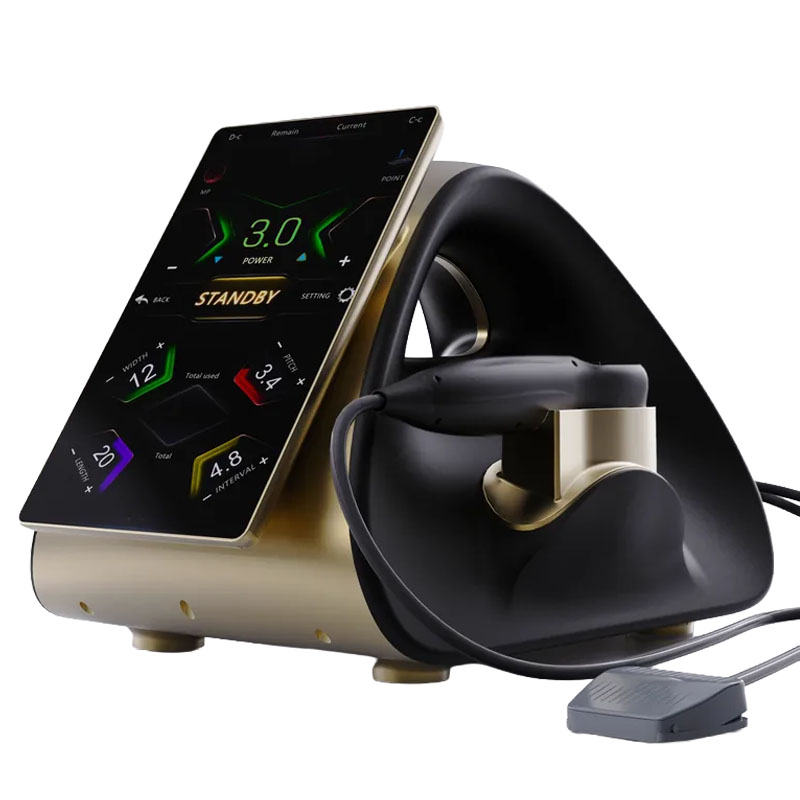
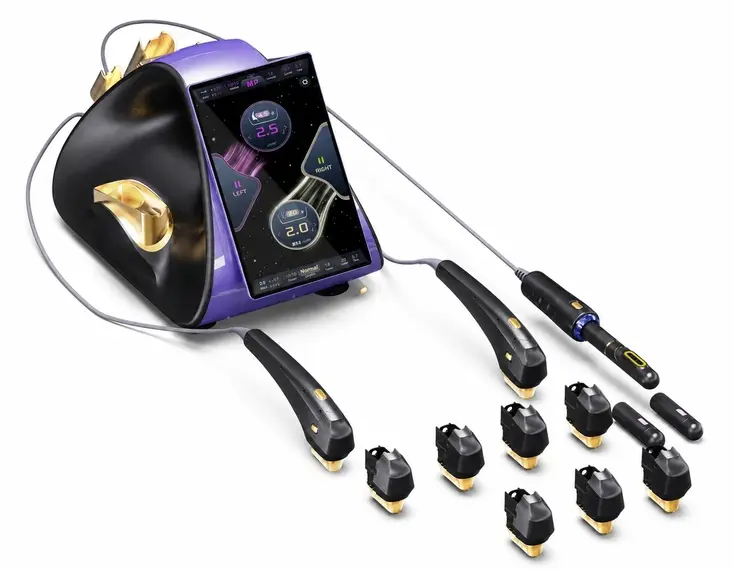
Ultraformer MPT ist die derzeitige repräsentative Plattform. Sie nutzt mikro- und makrofokussierten Ultraschall, Normal-Dot- und MP-Modi sowie F-Typ- und Booster-Kartuschen zur Erweiterung von Gesichts- und Körper-Workflows. Dies ordnet sie in das ausgereifte, bildgebungsfreie Segment mit hohem Durchsatz ein, wobei Modusumschaltung, Abgabeeffizienz und Applikatorenauswahl ihre wesentlichen technischen Merkmale sind.
Herstellung, F&E & Qualitätsmanagement
CLASSYS combines product development with an expanding production base; the second plant opened in 2019 is one marker of manufacturing continuity. The Ultraformer family sits within a continuing R&D and production structure. Quality-system scope and market documents still belong to the exact system and supplying entity; the group name provides company context only.
Märkte und Kundenprofil
Clinics and regional distributors usually choose CLASSYS to build around an established Korean brand and a continuing Ultraformer product family. The model works best where recognizable product naming, professional education, and recurring consumable supply support the commercial plan. A startup that needs its own logo, enclosure, and product identity will have little room to shape the platform.
OEM/ODM- und Private-Label-Fähigkeiten
CLASSYS uses a branded-distribution model. Distributors develop a territory around the company’s products, training, and marketing framework, and the devices retain the CLASSYS identity. Commercial discussions center on territorial responsibilities, launch planning, sales targets, consumable supply, and service readiness.
Globaler Vertrieb & Schulung
International subsidiaries and distribution partners support market entry, education, and product supply. Product versions, consumables, language materials, and service workflows can differ by country. The practical comparison is local: who teaches operators, who repairs the system, how much stock the distributor keeps, and how unresolved technical cases reach CLASSYS.
Hironic
Unternehmensübersicht
HIRONIC began with SP Medical in 2006 and established Hironic Co., Ltd. in 2008. The Doublo line followed in 2011, giving the company a long operating history in focused ultrasound; 2026 marks twenty years from its business roots. HIRONIC has since expanded into a broader energy-based device portfolio while retaining the identity of a Korean professional aesthetic manufacturer with its own brands and education activities.
Hauptprodukte & Technische Ausrichtung
New Doublo 2.0 represents HIRONIC’s current MFU direction. The system combines microfocused ultrasound and RF, with dot and line delivery, contact and movement sensors, four handpieces, and saved treatment parameters. Combined energy, operator feedback, and workflow control place it among the newer multimodality platforms.
Herstellung, F&E & Qualitätsmanagement
HIRONIC develops and commercializes its own energy-based platforms, so R&D, product management, and manufacturer training sit within a brand-led structure. The long-running Doublo line shows development continuity. Manufacturer-owned product development is the main advantage for distributors; general private-label factory access falls outside this model.
Märkte und Kundenprofil
HIRONIC usually enters projects led by clinics, physicians, medical-aesthetic groups, and regional distributors building a branded Korean HIFU line. The partner is expected to develop local clinical education and the professional brand. A wholesaler competing mainly on generic-machine price is working with a different commercial model.
OEM/ODM- und Private-Label-Fähigkeiten
HIRONIC focuses on its own branded platforms and distributor network. Partnerships are channel-led: the distributor represents the company’s product identity, develops the territory, and follows the agreed commercial and training framework. Buyers wanting a custom logo, a buyer-owned enclosure, or low-volume white labeling should prioritize factory-direct manufacturers.
Globaler Vertrieb & Schulung
HIRONIC combines international partners with academy-style education and marketing resources for professional users. Product naming, availability, and service routes can vary by territory. The appointed importer therefore matters as much as the corporate brand: it controls operator training, parts, repairs, and the handoff of complex cases to the manufacturer.
Jeisys Medical
Unternehmensübersicht
Jeisys began as an individual business in 2001 and converted to Jeisys Medical in 2004. It subsequently grew into a multi-platform professional aesthetic-device business with a continuing international expansion strategy. Jeisys should be evaluated through its operating history, product breadth, and multi-platform technology capability. LinearZ represents its current HIFU direction.
Hauptprodukte & Technische Ausrichtung
LinearZ, launched in 2022, is the representative HIFU platform. It switches between dot and linear modes, while four cartridge groups adjust the energy form and target depth. The handpiece displays mode, depth, transducer position, and cartridge temperature for immediate operating feedback. This is a modern multi-mode, non-imaging platform with developed depth control, mode switching, and handpiece feedback.
Herstellung, F&E & Qualitätsmanagement
Jeisys established an affiliated R&D center and recorded ISO 13485 quality-system certification in 2004, early in its corporate development. Its multi-platform portfolio places hardware and application development within one company framework. The certificate holder, covered address, and scope remain specific to the supplying entity and selected model.
Märkte und Kundenprofil
A Jeisys project often starts with a clinic group or distributor that wants one Korean technology partner across several device categories. The relationship is built around consistent brand positioning, professional training, and a multi-device portfolio. Private-label control is limited, while adjacent Jeisys platforms can strengthen a distributor’s offer within one territory.
OEM/ODM- und Private-Label-Fähigkeiten
The company is positioned around Jeisys-branded platforms. Buyers normally work through its product, distribution, and education structure. Broad OEM HIFU supply, private logos, and buyer-owned industrial design fall outside the central offer. Contract discussions should focus on territorial rights, the portfolio to be represented, launch obligations, service capability, and ongoing access to consumables and product education.
Globaler Vertrieb & Schulung
Jeisys extended its international structure through entities in Australia, Vietnam, North America, Brazil, Europe, and China between 2022 and 2026. This can shorten communication, but sales, training, parts, and escalation responsibilities still differ by territory. A distributor needs a clear map of those roles, especially for product naming and consumable supply.
Asterasys
Unternehmensübersicht
ASTERASYS Co., Ltd. was established in South Korea on July 7, 2015. The company has built its identity around clinical aesthetic technologies, with focused ultrasound occupying an important place in the portfolio. Its concentrated brand proposition comprises a Korean professional product family, clinical positioning, and a partner network. Buyers can assess portfolio breadth separately through the current product catalog.
Hauptprodukte & Technische Ausrichtung
Liftera 2 is the representative system. Its Line handpiece and Pen applicator address different facial contours and smaller treatment areas, with digital control and continuous delivery supporting the treatment rhythm. It belongs to the modern precision-applicator, non-imaging HIFU tier. Its technical strengths are pen contact, curved-area access, and line-workflow efficiency.
Herstellung, F&E & Qualitätsmanagement
Asterasys manages Liftera as a proprietary focused-ultrasound family within a professional clinical-device business. Product development and life-cycle responsibility sit inside its brand model. Its primary commercial direction is branded distribution and clinical market development, with Liftera 2 documents and consumable controls tied to the market-specific product version.
Märkte und Kundenprofil
Clinics, physicians, and clinical-brand distributors choose Asterasys when they want to build a market around the Liftera name. The model requires professional education and local brand development. In countries without a direct Asterasys operation, the appointed importer becomes the working face of the brand and carries much of the service responsibility.
OEM/ODM- und Private-Label-Fähigkeiten
The commercial direction centers on the Asterasys and Liftera brands. Standardized, low-MOQ private-label HIFU supply falls outside its central model. Distributor discussions address territory, market development, product education, and service competence.
Globaler Vertrieb & Schulung
Distribution, operator education, and technical support are coordinated with partners in each market. The local partner controls the day-to-day experience: product availability, access to trainers, consumable supply, repairs, and the point at which a technical case moves from the local team to Asterasys.
Newpong
Unternehmensübersicht
NEWPONG was established in South Korea in April 2015 and launched Sonoqueen in July of that year. It has since developed around ultrasound technologies for aesthetic and other professional applications. Its company identity centers on ultrasound specialization and a concentrated technology portfolio.
Hauptprodukte & Technische Ausrichtung
LINCURVE PRO is Newpong’s representative HIFU system. Its curved cartridge and curved-motion delivery are designed to follow facial contours, while Deep and Booster modes operate through the same cartridge family. This is a newer structural innovation within non-imaging HIFU, focused on surface contact and consistent focal depth. The platform is relatively recent, so its global channel and long-term installed-base ecosystem are still developing.
Herstellung, F&E & Qualitätsmanagement
Newpong established its R&D center soon after its 2015 formation, added ISO 13485 quality management in 2016, and completed a second factory in 2020. Its organization covers hardware, software, mechanical design, regulatory work, production, QC, and QA. That functional depth is meaningful for ultrasound-focused buyers because development, production, and quality feedback can remain within one specialized operating structure.
Märkte und Kundenprofil
The typical Newpong buyer is a clinic or distributor building a focused ultrasound offer. Its narrower technology range gives that partner a clear product story and access to a team centered on ultrasound development. A multi-category wholesaler may still prefer the convenience of a broader factory.
OEM/ODM- und Private-Label-Fähigkeiten
The company emphasizes its technology and partnership model. Localization, co-development, and branding are handled as defined commercial projects. The permitted changes, engineering responsibility, approval process, and ownership should be set before development begins. Normal distributor support and full ODM are separate scopes.
Globaler Vertrieb & Schulung
Newpong works with B2B partners across Europe, Asia, the Middle East and Africa, and Latin America. The quality of delivery still depends on the territory partner’s registration work, education, spare-parts stock, and repair capability. The most important channel detail is the handoff to Korea when a local team cannot close a technical case.
Fotromed
Unternehmensübersicht
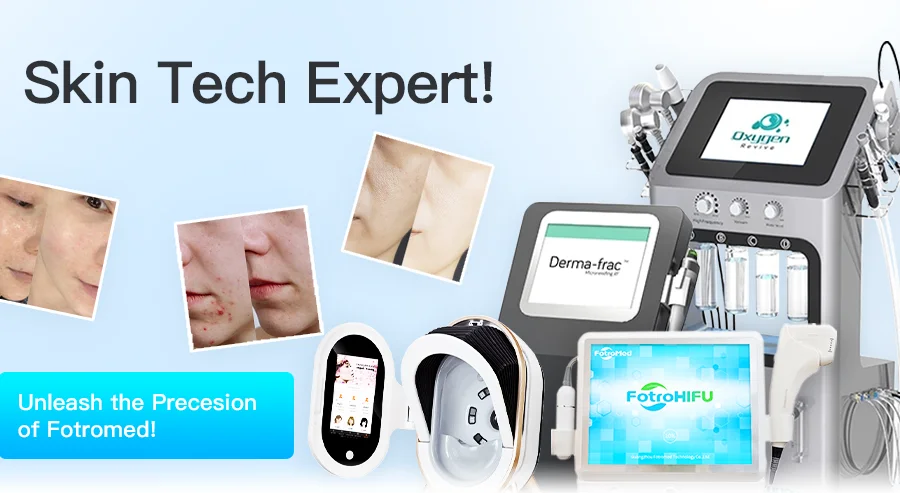
Fotromed was founded in Beijing in 2018. We began expanding our professional hifu machine line in 2020 and established an R&D center in 2021. Current operations cover factory-direct supply, multi-category purchasing, OEM/ODM projects, regional distribution partnerships, and procurement for clinic groups.
Hauptprodukte & Technische Ausrichtung
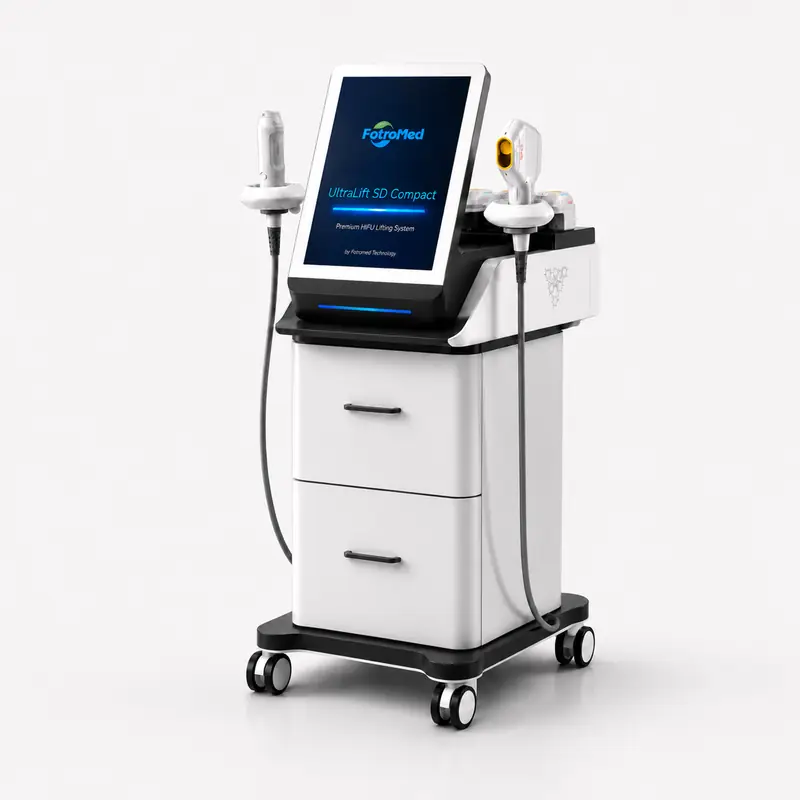
UltraLift SD Kompakt is Fotromed’s representative HIFU system. It adds an RF handpiece to focused ultrasound to shorten combined-care workflows and improve operating comfort. The system sits in the combined-energy, non-imaging tier, above a basic single-energy HIFU platform; image guidance is the next development step. Our catalog covers more than 95% of the common machine formats in standard HIFU inquiries, and our R&D team plans a visualization-enabled platform by the end of 2026. That project remains in development.
Herstellung, F&E & Qualitätsmanagement
We apply our ISO 13485 quality management system to product development, purchasing, assembly, inspection, nonconformity handling, and corrective action. Each OEM/ODM project needs a defined sample standard, mass-production inspection requirements, and an engineering change process. Our annual shipment volume has remained above 5,000 aesthetic devices. Before delivery, every unit goes through assembly checks, functional testing, and final shipment inspection under our quality-control and warranty procedures; any abnormal result enters the nonconformity and corrective-action process.
Märkte und Kundenprofil
Fotromed serves distributors, importers, private-label brands, independent aesthetic practices, clinic groups, and premium multi-location medspas. Larger medspa groups often need consistent appearance and configuration, centralized training, coordinated rollout schedules, spare-parts planning, and service across several locations. We can build product mixes, language materials, batch plans, and training arrangements around those needs, while helping distributors expand from one HIFU product into a broader aesthetic-equipment range.
OEM/ODM- und Private-Label-Fähigkeiten
We support logo and private-label work, packaging, interface and language localization, appearance changes, and deeper ODM development when technically feasible. Common buyer pain points include differences between samples and production units, unclear ownership of artwork or molds, missing software-language deliverables, and component changes without advance notice. At project launch, we work to define the MOQ, approved sample, design ownership, permitted component changes, inspection standards, and change-notification process.
Globaler Vertrieb & Schulung
Global supply and training are major parts of Fotromed’s operating model. Before shipment, we can help customers define the product mix, branding and language content, launch materials, sales training, operator training, and initial spare-parts plan. After shipment, support continues through troubleshooting, technical escalation, repeat-order configuration, market feedback, and engineering or quality follow-up. Our goal is to help customers build an executable aesthetic business around the equipment, including product presentation, team training, local service, and repeat purchasing.
Sincoheren
Unternehmensübersicht
Beijing Sincoheren S&T Development Co., Ltd. was established in 1999, giving it one of the longer operating histories among the factory-direct companies in this list. Its business combines R&D, manufacturing, international sales, and after-sales functions across multiple aesthetic-equipment categories. Each order still needs to identify the producing entity and the quality-system scope that covers it.
Hauptprodukte & Technische Ausrichtung
3D HIFU can serve as Sincoheren’s baseline representative system, while its current HIFU catalog also includes 4D three-in-one and 5D five-in-one platforms. The technology direction extends from multi-line delivery to Radar Carving, Liposonic, and multifunction integration. The range has moved beyond early single-line HIFU and now sits in the feature-integrated, non-imaging tier, with multiple modes and combined-energy functions as its technical focus.
Herstellung, F&E & Qualitätsmanagement
Sincoheren integrates R&D, manufacturing, inspection, international sales, and after-sales within a multi-category factory structure. This can support repeat orders and cross-category sourcing. For HIFU, the relevant evidence comes from the responsible engineering team, manufacturing site, inspection plan, and applicable quality-system scope. Total catalog size only describes the range of the company.
Märkte und Kundenprofil
A regional distributor can use Sincoheren to combine HIFU with laser, RF, IPL, and body-contouring systems in one factory relationship. Consolidated orders and direct factory communication are the main commercial reasons to choose it. A clinic purchasing one physician-led treatment brand is solving a different procurement problem.
OEM/ODM- und Private-Label-Fähigkeiten
The company supports OEM, ODM, and private-label cooperation across brand identity, product configuration, packaging, and other adaptations. A simple logo project and an engineering project need different samples, tooling terms, component approvals, inspection plans, and design responsibilities. The written scope needs to name which level of work is being purchased.
Globaler Vertrieb & Schulung
International sales and distributor support cover product supply, product education, troubleshooting, and after-sales coordination. A long-term distribution program needs one agreed route for product updates, field complaints, repeat-order forecasts, and cases that require the HIFU engineering team. That communication route matters more here than the size of the overall export catalog.
ADSS
Unternehmensübersicht
Beijing ADSS Development Co., Ltd. was established in July 2005. Its main business is medical-aesthetic laser and optoelectronic equipment, including diode-laser hair removal, picosecond and Q-switched lasers, CO2 lasers, IPL, and related light-based platforms. HIFU is a supporting category within this wider catalog. ADSS is therefore best evaluated as a laser-led, multi-category manufacturing and channel partner.
Hauptprodukte & Technische Ausrichtung
FG 660-D+ is ADSS’s current representative HIFU system. It uses an established replaceable-cartridge focused-ultrasound architecture for facial and body applications. The platform belongs to the mature conventional, non-imaging HIFU tier. Its operating structure and configuration are easy to understand, while its technical level remains conservative. Its commercial value comes mainly from standardized supply within a wider equipment portfolio.
Herstellung, F&E & Qualitätsmanagement
ADSS combines product development, manufacturing, inspection, and service in an integrated factory model. Its broad portfolio can support engineering reuse and bundled production. HIFU still needs its own approved sample, inspection criteria, and technical owner, especially when an OEM/ODM project changes appearance, software, or internal configuration.
Märkte und Kundenprofil
A regional seller may choose ADSS to source laser, light-based, and HIFU equipment through one manufacturing relationship. This reduces the number of vendors behind a broad aesthetic catalog and leaves room for private-label or channel projects. A physician-led clinic purchasing one tightly controlled HIFU treatment brand will usually begin with a clinical-brand company.
OEM/ODM- und Private-Label-Fähigkeiten
ADSS offers OEM and ODM work covering branding, interface localization, appearance, packaging, and project-specific development. An existing-platform private label is a different job from one that changes engineering or tooling. The production agreement needs to record the approved sample, permitted substitutions, artwork and mold ownership, inspection standards, product-change notice, and responsibility for local documents.
Globaler Vertrieb & Schulung
ADSS supports international distribution with product education, marketing resources, technical service, and complaint-handling routes. Its business school and optoelectronic training center give channel development a dedicated support structure. The distributor agreement still needs a clear division between local training and repair work and cases that return to the manufacturer.
HUIMAIN
Unternehmensübersicht
HUIMAIN’s development timeline begins with investment and product work from 2013 to 2016, followed by the brand launch in Guangzhou in 2017. The company moved into a 3,000-square-meter factory in 2019 and established a mold facility in 2022. The 2017 milestone is the brand-launch date. Legal incorporation should be verified from company registration records and the entity named in the contract.
Hauptprodukte & Technische Ausrichtung
HI-8D HIFU is the representative system. Its product route includes single- and multi-line delivery, multiple frequencies, dual handpieces, and a 360-degree line-sculpting mode. This is a feature-complete, high-throughput non-imaging platform above basic single-line HIFU. “8D” is a manufacturer model label; the technical value comes from line output, mode switching, and energy control.
Herstellung, F&E & Qualitätsmanagement
HUIMAIN’s move to a larger factory in 2019 and establishment of a mold facility in 2022 support in-house production and appearance-development work. These assets matter most in private-label projects that need enclosure changes. The contracting entity, production address, quality documents, sample standard, and change-control process need to refer to the same project.
Märkte und Kundenprofil
A startup equipment brand can use HUIMAIN for localized branding, smaller opening orders, and a catalog that expands across several device categories. The factory and mold capability are more useful to this buyer than an established treatment name. Physician-led clinics purchasing a premium clinical brand will normally follow another route.
OEM/ODM- und Private-Label-Fähigkeiten
HUIMAIN supports product design, private labeling, packaging, configuration, and enclosure development. Its mold capability can support appearance-led projects, while the production model can move from smaller batches toward larger orders. The project scope needs to separate standard parts from new tooling and state who owns the final design, approves samples, and controls later component or software changes.
Globaler Vertrieb & Schulung
Export support includes manuals, training videos, one-to-one remote guidance, spare-parts coordination, and marketing or training materials. Private-label partners use these resources to support local customers under their own name. Language coverage and the division of first-response work between the local brand and HUIMAIN are the main service questions.
Goodway
Unternehmensübersicht
Goodway traces its operating origins to the early 2010s. Its brand story places the founding team in 2009 and formal company establishment in 2015; its manufacturer profile uses 2010 as the founding year. This article retains both timelines. The legal entity on the contract needs to match the manufacturing address, quality documents, bank account, and party responsible for the order.
Hauptprodukte & Technische Ausrichtung
GW-12D MAX is the representative HIFU system. It uses dual output, an NP multi-point line mode, Superpulse ultrasound, and separate face and body handpieces to extend treatment workflow. This is a mid-tier, feature-integrated non-imaging platform with more delivery options and higher throughput than traditional single-line equipment. “12D” is a product label and does not define a technical generation by itself.
Herstellung, F&E & Qualitätsmanagement
Goodway positions its operation around factory production, laboratories, and OEM/ODM development. Because its company pages use different dates, the contracting entity, manufacturing address, quality-system documents, and bank beneficiary deserve more attention than the brand timeline alone. For HIFU, the approved sample and named engineering owner provide the clearest project-level reference.
Märkte und Kundenprofil
Goodway’s typical project combines multi-category sourcing with factory customization for a wholesaler, regional distributor, importer, or private-label brand. Its export story includes Japan, Europe, and the United States, and the commercial model assumes that the local partner can handle branding, sales, training, and first-line service. A clinic seeking a turnkey premium treatment name will usually compare brand-led companies first.
OEM/ODM- und Private-Label-Fähigkeiten
Goodway supports OEM, ODM, branding, packaging, and wholesale production. A logo project does not require the same work as a new enclosure, interface, or internal configuration. The order process needs to identify sample approval, artwork and mold ownership, permitted component changes, inspection criteria, quality-system scope, and notice of later design or supplier changes.
Globaler Vertrieb & Schulung
Export sales, product guidance, and technical support are available for channel partners. A private-label buyer becomes the visible brand in its own market, so it needs training files, a defined troubleshooting boundary, spare-parts planning, complaint feedback, and access to the factory when local support reaches its limit.
Winkonlaser
Unternehmensübersicht
Beijing Winkonlaser Technology Limited was founded in 2012. The company combines R&D, production, overseas sales, warehouse support, and distributor cooperation across a multi-category aesthetic-device range. Its export model connects the quoted product, producing entity, warehouse, and regional partner; those roles can belong to different parts of the supply chain.
Hauptprodukte & Technische Ausrichtung
HU700 is Winkonlaser’s representative platform, integrating HIFU, Liposonix, intimate-care functions, and microneedle RF in one workstation. Platform breadth is high and supports several service categories. Its HIFU subsystem uses multi-depth cartridges and remains on a conventional non-imaging control path, while the multifunction integration is more recent.
Herstellung, F&E & Qualitätsmanagement
Winkonlaser combines R&D and production with export warehouses and channel operations. This can shorten commercial response times, but manufacturing and regional fulfillment remain separate responsibilities. For HU700, the production site and its quality system control the product; the warehouse controls local stock and delivery.
Märkte und Kundenprofil
A regional distributor may use Winkonlaser to combine a broad device catalog with overseas stock and local customer service. That model can shorten delivery and parts response within a territory. A physician-led clinic buying one established treatment brand is unlikely to use the warehouse network in the same way.
OEM/ODM- und Private-Label-Fähigkeiten
The company offers OEM, ODM, logo, packaging, exterior or casing changes, interface customization, wholesale, and private-label cooperation. Branding, interface, enclosure, and engineering work form separate scopes. The commercial agreement needs to assign samples, design ownership, molds, software languages, component approval, inspection, product-change notice, territory, and documentation responsibilities.
Globaler Vertrieb & Schulung
Winkonlaser’s channel network includes warehouse arrangements in China, the United States, France, and Turkey. Distributor support can include manuals, training videos, live online training, marketing materials, territorial cooperation, and spare-parts coordination. The distinctive issue is the warehouse boundary: local stock and basic service may sit close to the buyer, while repairs and product changes can still return to the factory.
HIFU Manufacturer Comparison Table
| Manufacturer | Founded | HQ | Positioning | HIFU | Route | Am besten geeignet für | Price |
|---|---|---|---|---|---|---|---|
| Merz Aesthetics | 1908 | Germany | Premium clinical brand | Ultherapy PRIME | Authorized channel | Physician clinics | $$$ |
| Classys | 2007 | South Korea | Professional manufacturer | Ultraformer MPT | Branded distribution | Clinics, groups | $$$ |
| Hironic | 2008 | South Korea | Branded manufacturer | New Doublo 2.0 | Branded distribution | Clinics, distributors | $$$ |
| Jeisys Medical | 2004 | South Korea | Technology company | LinearZ | Branded distribution | Clinics, groups | $$$ |
| Asterasys | 2015 | South Korea | Clinical-device brand | Liftera 2 | Branded distribution | Clinics, distributors | $$$ |
| Newpong | 2015 | South Korea | Ultrasound company | LINCURVE PRO | B2B partnerships | Clinics, distributors | $$$ |
| Fotromed | 2018 | Beijing, China | Factory-direct/OEM | UltraLift SD Kompakt | OEM/ODM, private label | Distributors, private-label buyers, clinics, medspa groups | $$ |
| Sincoheren | 1999 | Beijing, China | Multi-category factory | 3D HIFU | OEM/ODM | Distributors, catalog buyers | $$ |
| ADSS | 2005 | Beijing, China | Laser/multi-category factory | FG 660-D+ | OEM/ODM, distribution | Distributors, clinic groups | $$ |
| HUIMAIN | 2017 | Guangzhou, China | Factory-direct/OEM | HI-8D HIFU | OEM/ODM, private label | Private labels, value buyers | $ |
| Goodway | 2010 | Guangzhou, China | OEM/ODM manufacturer | GW-12D MAX | Wholesale, private label | Wholesalers, brand projects | $ |
| Winkonlaser | 2012 | Beijing, China | Factory/channel partner | HU700 | OEM/ODM, distribution | Regional distributors, private labels | $ |
Note: Merz uses the parent-group year, HUIMAIN the brand year, and Goodway the 2010 company timeline. $, $$, and $$$ indicate relative procurement levels; configuration, training, documentation, and service determine the final quotation.
Which Company Fits Each Buyer Type?
The table provides a first-pass shortlist. Start by comparing companies that use the same commercial model, then request matched quotations with equivalent product scope, training, documents, consumables, and service. Mixing a premium clinical-brand package with an entry-level private-label package can distort both price and support comparisons.
| Buyer need | Companies to compare first | Why | Facts to confirm |
|---|---|---|---|
| Physician clinic | Merz Aesthetics, Classys, Hironic, Asterasys | Established brands and education | Local training, repairs, and documents |
| Medspa or aesthetic clinic | Classys, Jeisys Medical, Fotromed, Sincoheren | Supply, training, and budget choice | Staff training, parts, and total cost |
| Distributor or importer | Fotromed, Sincoheren, ADSS, Winkonlaser | Factory access and repeat supply | Legal entity, lead time, and territory |
| OEM/ODM or private label | Fotromed, Sincoheren, HUIMAIN, Goodway | Private label and engineering | MOQ, sample, and design ownership |
| Multi-location group | Classys, Jeisys Medical, Fotromed, ADSS | Standardized rollout and batch control | Configuration, training, parts, and upgrades |
Physician-Led Clinics
Physician-led clinics should begin with Merz Aesthetics, Classys, Hironic, and Asterasys when established product positioning, professional education, and an authorized local channel are central to the purchase. Reduce the list to companies with an active seller, qualified trainer, clear repair route, and suitable product documentation in the clinic’s market.
Distributors and Private-Label Buyers
Distributors, importers, and private-label buyers should start with Fotromed, Sincoheren, ADSS, and Goodway. Compare the legal entity, producing factory, customization depth, territory, sample process, inspection standard, design ownership, and repeat-supply plan. These fields reveal the practical difference between a logo project, a localized private label, and a deeper ODM program.
Medspas and Multi-Location Groups
Medspas and clinic groups need consistent configurations, repeatable staff training, coordinated rollout, spare-parts planning, and a service path that works across locations. Classys, Jeisys Medical, Fotromed, and ADSS can enter the first comparison. Premium medspa chains can examine Fotromed for consistent batches, localized materials, centralized training, and phased deployment across sites.
Conclusion
There is no single best HIFU machine manufacturer for every buyer. Merz Aesthetics, Classys, Hironic, Jeisys Medical, Asterasys, and Newpong are logical starting points for buyers seeking a defined clinical brand and professional channel. Fotromed, Sincoheren, ADSS, HUIMAIN, Goodway, and Winkonlaser are more relevant when factory access, OEM/ODM, private labeling, catalog breadth, and distributor economics are central.
The strongest shortlist is the one that matches the commercial task. First decide whether you are buying a branded clinical ecosystem or building a supply and distribution program. Then compare company continuity, quality management, factory control, customization depth, target-market documents, training, and long-term support.
Future Trends in HIFU Machine Manufacturing
A Southeast Asian distributor was initially impressed by a supplier’s specification sheet advertising “9 lines, 12 heads, and more than 20 treatment modes,” and signed an initial distribution agreement. Customer feedback during the first few months was positive. From the second order onward, probe output began to vary noticeably, and some batches failed to reach the promoted performance. Lead times for replacement cartridges and spare parts stretched from the promised two weeks to six to eight weeks, while the interface-language version differed from the first shipment. Within six months, the distributor was maintaining two operating manuals, complaints were increasing, and the product line was abandoned in favor of a supplier willing to sign batch-consistency terms.
Fotromed evaluates HIFU projects through product control and delivery. A larger D label or a longer mode list does not answer whether energy output stays stable, treatment depths are clearly defined, or operators can repeat the same workflow after training. Distributors face a different test: the next batch must match the approved sample, cartridges and parts must remain available, localized interfaces must stay consistent, and product changes must be recorded.
Visualization and combined-energy platforms are two active engineering directions. A 2025 systematic review and meta-analysis of MFU-V documents the clinical evidence accumulated around visualized microfocused ultrasound. A 2025 randomized split-face study of MFU combined with microneedle RF und die von HIRONIC auf der IMCAS Asia 2026 gezeigte MFU- und RF-Plattform untersuchen oder wenden eine schichtweise Behandlung mit mehr als einer Energieart an. Diese Beispiele beweisen nicht, dass jede kombinierte Plattform technisch ausgereift ist. Das Design muss nach wie vor Energie, Softwarelogik, Behandlungsreihenfolge, Sicherheitsgrenzen und Anwenderschulungen steuern.
In Fotromed projects, the purchasing discussion now covers the manufacturing entity, quality system, model documents, consumable supply, and local service alongside unit price. OEM/ODM scopes also extend beyond a logo: sample approval, version control, quality traceability, and later upgrades all affect repeat orders. A supplier that cannot keep those records and responsibilities connected will be difficult to support after the first shipment.
FAQ
Was ist der Unterschied zwischen einem HIFU-Hersteller, Lieferanten, Marke und Distributor?
Ein Hersteller kontrolliert oder verwaltet die Produktion direkt. Eine Marke besitzt die Marktidentität und das Produktangebot. Die Produktion kann intern oder über eine Partnerfabrik erfolgen. Ein Lieferant verkauft Ausrüstung und kann eine Fabrik, ein Exporteur, ein Großhändler oder ein Dienstleistungsunternehmen sein. Ein Distributor vertritt Produkte in einem vereinbarten Gebiet und bietet häufig lokalen Vertrieb, Schulungen und Support. Fragen Sie, welche juristische Person die Maschine herstellt, welche juristische Person auf den Produktdokumenten erscheint und welche Partei nach der Lieferung verantwortlich ist.
Welche HIFU-Hersteller bieten OEM- oder Private-Label-Dienstleistungen an?
Fotromed, Sincoheren, ADSS, HUIMAIN, Goodway und Winkonlaser bieten OEM-, ODM- oder Eigenmarken-Kooperationen in unterschiedlicher Tiefe an. Logo und Verpackung sind Anpassungen auf Einstiegsniveau. Schnittstellenlokalisierung, Gehäusedesign, technische Änderungen und gemeinsam entwickelte Modelle erfordern eine tiefere Entwicklung. Käufer sollten einen schriftlichen Leistungsumfang, MOQ, den Musterprozess, das Eigentum an Werkzeugen, das Änderungssteuerungsverfahren und die Verantwortung für technische Unterlagen anfordern.
Warum ist ISO 13485 bei der Auswahl eines HIFU-Herstellers wichtig?
ISO 13485 ist ein Qualitätsmanagementstandard für Organisationen, die in der Entwicklung und Herstellung von Medizinprodukten tätig sind. Auf Herstellerebene kann sie einen Rahmen für Dokumentenlenkung, Lieferantenmanagement, Produktion, Prüfung, Nichtkonformitäten, Korrekturmaßnahmen und Rückverfolgbarkeit bieten. Für Händler, die auf kontinuierliche Folgebestellungen angewiesen sind, liefert sie nützliche Nachweise für eine langfristige Produktionsdisziplin. Ein generisches Qualitätslogo bietet keine vergleichbare Systemtiefe.
Reicht ISO 13485 allein aus, um zu beweisen, dass ein Lieferant zuverlässig ist?
ISO 13485 hat eine definierte und begrenzte Rolle. Bestätigen Sie den Zertifikatsinhaber, die ausstellende Stelle, die Gültigkeit, die abgedeckte Adresse und den Geltungsbereich und vergleichen Sie diese Angaben anschließend mit der im Angebot und den Produktdokumenten genannten Fabrik und Rechtsperson. Der produktspezifische Marktzugang erfordert einen separaten Nachweis für das genaue Modell und Land. Produktprobenahme, Werksbewertung, Inspektion, Schulung und Vertragsbedingungen bleiben weiterhin erforderlich.
Wie können Käufer überprüfen, ob ein HIFU-Lieferant eine Fabrik besitzt oder kontrolliert?
Gleichen Sie die Gewerbeanmeldung, die Fabrikadresse, das QMS-Zertifikat, die Produktkennzeichnung und den Bankbegünstigten ab. Fordern Sie einen Live-Video-Rundgang oder ein Audit vor Ort an, das dem tatsächlichen Produktionsablauf von der Wareneingangsprüfung über die Montage, Prüfung, Endkontrolle, Verpackung bis hin zur Freigabe aus dem Lager folgt. Eine Inspektion durch Dritte kann anschließend das genehmigte Muster, die Menge, die Kennzeichnung, das Zubehör und die vereinbarten Prüfungen vor dem Versand überprüfen.
Sollten Kliniken und Händler dieselbe Art von HIFU-Unternehmen wählen?
Die Prioritäten unterscheiden sich. Eine Klinik, die eine geringe Stückzahl an Systemen erwirbt, legt ihren Schwerpunkt möglicherweise auf eine einsatzbereite Plattform, Schulungen vor Ort und einen klaren Serviceweg. Ein Händler oder Private-Label-Käufer muss darüber hinaus Fertigungskontrolle, MOQ, Margenstruktur, Vertriebsgebiet, Dokumentation, Design-Eigentum, Reproduzierbarkeit und technische Eskalation bewerten. Ein Unternehmen kann beide Gruppen über separate Verträge und Support-Modelle bedienen.