
Quick answer: A HIFU cartridge is a replaceable head that fits your ultrasound handpiece. It focuses sound waves into a small zone under the skin. Tissue absorbs that sound energy and turns it into heat. On count-limited systems, the screen shows the remaining use count.
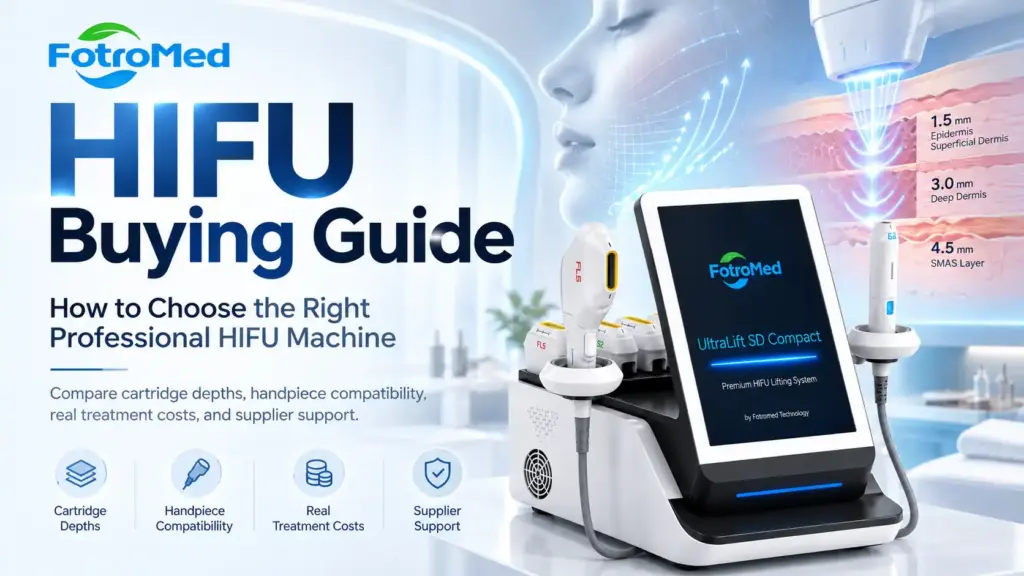
Common face options include four depths at 1.5, 2.0, 3.0, and 4.5 mm. Common body options include three depths at 6.0, 9.0, and 13.0 mm. The supported set of heads depends on your specific system.
Buying a HIFU machine is only your first expense. Heads and coupling gel add ongoing costs as your clinic treats clients. Your handpieces and cords also face wear from daily use. Knowing how these HIFU accessories work helps you read labels and plan your budget.
This guide explains the parts for clinic owners, medspa managers, and distributors. You don’t need physics training to follow what happens inside a head. Once you see how sound creates heat, depth and frequency ratings make more sense.
What Is a HIFU Cartridge?
High-intensity focused ultrasound (HIFU) systems share their work across three main parts. Your main console supplies power, controls pulse timing, and holds the screen. A corded handpiece gives your operator a grip and carries power from the console. The head fits onto that handpiece and turns electrical pulses into focused sound.
Your clinic also uses ultrasound coupling gel, a supply separate from the machine. Gel fills the sound path between the tip window and skin. In normal service, your handpiece and cord stay in use through many head changes. Your budget therefore includes both supplies you use up and longer-lasting parts.
This guide covers replaceable heads with a set use limit on aesthetic ultrasound machines. Each head has its own focus depth. Swapping heads lets the same handpiece work at another depth. Your screen shows how much of each head’s rated use count remains.
How Does a HIFU Cartridge Work?
Sound travels as fast pressure waves through water or soft tissue. Ultrasound works the same way, except its waves vibrate far above human hearing. Your console sends timed electrical pulses through the cord into the head. Inside, a sound-making element vibrates fast and sends those waves toward the tip.
Focusing Sound Waves Below the Tip
A curved element or shaped sound lens bends those pressure waves inward. The waves pass through skin and meet in one small zone, called the focus. Picture a magnifying glass gathering sunlight onto a tiny spot. Your head focuses sound in a similar way.
Each brief firing sends many fast wave cycles forward together. Near the contact window, the incoming sound beam spans a wider area. Deeper down, waves crowd into a narrow focus at the distance marked on your head. Past that focus, the waves cross and spread back out into deeper tissue.
How Tissue Turns Sound Into Local Heat
Soft tissue along the beam path absorbs part of that sound energy as heat. Above and below the focus, the wider beam spreads energy across more tissue. At the focus, waves meet and pack energy into a tiny spot. That builds stronger local heat.
How heat spreads across tissue layers also depends on energy, time, and skin contact.
Focused sound heats a buried tissue layer without cutting outer skin. The shape of parts inside the head forms that focus. Trained clinical staff choose target layers and settings.
Machines also differ in how they place heated zones when your operator fires. Some modes place a single point. Others place a row of points along a line.
Your machine groups these pulses into counted uses. That design sets what one count on your screen means.
HIFU Cartridge Depth and Frequency Explained
Focus depth and sound frequency are your two core head ratings. Depth uses millimeters (mm), while frequency uses megahertz (MHz). Some labels show both, while others leave details in the part guide. Together, the ratings describe where waves meet and how they travel through tissue.
Focus Depth in Millimeters
The millimeter rating states focus distance beneath the flat tip window touching skin. A 3.0 mm head brings sound waves together three millimeters below that contact surface. On fixed-focus heads, the shape inside sets that distance at the factory.
Power controls the rate at which energy enters your head. Changing it leaves the designed focus distance in place.
Heating also depends on time, contact, and how much sound the tissue absorbs. Shallower facial heads aim toward the dermis. This skin layer contains collagen and sits under the outer skin.
Deeper facial heads aim toward the SMAS (superficial musculoaponeurotic system), a fibrous muscle support layer.
Skin and fat thickness vary across people and facial zones. A 4.5 mm rating therefore marks a distance from the tip. The tissue at that distance can differ between people and areas.
Sound Frequency in Megahertz
Megahertz counts how fast sound waves cycle. At 1 MHz, one million cycles pass each second. Higher-frequency sound has shorter waves and generally loses energy faster in tissue. Lower-frequency sound loses less energy over the same distance.
The head design sets its focus. Frequency affects how much sound is lost along the path.
Both sound frequency and element shape also influence focal spot size. Microfocused ultrasound (MFU) systems place small heated zones in layers near the surface.
In reviewed MFU setups, 10 MHz heads focus at 1.5 to 2 mm beneath the window. Mid-depth 7 MHz heads reach up to about 3 mm in those same systems. Deeper 4 MHz heads reach up to about 4.5 mm across those published MFU setups.
Each platform pairs focal distance and sound frequency in its own way. Match both ratings to your system manual before ordering heads.
HIFU Cartridges for Face, Body, and Special Uses
Catalogs group heads by face or body use to describe their target tissue. Skin thickness and fat depth vary across body areas and between clients. Shallow tightening heads target the dermis and fibrous support layers near the surface. Deeper body heads target fat beneath the skin.
A fixed-focus head keeps its designed focus distance wherever your operator places it. Moving a 3.0 mm tip from cheek to stomach still focuses 3.0 mm deep. Heads used for facial tightening can serve body-skin uses listed for your system. Deeper fat work calls for a head built for that deeper target.
For deep fat targets, the design pairs a longer focus with its sound frequency. A 2024 ultrasound safety tutorial describes a body-fat system with a 13 mm focus at 2 MHz. The 13 mm figure describes that body system. It gives you a concrete example, rather than a range for all body heads.
Review your system’s listed body areas and supported depths before ordering body heads.
Specialist heads include vaginal probes, which have their own matched systems and clinical uses.
Inside a HIFU Cartridge: Parts, Wear, and Shot Limits
Internal Parts and Physical Wear
Several parts work inside the outer housing to aim ultrasound cleanly. At the core sits the transducer, which turns electricity into rapid vibration. In piezoelectric designs, a ceramic element flexes as the electrical drive changes. That repeated flexing produces sound.
The connection to your handpiece carries power and control signals.
In liquid-filled designs, sealed fluid sits between the internal element and tip window. That liquid carries sound waves smoothly from the vibrating element to the front face. The thin window lets sound exit toward skin while seals hold fluid in and block outside air.
Small losses during energy conversion build heat inside the head. Excess heat or stress can change how its element responds. Wear also includes aging seals and scuffed windows. Each pulse does not cause the same fixed amount of wear.
Shot Caps, Resets, and Refurbished Heads
Counted life and physical part wear are two separate things on count-limited machines. A shot cap is the maker’s allowed use count set for that head. Your console counter tracks firing history without measuring internal wear directly.
Zero marks the end of that allowance. Some count-limited systems then stop further firing.
A count reset changes the logged count, while physical part service is separate work. A refurbished head is a used part that has undergone service. The word itself gives you no detail about the work inside. Resetting a counter without servicing worn parts leaves old wear inside the head.
That distinction matters when you compare new, reset, and refurbished heads. Source replacement heads from your machine maker or an authorized channel for clear part origin.
Why HIFU Needs Gel, and What Air Does
Ultrasound moves well through watery skin, yet air disrupts its travel path. Air and tissue respond very differently to sound pressure waves. Because watery tissue and air differ sharply, even a thin air gap causes strong reflection. Coupling gel carries sound well and fills tiny air gaps under your tip window.
Fine hairs, pores, and skin curves leave gaps under a flat tip. Air in those gaps reflects sound strongly. A dry patch or trapped gel bubble scatters waves instead of letting them focus cleanly. Any break in the sound path reduces the energy that reaches the deep focus.
Some machines pair microfocused ultrasound with live tissue imaging, called MFU-V. Poor contact during those sessions can lead to unwanted heating near outer skin. A 2026 review of MFU-V complications lists uneven contact and air pockets among skin injury risks.
A liquid-filled head has a sound path on each side of its window. Internal liquid carries waves behind the window, while gel bridges the outer face to skin. Extra skin gel cannot clear an internal bubble trapped behind that barrier. That internal bubble scatters sound inside the chamber before waves reach the window.
A sealed liquid chamber keeps its fluid separate from the outside gel. Some head designs allow user filling with their designated fluid. Keeping both sound paths intact helps your head focus sound at the target layer.
HIFU Cartridge Shots, Lifespan, and Treatment Cost
What one count means on screen depends on your machine’s delivery design. One count might equal a single pulse, one heated point, or a full line. Cost per 1,000 counts gives a fair comparison only when firing mode and what each count means both match.
Landed cost is your head price plus shipping, duty, and tax. It is the total cost of bringing one head into stock.
Appointments per head = Rated shots ÷ Shots used per appointment on that head
Consumable cost per single-head visit = (Landed head cost ÷ Appointments per head) + Gel cost per visit
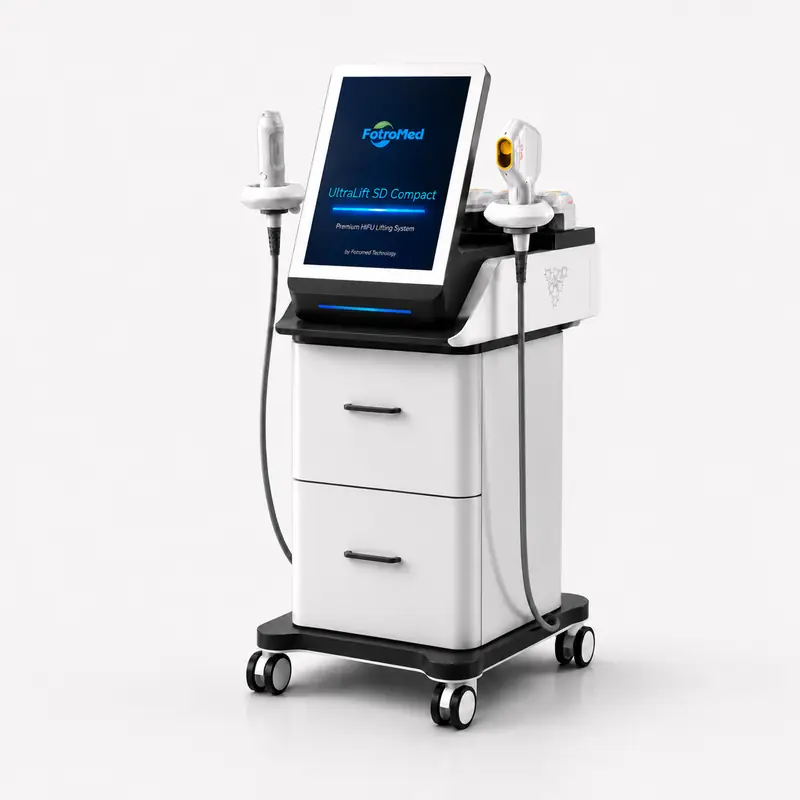
Our UltraLift SD HIFU machine offers a clear stock-planning example. The replaceable SD cartridge for its SD handpiece has a rated capacity of 2,000 shots. If you use 500 SD shots from that same cartridge per appointment, dividing 2,000 by 500 gives 4 appointments. Here, 500 is only an illustrative count for planning math, since actual shot use and appointment totals depend on each clinic’s protocol.
Dividing that SD cartridge’s landed cost by 4 gives its cost per appointment. Adding gel gives its supply cost per appointment. Staff time and clinic overhead sit outside this formula.
For a visit using several depths, the used share of each head adds to your cost. Gel enters that sum once. Each head has its own remaining count and stock needs.
Your reorder point combines expected use during delivery with spare shots as a buffer. Expected use equals your weekly count use on that head times delivery weeks. Ordering before counts reach that point allows time for the next head to arrive.
Handpieces and Cables
Your handpiece holds the head and gives your operator a grip during sessions. Its cord carries power and control signals between the console and head. A plug connects the cord to the console. Repeated tight bends strain the cord, especially near either end.
A worn cord cover, cracked plug shell, or loose head mount shows a condition issue. Those signs give you no exact diagnosis of an internal fault. Check whether your replacement quote includes the grip, cord, and plug together or as separate parts.
Buying HIFU Cartridge Replacements
A replacement head needs to fit your handpiece and work with your console. Its physical connection is one part of that match. In clinics with several machines, each unit needs its own matched parts. Include these four details whenever you price or order replacement heads:
- Console model name and serial number
- Handpiece version or part code
- Head focal depth (mm) and sound frequency (MHz)
- Rated shot limit and what one screen count means
Your order terms state the head’s warranty coverage alongside the console’s coverage. They also explain how the seller handles damage on arrival or a fault in a new head.
Dispatch origin and lead time also shape your reorder buffer and landed cost. An overseas order also passes through customs on its way to your clinic. Including transit time in your stock plan helps you judge when to reorder.
Conclusion
At Fotromed, as a leading HIFU manufacturer in China, we believe a console should fit cleanly with its handpieces and replaceable heads. Clear shot-count meaning on screen matters too, since your team needs to know what each count represents. That clarity gives your clinic a practical basis for estimating head use and planning replacements.
In our future design and support work, we prioritize straightforward daily upkeep alongside physical fit and screen clarity. We also aim to provide clear matching guidance as clinics plan replacement head orders around expected use. Browse our compatible HIFU cartridges and spare parts when you prepare your next clinic order.
HIFU Cartridge FAQs
Does higher HIFU cartridge frequency mean higher power?
No, frequency counts sound cycles per second, while power measures energy per second. A higher MHz rating means more wave cycles in that time. It also affects how fast sound loses energy in tissue. Local heating depends on the energy reaching the focus, time, tissue makeup, and skin contact.
Why is an air bubble harmful during HIFU?
An air bubble strongly reflects sound and disrupts its path. In a liquid-filled head, an internal bubble interrupts sound before it reaches the tip window. A gap in surface gel disrupts the path after that window. Extra skin gel stays outside, so it cannot reach a bubble trapped inside your head.
Can you use a facial HIFU cartridge on the body?
A head used for facial tightening can serve body-skin uses listed for your system, such as arm or stomach skin. A fixed-focus head keeps its designed distance from the tip. The tissue at that depth can differ across body areas. Deeper body-fat work calls for a head built for that deeper target.
Is a HIFU cartridge the same as a laser tip?
No, a HIFU cartridge sends sound pressure waves, while a laser tip delivers light. How laser light travels and heats tissue depends on its wavelength and tissue absorption. HIFU brings sound waves together below the tip to build local heat. Each type of machine needs parts built for its own energy source.
Should you peel the film off a HIFU cartridge tip?
Remove a film only when the instructions for your head say to. A shipping cover can look like a working membrane, the thin layer through which sound passes. Some protective seals also stay in place during use. Your part guide identifies which kind your head has.