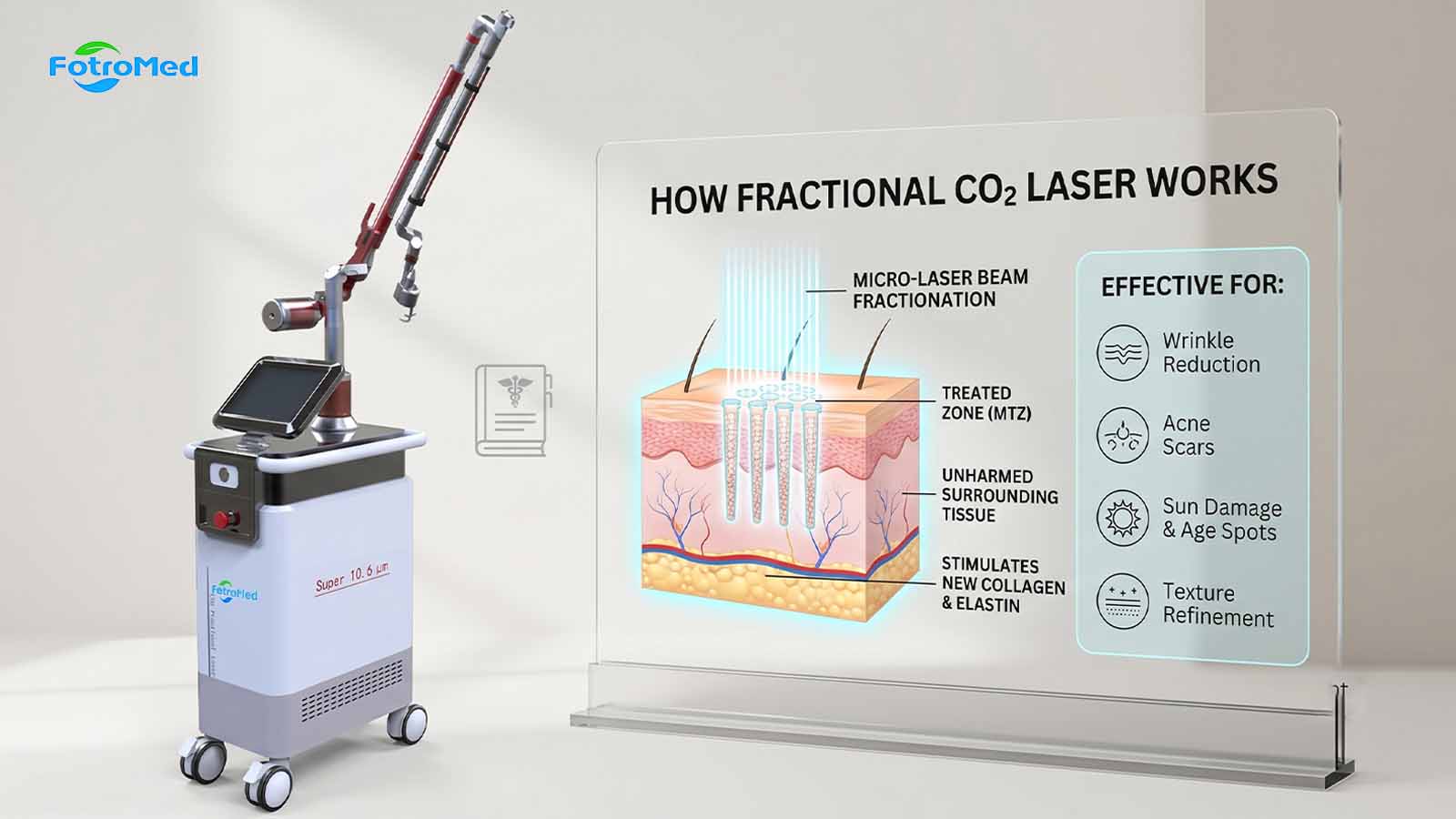
 Most articles on fractional CO2 lasers fall into one of two camps. The first reads like a chamber-of-commerce brochure for a single clinic — long on testimonials, short on parameters. The second is encyclopedia filler that defines “fractional” in a sentence and never explains why the technology actually works, what separates a clinical-grade machine from a budget unit, or what a clinic should ask a manufacturer before signing a purchase order.
This guide is written for a different reader: the clinic owner, dermatology practice manager, medspa operator, or distributor who needs to understand the technology and the device. We cover the optics, the clinical evidence, the side-effect profile, and the engineering decisions that decide whether a machine performs reliably over a multi-year service life. Where regulatory status matters, we name it precisely. Where vendor claims diverge from peer-reviewed findings, we say so. References to the foundational literature appear inline and are listed in full at the end.
Fractional CO2 Laser: The Essentials at a Glance
| Parameter | Value / Range |
|---|---|
| Laser type | Ablative fractional, CO2 |
| Wavelength | 10,600 nm (10.6 µm) — far-infrared, strongly absorbed by tissue water |
| Primary mechanism | Microthermal treatment zones (MTZs) — columns of ablation surrounded by intact tissue |
| Typical power output (clinical systems) | 30–60 W |
| Common spot/dot pitch range | 0.1–2.0 mm |
| Pulse width range | 0.1–10 ms |
| Established indications (well-supported by literature) | Acne and surgical scars, photoaging, fine lines and wrinkles, dyschromia, actinic keratoses, soft-tissue excision of benign lesions |
| Typical session length | 20–45 minutes face; longer for body areas |
| Downtime | 5–14 days depending on aggressiveness |
| Sessions for full result | Often 1–3 (deep) or 3–5 (lighter passes), spaced 4–8 weeks |
| Regulatory status (US) | Specific cleared systems hold FDA 510(k) for named indications; the category itself is not “FDA approved” |
| Foundational science | Manstein et al., Lasers Surg Med (2004) — fractional photothermolysis |
Use this as a quick reference; the rest of the article unpacks each row.
What Is a Fractional CO2 Laser?
A fractional CO2 laser is a medical-aesthetic device that emits a 10,600 nm (10.6 µm) far-infrared beam, then splits that beam into a grid of microscopic columns delivered to the skin in a controlled pattern. Each column ablates and heats a tiny vertical channel of tissue — a microthermal treatment zone, or MTZ — while the surrounding skin is left intact.
That fractionated geometry is the entire point. A traditional, fully ablative CO2 laser removes a continuous sheet of epidermis and dermis, producing dramatic results but also weeks of crusting, prolonged erythema, and a real risk of scarring or pigmentary change. A fractional CO2 laser delivers comparable depth in narrow columns and uses the untouched tissue between them as a reservoir of viable cells that re-epithelialize the treated zones from the sides. The healing window collapses from weeks to days, while collagen remodeling continues for months.
The underlying concept — fractional photothermolysis — was introduced by Manstein and colleagues at the Wellman Center for Photomedicine in 2004 and adapted to CO2 wavelengths by 2007. It is the single most cited innovation in modern laser dermatology.
For B2B buyers, the practical takeaway is that “fractional CO2” is not one device but a family of systems with very different optics, power, scanner technology, and operating ranges. Fotromed’s Mesin Laser CO2 Fraksional range, for context, spans clinic-grade units in this market segment.
CO2 Laser vs Fractional CO2 Laser: What’s the Difference?
This is the highest-volume disambiguation question in the category, and the answer matters because the two technologies carry very different downtime, risk profiles, and use cases.
| Attribute | Traditional CO2 Laser (fully ablative) | Fractional CO2 Laser |
|---|---|---|
| Beam delivery | Continuous sheet across the treated area | Grid of microscopic columns (MTZs) covering 5–30% of the surface area per pass |
| Epidermal removal | Complete, in the treated zone | Partial, fractionated |
| Healing reservoir | None — the entire treated zone re-epithelialises from wound edges | Untreated tissue between MTZs accelerates re-epithelialisation |
| Typical downtime | 2–4 weeks of crusting, weeping, erythema | 5–14 hari; kisaran lebih ringan dengan pengaturan konservatif |
| Risiko pembentukan jaringan parut / dispigmentasi | Lebih tinggi | Jauh lebih rendah, tetapi tidak nol |
| Best for | Kerutan parah, parut jerawat dalam di mana resurfacing maksimum dapat diterima | Photoaging, parut ringan–sedang, diskromia, pemeliharaan resurfacing |
| Toleransi pasien | Sering kali memerlukan anestesi yang lebih dalam / sedasi | Biasanya anestesi topikal |
Sebagian besar platform CO2 yang dijual saat ini adalah fractional-capable, dan banyak juga yang dapat beroperasi dalam mode gelombang kontinu (CW) atau terdenyut untuk eksisi bedah (kutil, skin tag, lesi jinak). Ketika pembeli membandingkan “laser CO2” dengan “laser CO2 fraksional” dalam spesifikasi vendor, mereka biasanya membandingkan mode dari mesin yang sama, bukan dua perangkat yang berbeda.
Cara Kerja Laser CO2 Fraksional pada Kulit
Panjang gelombang 10,6 µm dan penyerapan air
Panjang gelombang 10.600 nm tidak dipilih berdasarkan tradisi; panjang gelombang ini dipilih karena berada pada puncak penyerapan air yang kuat di dalam jaringan. Kulit mengandung sekitar 60–70% air, sehingga energi 10,6 µm diserap dalam kedalaman yang sangat dangkal — dalam kisaran puluhan mikrometer — dan diubah hampir seluruhnya menjadi panas. Penyerapan superfisial yang ekstrim itulah yang membuat laser CO2 menjadi ablator yang efisien: laser menguapkan jaringan sebelum panas sempat merambat secara lateral.
Perilaku panjang gelombang inilah yang membedakan CO2 dari perangkat “fraksional” lainnya. Erbium:YAG pada 2.940 nm memiliki koefisien penyerapan air yang bahkan lebih tinggi dan melakukan ablasi secara lebih bersih dengan kerusakan termal sisa yang lebih sedikit. Laser fraksional non-ablatif pada 1.540–1.927 nm menembus lebih dalam tetapi tidak menguapkan jaringan. Pemilihan panjang gelombang menentukan seluruh profil waktu pemulihan (downtime) dan remodelling.
Zona perawatan mikrotermal (MTZ)
Di dalam setiap MTZ, laser melakukan dua hal secara berurutan: mengablasi kolom jaringan yang sempit dan menciptakan selubung di sekitarnya berupa dermis terkoagulasi yang mengalami kerusakan termal. Kolom ablatif adalah bagian yang menghilangkan lesi berpigmen dan ketidakrataan permukaan. Selubung koagulatif adalah bagian yang memicu kaskade penyembuhan luka jangka panjang yang menghasilkan pembentukan kembali (remodeling) kolagen.
Geometri pola MTZ dikontrol oleh tiga parameter yang harus ditampilkan oleh setiap antarmuka kelas klinis:
- Densitas (dot pitch) — jarak antara kolom yang berdekatan, biasanya 0,1–2,0 mm. Kerapatan yang lebih rapat meningkatkan cakupan dan agresivitas tetapi memperpanjang downtime.
- Lebar pulsa \/ energi pulsa — mengontrol seberapa dalam setiap kolom menjangkau dan seberapa banyak sisa panas yang didepositkan.
- Bentuk dan mode pola pemindaian — persegi, lingkaran, heksagon, atau raster kustom; penempatan titik berurutan vs acak (pola acak mengurangi akumulasi panas berlebih di suatu area).
Ablasi + koagulasi: memicu pemodelan ulang kolagen
Literatur terbaru telah merevisi asumsi lama bahwa fluens yang lebih tinggi selalu menghasilkan hasil yang lebih baik. Tinjauan terhadap parameter peremajaan kulit CO2 fraksional menunjukkan bahwa fluens yang lebih rendah dengan kerapatan sebanding dapat menginduksi penanda penyembuhan luka molekuler serupa dengan efek samping yang lebih sedikit — panduan yang berguna bagi operator yang tergoda untuk memaksakan pengaturan energi demi hasil yang “lebih kuat”.
Catatan teknik. Rasio zona ablasi terhadap batas koagulasi sebagian besar ditentukan oleh lebar pulsa. Pulsa pendek (sub-milidetik) mendukung ablasi bersih dengan kerusakan termal minimal — bagus untuk pengerjaan tekstur permukaan. Pulsa yang lebih panjang (2–10 ms) memperlebar batas koagulasi — berguna saat kontraksi kolagen menjadi tujuan (ritida yang lebih dalam, pemodelan ulang bekas luka). Mesin yang menawarkan rentang lebar pulsa 0,1–10 ms memberikan fleksibilitas klinis yang jauh lebih besar kepada operator daripada sistem pulsa tetap.
Untuk Apa Laser CO2 Fraksional Digunakan?
Bekas jerawat dan bekas luka operasi
CO2 fraksional adalah salah satu modalitas laser dengan bukti terbaik untuk bekas jerawat atrofi. Sebuah tinjauan sistematis oleh Ong dan Bashir menemukan peningkatan konsisten pada tampilan bekas luka di seluruh literatur yang dipublikasikan, dengan sebagian besar penelitian melaporkan peningkatan 25–75% dalam 2–4 kali perawatan. Mekanismenya — cedera dermal terkontrol yang diikuti oleh reorganisasi kolagen — juga berlaku untuk bekas luka operasi hipertrofik dan kontraktur bekas luka bakar, meskipun parameter dan konseling pra-perawatan berbeda.
Photoaging, garis-garis halus, dan kerutan
Ritida periorbital dan perioral adalah indikasi klasik. Pendekatan fraksional menghasilkan hasil sesi tunggal yang kurang dramatis dibandingkan tindakan ablasi penuh, tetapi rangkaian 1–3 perawatan biasanya memberikan penghalusan yang terlihat dan tahan lama dengan downtime yang dapat dikelola, yang menjadikan prosedur ini pilihan utama dalam praktik dermatologi dan bedah plastik selama lima belas tahun terakhir.
Diskromia dan tekstur tidak merata
Lentigo solaris, hiperpigmentasi pasca-inflamasi, dan ketidakrataan tekstur secara umum merespons dengan baik pada pasien berkulit lebih terang (Fitzpatrick I–III). Fototipe yang lebih gelap memerlukan penilaian risiko-manfaat yang berbeda, yang dibahas pada bagian berikutnya. Untuk pigmentasi difus, alternatif seperti Laser Thulium 1927nm or IPL Machines mungkin lebih sesuai atau digunakan sebagai platform kombinasi.
Indikasi lain: eksisi bedah jaringan lunak
Platform CO2 dengan handpiece bedah terfokus banyak digunakan untuk eksisi lesi kulit jinak — kutil, skin tag, keratosis seboroik, tahi lalat (jika sesuai dan setelah diagnosis), dan prosedur jaringan lunak kecil lainnya. Ini adalah aplikasi bedah terbukti dari panjang gelombang 10,6 µm, mendahului modalitas fraksional selama beberapa dekade.
Catatan tentang indikasi di luar arus utama dermatologi: beberapa sistem CO2 dipasarkan dengan handpiece intravagina atau vulvovagina untuk “peremajaan vagina,” inkontinensia urin, atau sindrom genitourinari menopause. FDA AS belum menyetujui perangkat berbasis energi apa pun untuk indikasi-indikasi ini, dan pada Juli 2018 mengeluarkan safety communication peringatan mengenai laporan luka bakar vagina, pembentukan jaringan parut, dan nyeri kronis setelah prosedur tersebut. Pembeli yang mengevaluasi platform multi-handpiece harus memperlakukan klaim izin apa pun di area ini dengan hati-hati dan meminta ringkasan 510(k) khusus untuk indikasi yang bersangkutan.
Tipe Kulit Mana yang Cocok untuk Laser CO2 Fraksional?
| Tipe kulit Fitzpatrick | Kesesuaian | Pertimbangan utama |
|---|---|---|
| I–II (sangat terang) | Tinggi | Risiko PIH lebih rendah; parameter standar umumnya dapat ditoleransi |
| III (terang-sedang) | Tinggi dengan parameter yang wajar | Profilaksis pigmentasi pra/pasca sering digunakan |
| IV (sedang) | Dapat diterima dengan pengaturan konservatif | Kepadatan lebih rendah, interval perawatan lebih panjang; pertimbangkan uji sampel |
| V–VI (gelap) | Gunakan dengan hati-hati atau pertimbangkan alternatif non-ablatif | Risiko hiperpigmentasi pasca-inflamasi (PIH) yang secara signifikan lebih tinggi; beberapa ahli menyarankan untuk menghindari CO2 fraksional ablatif pada tipe V–VI dan lebih memilih perangkat fraksional non-ablatif |
Kontraindikasi standar mencakup infeksi herpes simpleks aktif di area perawatan (profilaksis HSV umumnya diresepkan untuk perawatan wajah), jerawat inflamasi aktif dengan pustula di area tersebut, penggunaan isotretinoin baru-baru ini (waktu tunggu 6 bulan yang telah lama diterapkan telah dipertanyakan dalam literatur terbaru, tetapi sebagian besar praktisi masih mematuhinya), kecenderungan keloid, kehamilan, dan infeksi kulit aktif apa pun.
Sesi, Pemulihan, dan Hasil: Apa yang Diharapkan
Berapa lama durasi satu sesi?
Sesi CO2 fraksional seluruh wajah biasanya membutuhkan waktu 20–45 menit waktu laser, ditambah 30–60 menit sebelumnya agar anestesi topikal bekerja. Area perawatan yang lebih kecil (perioral, periorbital) membutuhkan waktu 10–15 menit. Perawatan tubuh di banyak area — stretch mark, bekas luka besar — dapat berlangsung lebih lama.
Berapa banyak sesi yang direkomendasikan?
Untuk photoaging dan jaringan parut ringan, 1–3 sesi yang lebih dalam dengan jeda 6–8 minggu sering kali memberikan hasil yang ditargetkan. Untuk bekas jerawat atrofi dan photoaging yang lebih lanjut, 3–5 sesi dengan intensitas progresif adalah protokol yang umum. Praktisi konservatif semakin menyukai beberapa tindakan yang lebih ringan daripada satu perawatan agresif karena hasil kumulatifnya serupa dan risiko efek sampingnya lebih rendah.
Linimasa pemulihan
| Hari | Apa yang biasanya dialami pasien |
|---|---|
| Hari 0 (perawatan) | Sensasi seperti terbakar matahari, pembengkakan dimulai dalam beberapa jam |
| Hari 1–3 | Eritema dan pembengkakan puncak; keluar cairan ringan; gatal saat penyembuhan dimulai |
| Hari 4–7 | Pengerasan dan pengelupasan; kulit baru di bawahnya; gatal mencapai puncak |
| Hari 7–14 | Kulit merah muda, sensitif; riasan biasanya ditoleransi mulai hari ke-7–10 |
| Minggu 2–6 | Eritema memudar; tekstur terus membaik |
| Bulan 3–6 | Remodelisasi kolagen memberikan peningkatan berkelanjutan |
Perlindungan sinar matahari (SPF 50+, penghindaran sinar UV secara ketat) sangat penting selama setidaknya tiga bulan pasca-perawatan untuk meminimalkan risiko PIH.
Apa Saja Kekurangan dan Risiko Laser CO2 Fraksional?
Tidak ada perangkat ablatif yang bebas risiko, dan operator B2B yang bertanggung jawab harus dapat menjelaskan baik risiko yang telah terbukti maupun komplikasi langka kepada calon pasien.
Efek samping yang paling umum dan diperkirakan adalah eritema, edema, pengerasan, dan pruritus sementara selama masa penyembuhan — ini adalah bagian dari mekanisme, bukan komplikasi. Risiko yang signifikan secara klinis yang terdokumentasi dalam literatur meliputi:
- Hiperpigmentasi pasca-inflamasi (PIH) — paling umum pada Fitzpatrick IV–VI; biasanya bersifat sementara tetapi dapat bertahan selama berbulan-bulan
- Hipopigmentasi pasca-inflamasi — lebih jarang terjadi tetapi lebih sulit dipulihkan
- Eritema berkepanjangan berlangsung lebih dari 4–6 minggu
- Erupsi akneiformis atau milia selama penyembuhan
- Infeksi bakteri, virus (reaktivasi HSV), atau kandida pada area yang dirawat
- Jaringan parut, termasuk jaringan parut hipertrofik, terutama di leher dan dada di mana dermis lebih tipis — Fife, Fitzpatrick, dan Zachary mendokumentasikan empat kasus dalam makalah tahun 2009
- Garis demarkasi di batas area perawatan jika perbauran kurang baik
Besarnya risiko meningkat seiring dengan agresivitas perawatan, lokasi anatomi, pengalaman operator, dan jenis kulit pasien. Parameter konservatif, uji tempel pada pasien berisiko lebih tinggi, dan profilaksis HSV merupakan langkah standar pengurangan risiko.
Apa yang Membuat Mesin Laser CO2 Fraksional Terbaik?
Bagi klinik atau distributor yang mengevaluasi pembelian, perbedaan antara laser CO2 fraksional yang biasa saja dan yang unggul terletak pada lima keputusan rekayasa. Nama merek, negara asal, dan bahasa pemasaran adalah sinyal yang lebih lemah dibandingkan komponen yang mendasarinya.
Tabung logam RF vs tabung kaca — satu faktor keandalan terbesar
Sumber laser CO2 berupa tabung logam tereksitasi RF atau tabung laser kaca (tereksitasi DC). Perbedaan performa dan masa pakainya tidak signifikan.
| Spesifikasi | Tabung logam RF | Tabung laser kaca |
|---|---|---|
| Masa pakai | ~20.000 jam | ~2.000 jam |
| Stabilitas daya puncak | Tinggi, konsisten sepanjang masa pakai | Lebih rendah; terdegradasi lebih cepat |
| Ukuran titik minimum | ~0,07 mm dapat dicapai | Batas bawah tipikal ~0,25 mm |
| Keandalan | Unit yang stabil dan tersegel | Lebih rapuh; sensitif terhadap penanganan |
| Biaya penggantian / waktu henti | Biaya unit lebih tinggi, tetapi jarang | Biaya unit lebih rendah, tetapi lebih sering |
Bagi klinik yang menjalankan perawatan harian, sistem tabung RF sepadan dengan biayanya dalam hal waktu aktif dan konsistensi. Bagi praktik penggunaan sesekali, kalkulasinya lebih tipis, tetapi ukuran titik lebih kecil yang dapat dicapai dengan sumber RF penting secara klinis — pola titik yang lebih halus memberikan perawatan yang lebih lembut dengan total energi yang sama.
Teknologi pemindai, rentang densitas, dan lebar pulsa
Pemindai adalah komponen yang mengubah satu kolom laser menjadi pola kisi yang berguna secara klinis. Pemindai galvanometer (galvo) dengan kontrol penggerak ikatan tertutup (closed-loop) memberikan penempatan titik yang lebih akurat daripada sistem prisma berputar atau cermin-pada-motor-stepper yang lebih lama. Perhatikan:
- Rentang lebar pulsa — makin lebar makin baik. Rentang 0,1–10 ms memberi operator ablasi yang bersih (sub-milidetik) dan koagulasi yang lebih dalam (multi-milidetik) pada platform yang sama.
- Rentang dot pitch — 0,1–2,0 mm adalah nilai umum untuk sistem fleksibel.
- Mode pemindaian — pola sekuensial, acak, dan middle-out masing-masing memiliki kasus penggunaan klinis. Pola acak meminimalkan pemanasan massal pada satu area tertentu; sekuensial lebih cepat tetapi lebih hangat.
- Bentuk pola — persegi dan lingkaran bersifat universal; isian heksagonal dan segitiga, ditambah bentuk yang dapat disesuaikan oleh operator, memungkinkan penyesuaian yang lebih baik terhadap kontur anatomi.
Ukuran titik, kedalaman fokus, dan handpiece
Beberapa tip pemindai dengan fokus tetap atau yang dapat dipertukarkan memungkinkan operator mengubah kedalaman ablasi tanpa mengubah pengaturan energi. Kelompok empat tip yang umum berkisar dari tip ultra-ablatif dengan diameter fokus ~0,2 mm (penetrasi terdalam, penanganan bekas luka dalam) hingga tip non-ablatif dengan diameter fokus ~0,8–1,2 mm (resurfacing ringan, area sensitif).
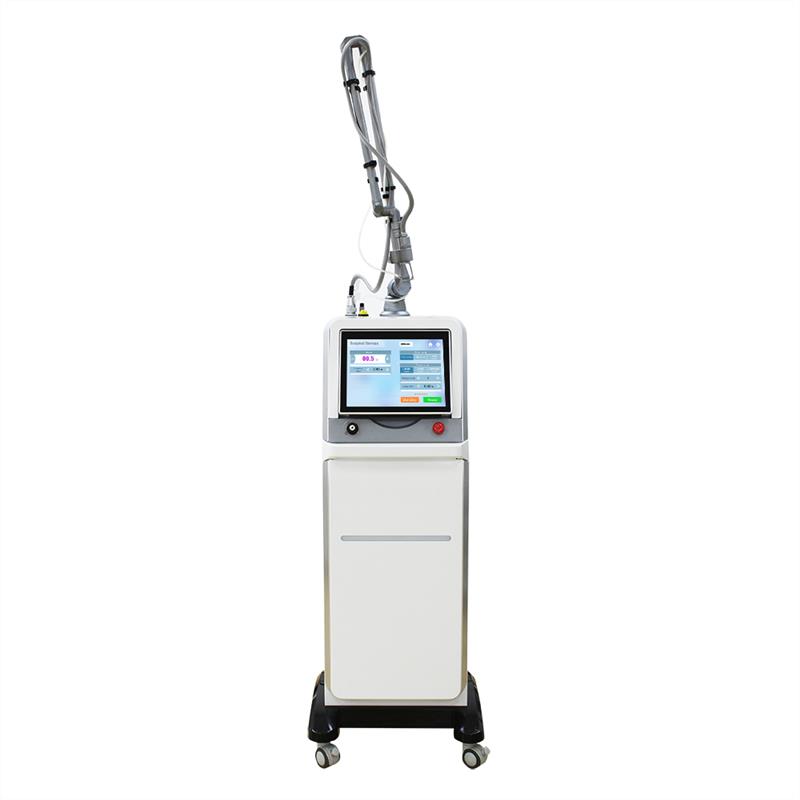
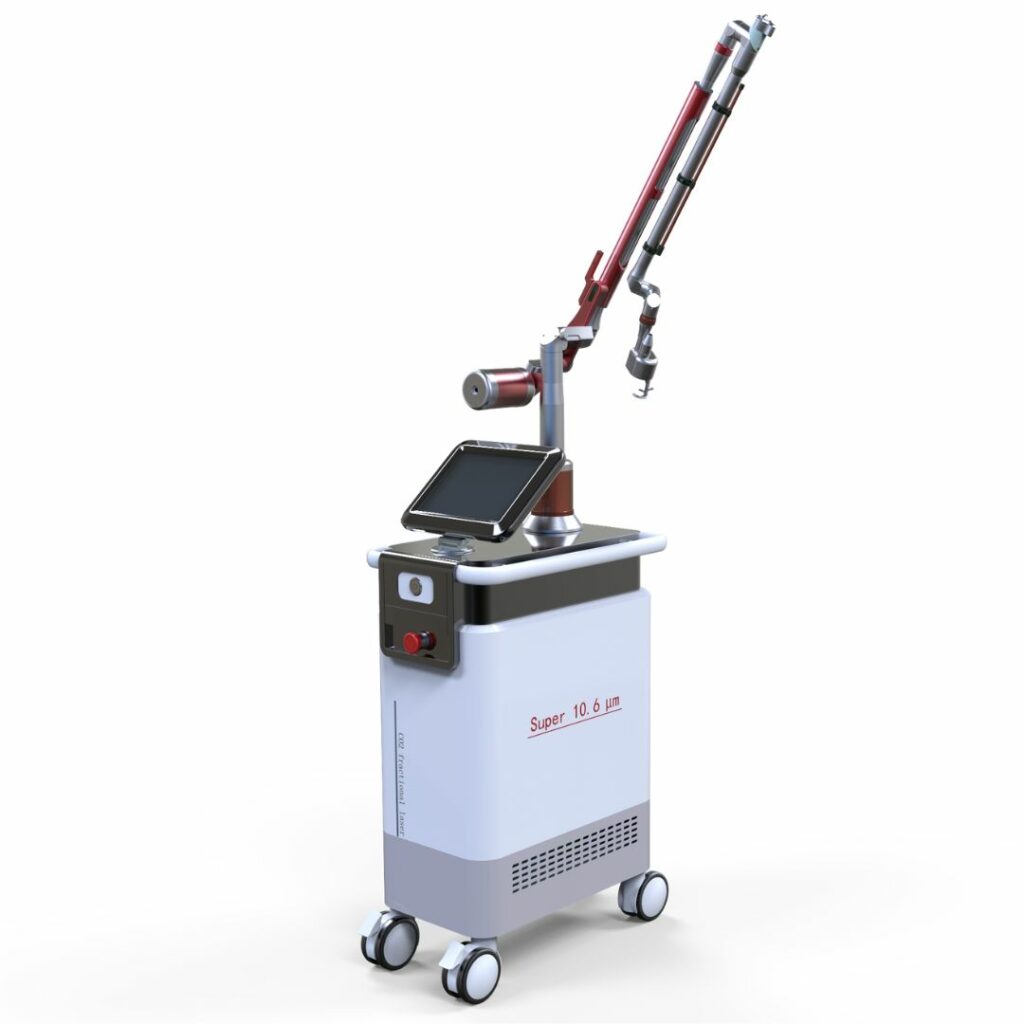
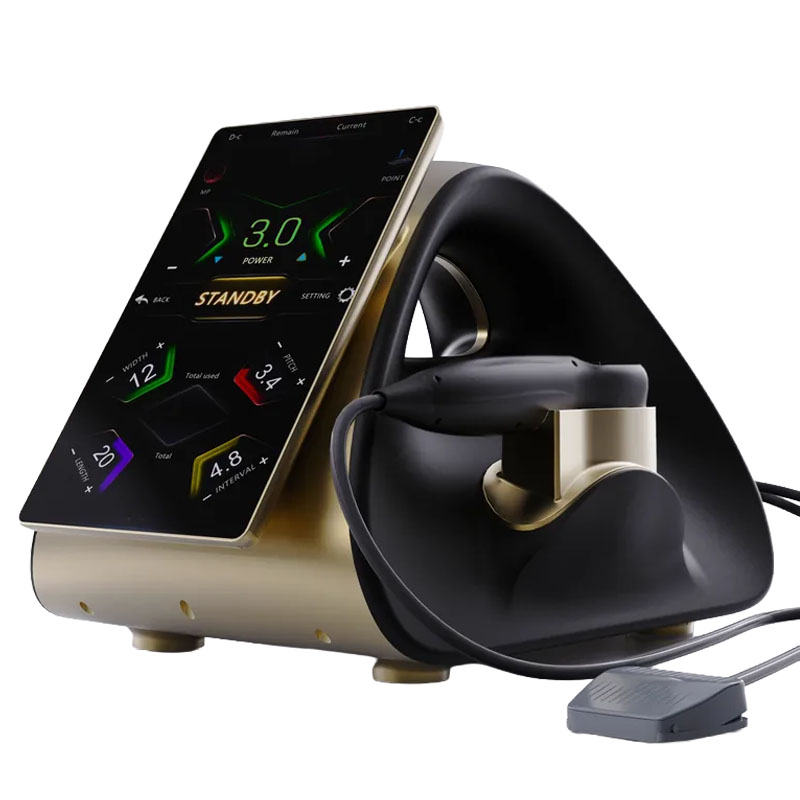
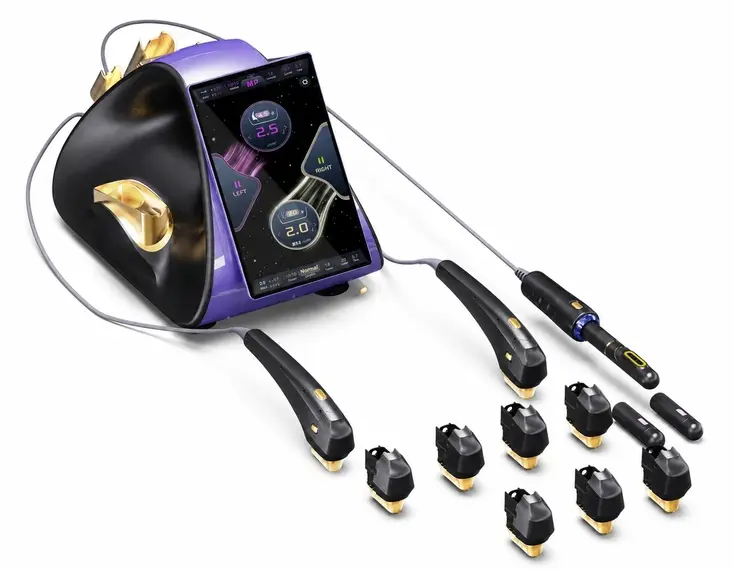
Contoh kasus — CeloLaser CO2 Fractional (Fotromed). Platform CeloLaser mengilustrasikan desain tabung RF kontemporer: pemancar logam RF Coherent 40 W buatan AS pada 10.600 nm ±0.3%, lengan terartikulasi 7-sendi impor Korea dengan deviasi jalur optik <0.5%, modul pemindai Galvo Jerman, dan empat tip pemindai yang dapat dipertukarkan yang mencakup rentang titik fokus ultra-ablatif hingga ultra-non-ablatif. Antarmuka menyediakan 5 bentuk pola (persegi, lingkaran, heksagon, segitiga, kustom), 3 mode pemindaian, dan rentang lebar pulsa 0,1–10 ms — jenis cakupan parameter yang mendukung alur kerja dermatologi dan bedah estetika tanpa perlu menggunakan dua mesin terpisah. Spesifikasi lengkap tersedia di Mesin Laser CO2 Fraksional halaman kategori.
Daftar periksa pembeli — apa yang harus ditanyakan kepada produsen sebelum menandatangani perjanjian.
- Tabung logam RF atau tabung kaca? Berapa masa pakai terukur dan biaya penggantiannya?
- Rentang lebar pulsa dan rentang dot-pitch — spesifikasi numerik lengkap, bukan bahasa pemasaran.
- Tip pemindai mana yang disertakan sebagai standar dan mana yang merupakan aksesori? Berapa diameter fokus untuk masing-masing tip?
- Bagaimana status regulasi di pasar sasaran Anda — FDA 510(k), tanda CE, atau setara lokal — dan untuk indikasi apa saja?
- Jaringan layanan dan ketersediaan suku cadang di wilayah Anda. Berapa waktu tunggu umum untuk penggantian emitter?
- Pelatihan termasuk? Perpustakaan parameter tindakan atau protokol awal disediakan?
- Siklus kerja penggunaan berkelanjutan — berapa jam per hari, dan berapa sesi sebelum pendinginan wajib?
Kualitas buatan dan optik lengan artikulasi
Lengan artikulasi yang menyalurkan berkas sinar dari emitter ke handpiece adalah komponen yang sering diabaikan. Lengan yang dibuat dengan buruk menyebabkan pergeseran jalur optik, kehilangan energi pada sambungan, dan misalignmen progresif yang menurunkan konsistensi tindakan. Pemasok optik presisi Korea dan Jerman mendominasi segmen ini karena suatu alasan. Spesifikasi yang layak ditanyakan: deviasi jalur optik di bawah 0.5%, artikulasi multi-sendi (7 sendi adalah standar praktis), dan output energi stabil yang dinyatakan selama sesi kerja.
Izin FDA, Penandaan CE, dan Standar Keselamatan
Status regulasi adalah satu-satunya area di mana pemasaran vendor dan kenyataan paling sering berbeda. Tiga perbedaan penting.
| Status | Apa artinya | Apa dampaknya tidak berarti |
|---|---|---|
| Diberi izin FDA 510(k) | FDA AS telah meninjau perangkat tersebut dan menentukan bahwa perangkat tersebut secara substansial setara dengan perangkat predikat yang dipasarkan secara sah untuk indikasi tertentu yang disebutkan. | Bahwa perangkat tersebut “disetujui FDA” (jalur PMA terpisah yang lebih tinggi). Izin 510(k) berlaku per perangkat, per indikasi. |
| Penandaan CE (UE) | Kesesuaian dengan Regulasi Perangkat Medis UE (MDR 2017/745). Mengizinkan penjualan komersial di Area Ekonomi Eropa. | Kesetaraan dengan izin FDA. Jalur dan standar bukti berbeda; CE bukan izin AS. |
| Bukan keduanya | Perangkat belum melewati salah satu jalur tersebut. | That it cannot be sold legally — depends on each jurisdiction’s local rules. Buyers should not interpret silence on regulatory status as equivalent to clearance. |
Several well-established fractional CO2 platforms hold FDA 510(k) clearances for dermatologic indications — examples include Lumenis UltraPulse, Solta Medical’s Fraxel Re:pair, Candela CO2RE, and Alma’s Pixel CO2 family. Other systems are CE-marked but not FDA-cleared, and some markets are served by devices with neither US nor EU clearance. None of this is inherently disqualifying for a B2B buyer — many CE-marked devices are clinically excellent — but the correct labeling matters.
For the device-safety side, fractional CO2 lasers fall under IEC 60601-2-22, the international particular standard for the safety of surgical, cosmetic, therapeutic, and diagnostic laser equipment. Compliance documentation should be available for any clinical-grade unit; eye-protection requirements (operator and patient), laser-safe-room signage, and key-switch interlocks are standard expectations.
The FDA’s July 2018 safety communication explicitly cautioned against marketing energy-based devices for vaginal rejuvenation, urinary incontinence, or menopause-related conditions. Any 510(k) claim for gynecological indications should be verified against the FDA 510(k) database before purchase.
How to Buy a Fractional CO2 Laser Machine: A B2B Sourcing Walk-Through
Most “how to buy” articles for fractional CO2 lasers stop at “ask the supplier for warranty and training.” That advice isn’t wrong, but it skips the parts of the procurement process where money actually leaks out: shadow costs hidden in the quotation, deployment failures at the clinic, and component-quality gaps that only show up after twelve months of use. The six steps below are written from the manufacturer side of the table — what an informed B2B buyer asks, sees, and verifies before signing.
Step 1: Define your case mix and buyer profile before you shop
Two buyer profiles approach the same SERP and need very different machines. Clinics and medspas typically buy a single unit they will run 4–10 hours a week, primarily for facial resurfacing and scar work; the procurement focus is training, warranty, and parts availability. Distributors and OEM partners buy a platform they will resell or rebrand across a region; the focus shifts to minimum order quantity, exclusive-territory terms, OEM/ODM capability, and payment terms (30/70 T/T against B/L is the common baseline). Settle this before requesting quotations — a quote sized for clinic procurement and a quote sized for regional distribution are different documents.
Step 2: Build a shortlist using filters that actually matter
Public “top 10” lists read like SEO listicles. For a real shortlist, apply three filters in this order:
- Source type — manufacturer, authorised distributor, or trading-company reseller. The price gap between a manufacturer and a trader on the same machine is typically 25–40%. If a seller can’t name the factory that made the unit, they are a trader, not a manufacturer.
- Reference installations — request two clinic references in your region or a comparable market. A manufacturer with a real installed base produces them. One without will deflect.
- After-sales footprint in your country — “we ship worldwide” is not the same as “we have a service partner in Riyadh / São Paulo / Jakarta.” Ask for the local contact before signing, not after.
Step 3: Audit the components, not just the brochure
This is where the manufacturer’s perspective diverges most from generic buying advice. A fractional CO2 laser is a system of sourced sub-assemblies — laser emitter, scanner, articulated arm, cooling unit — and the brochure rarely tells you who built each one. Ask the supplier for the original component manufacturer for each major sub-assembly, then request the corresponding factory certificate, batch number, or serial-traceable test report.
Reputable industrial component sources are well-known inside the industry:
- CO2 RF emitters on clinical-grade systems come from a small number of specialist manufacturers (US-based Coherent is the most widely used; a handful of peers serve the same segment). A supplier should be able to name the emitter brand and supply the original component certificate without hesitation.
- High-precision galvanometer scanners come predominantly from a short list of German and US optics vendors.
- Articulated arms with documented sub-0.5% optical-path deviation are most often Korean or German precision-optics products.
When a supplier names verifiable upstream brands for each sub-assembly, supplies the serial-numbered factory QC test report for the actual unit you are buying, and offers a live video factory tour or live demo of the assembled machine before shipment, you are dealing with an assembler that understands and stands behind its supply chain. When the answer is “we make everything in-house” with no upstream traceability, treat that as a yellow flag — vertical integration is fine, but refusal to name component sources is not.
Buyer tip. A factory QC test report should include the emitter serial number, the measured power output at full rating, the wavelength accuracy verification, and the date of test — all referenced to the unit’s chassis serial number. A generic “QC pass” stamp with no measured values is not a test report.
Step 4: Read the quotation — what’s missing is what costs you later
A clinic-grade fractional CO2 laser quote should explicitly list the following lines. If any line is absent, ask why before signing.
| Quotation line | Hal yang perlu dikonfirmasi |
|---|---|
| Konfigurasi mesin | Emitter wattage, included handpieces and scan tips, pattern-shape library, supported scan modes |
| Shipping incoterm | EXW / FOB / CIF / DDP — these shift 5–15% of total landed cost between buyer and seller |
| Spare parts package | Recommended first-year spares: focusing tips, indicator-light components, articulated-arm wear parts |
| Installation and commissioning | On-site or remote? Who covers the engineer’s travel and visa cost? |
| Operator training | Hours included, online vs on-site, language(s), completion certificate provided? |
| Warranty | Durasi and the warranty start-date definition — date of shipment vs date of commissioning is a 3–6 month gap |
| Service response time | Stated lead time for an emitter replacement and a scanner repair, in your region, in writing |
| Syarat pembayaran | T/T schedule, L/C accepted, milestone definitions, refund conditions if commissioning fails |
The quote that wins on headline price often loses on warranty start date and parts lead time. The five-year TCO delta is frequently larger than the unit-price delta.
Step 5: Negotiate the deployment package, not just the box
Three deployment items are routinely under-negotiated and cost real money later:
- Voltage and power-supply compatibility — a 110V-only machine arriving in a 220V market is unusable until a transformer is sourced. Professional units should be wide-range (110–240V AC); confirm in writing, not just on the brochure.
- Training certification — in many jurisdictions the operator, not the device, requires certification. Ask whether the supplier provides a training-completion certificate the clinic can keep on file for regulatory inspection.
- Customs and HS code support — the supplier should supply the appropriate HS code, country of origin certificate, and any documentation required for medical-device import in your jurisdiction. Customs delays of 2–6 weeks are routine when this is missing.
Step 6: Red flags that should end a deal
The pattern is consistent across the industry. The following are flags worth walking away from:
- A supplier conflates “FDA 510(k) cleared,” “FDA registered,” and “CE marked” as if they were equivalent. They are not, and the conflation is rarely accidental.
- Brochure claims for indications the FDA has explicitly warned against (vaginal rejuvenation, urinary incontinence) without an indication-specific 510(k) summary.
- Refusal to share a serial-numbered factory QC report for the actual unit being shipped.
- A warranty that excludes the laser emitter — the single most expensive component to replace.
- Prices that drop dramatically (>30%) after the first quote. Honest cost structures don’t carry that much margin to give back.
Frequently Asked Questions
How much does a fractional CO2 laser machine cost?
Fractional CO2 laser machines range from approximately USD 4,000 to over USD 150,000, depending on manufacturer, configuration, and regulatory status. Premium branded systems (Lumenis, Solta, Candela, Alma) run USD 60,000–150,000+. Mid-tier FDA- or CE-cleared platforms sit at USD 15,000–40,000. Manufacturer-direct platforms including Fotromed’s CeloLaser range start at USD 4,000–8,000. Confirm total cost of ownership alongside headline price.
What is the lifespan of a fractional CO2 laser?
A well-built fractional CO2 laser typically delivers a 10–20 year working life, with the laser tube as the limiting component. RF metal emitters are rated around 20,000 working hours — roughly 7–10 years of typical clinic utilisation. Glass tubes last around 2,000 hours and require more frequent replacement. Articulated-arm joints and reflection tips are the next most common service items.
Does fractional CO2 laser actually work?
Yes — within realistic expectations. The technology has been peer-reviewed since 2004 and is well-supported for atrophic acne scars, periorbital and perioral rhytides, photoaging, and surgical scar revision, with most studies reporting 25–75% improvement over 2–4 sessions. It does not tighten skin to surgical-lift extent, eliminate deep wrinkles in a single session, or correct volume loss.
Can fractional CO2 laser be used on dark skin?
Yes, but with significantly greater caution. Fitzpatrick IV–VI patients face materially higher post-inflammatory hyperpigmentation risk. Many practitioners prefer non-ablative fractional or longer-wavelength alternatives for these skin types, or use conservative parameters with pre- and post-treatment pigmentation prophylaxis. Test patches are essential. For broad pigmentation on darker skin, Laser Thulium 1927nm devices are often a safer first-line choice.
What are alternatives to fractional CO2 laser for sun damage?
Several validated alternatives exist depending on the dominant pathology. IPL Machines target diffuse vascular and pigmentary irregularities with minimal downtime. Non-ablative fractional lasers at 1,540–1,927 nm treat photoaging without epidermal ablation. Mesin RF Microneedle systems stimulate collagen remodeling without targeting pigment. Choice depends on skin type, acceptable downtime, and treatment goal.
How does fractional CO2 compare to Erbium and 1927 nm fractional lasers?
CO2 at 10,600 nm produces a wider zone of residual thermal damage than Er:YAG at 2,940 nm, favouring collagen contraction but slower healing. Er:YAG ablates more cleanly with less residual heat — faster recovery, less aggressive remodeling. 1,927 nm thulium fractional lasers are non-ablative, target water absorption superficially, and excel for melasma and surface pigmentation. Each wavelength has a clinical niche.
What’s different about machines designed for dermatology vs aesthetic surgery clinics?
The core 10.6 µm laser source is identical; the parameter envelope and accessory set differ. Dermatology systems emphasise fractional resurfacing protocols and finer scan tips, with focal points down to 0.2 mm. Aesthetic-surgery systems extend duty cycle and add a focused surgical handpiece for cutting and coagulation. Multi-handpiece platforms serve both workflows from one chassis — worth the premium only when both workflows actually run.
How often should the machine be serviced?
Annual preventive maintenance is the baseline — optical-path inspection, scanner calibration, and emitter performance check. Consumables (articulated-arm joint covers, indicator-light components, focusing tips) are replaced as needed. Daily operator checks should include energy output verification and visual inspection of the articulated arm and handpiece. Manufacturers should specify exact service intervals in the user manual.
Sourcing a Fractional CO2 Laser Machine for Your Clinic
A fractional CO2 laser is a 7–10 year investment, and the engineering decisions made before purchase determine the next decade of treatment quality and service margin. Match the system to your actual case mix, ask the questions in the buyer’s checklist above, and verify regulatory claims against the relevant database for your market.
Fotromed’s Fractional CO2 Laser Machine range, including the CeloLaser CO2 Fractional platform discussed above, is manufactured and sold direct to clinics, medspas, and distributors across more than 30 countries. For technical specifications, configuration options, and quotation, contact our team via the category page.
Tentang Panduan Ini
This article was written by Kelcy on behalf of Fotromed, a Chinese manufacturer of medical-aesthetic devices serving distributors and clinics internationally. The guide draws on (a) the foundational peer-reviewed literature on fractional photothermolysis and ablative fractional CO2 resurfacing, (b) published regulatory communications from the US FDA, (c) the international IEC 60601-2-22 laser-equipment safety standard, and (d) engineering parameters from current clinical-grade fractional CO2 systems including Fotromed’s own platforms. We have separated peer-reviewed findings from vendor claims throughout the text and cited sources inline. Clinical claims about specific patient outcomes should be confirmed against the cited literature; configuration claims about Fotromed devices reflect the specifications on file as of the publication date.
Referensi & Sumber
- Manstein D, Herron GS, Sink RK, Tanner H, Anderson RR. Fractional photothermolysis: a new concept for cutaneous remodeling using microscopic patterns of thermal injury. Lasers Surg Med. 2004;34(5):426–438.
- Hantash BM, Bedi VP, Kapadia B, et al. In vivo histological evaluation of a novel ablative fractional resurfacing device. Lasers Surg Med. 2007;39(2):96–107.
- Tierney EP, Eisen RF, Hanke CW. Fractionated CO2 laser skin rejuvenation. Dermatologic Therapy. 2011;24(1):41–53.
- Ong MWS, Bashir SJ. Fractional laser resurfacing for acne scars: a review. Br J Dermatol. 2012;166(6):1160–1169.
- US Food and Drug Administration. Statement from FDA Commissioner Scott Gottlieb, M.D., on efforts to safeguard women’s health from deceptive health claims and significant risks related to devices marketed for use in medical procedures for ‘vaginal rejuvenation’. Safety Communication, July 30, 2018.
- Fife DJ, Fitzpatrick RE, Zachary CB. Complications of fractional CO2 laser resurfacing: four cases. Lasers Surg Med. 2009;41(3):179–184.
- International Electrotechnical Commission. IEC 60601-2-22: Medical electrical equipment — Part 2-22: Particular requirements for basic safety and essential performance of surgical, cosmetic, therapeutic and diagnostic laser equipment.